
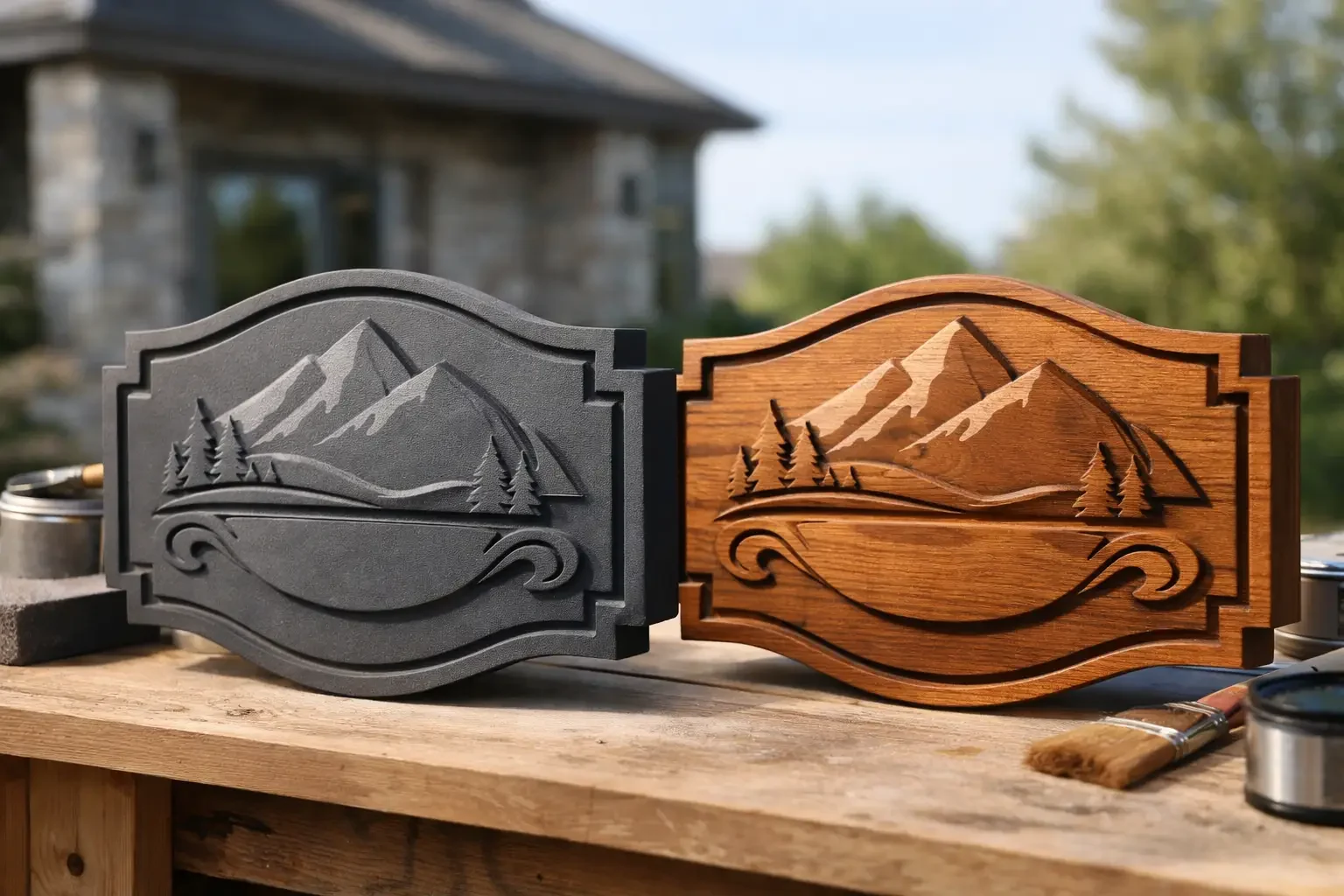
HDU and wood can both give a sign carved depth, but they behave differently outdoors. Look at the finished appearance you want, the exposure at the site and the maintenance you are prepared to arrange.
Real wood may be the right choice when natural grain is essential to the design. For a painted sign, HDU offers a consistent surface for routing lettering, borders and textures.
HDU Versus Wood Signage: The Material Difference
Wood is a natural material with grain, knots, density variation, and moisture content that can change from board to board. Those characteristics are part of its appeal on authentic rustic, historic, or hand-crafted signage. They are also the source of many production variables. Even properly selected and sealed wood can expand, contract, check, split, cup, or develop finish failures as it cycles through heat, rain, humidity, and freeze-thaw conditions.
High-density urethane, commonly called HDU, is a closed-cell polyurethane foam engineered for dimensional fabrication. It does not absorb water like wood, has no grain direction, and does not swell or rot. A routed border, prismatic letter, recessed copy area, or sandblasted texture stays more stable because the material is consistent throughout the panel.
That consistency matters when a sign program includes multiple locations, replacement panels, or branded architectural elements that must match from one production run to the next. With HDU, a shop can work from the same digital file and expect the substrate to machine predictably. With wood, natural variation remains part of the process even when using premium stock.
Exterior Durability Is Usually the Deciding Factor
Exterior wood signage can perform well when it is designed correctly, sealed thoroughly, maintained on schedule, and installed where water is managed effectively. The problem is that commercial sign programs do not always receive that level of ongoing care. A monument sign at a medical plaza, business park, church, or municipal facility may face full sun, irrigation overspray, wind-driven rain, and deferred maintenance for years.
HDU resists moisture-related decay, but it can be dented or damaged and its finish still needs care. Choose the coating and mounting details for the actual location rather than treating the material as indestructible.
The full assembly matters. Backing, fasteners, supports, drainage and paint all affect how the finished sign performs. HDU's moisture resistance does not make up for an unsuitable mounting arrangement.
Fabrication Predictability and Shop Throughput
Production control is where HDU has a clear advantage for trade buyers. CNC routing on HDU produces clean, repeatable results without grain tear-out or density changes across the panel. It accepts carved copy, raised copy, V-grooves, shape cutting, pockets, and textured backgrounds with reliable edge definition. Sandblasted HDU can also replicate the dimensional character associated with cedar without the inconsistent grain behavior of a natural board.
Wood often requires more hands-on judgment. Grain orientation can affect routed details. Knots and soft areas may compromise a surface. End grain and panel edges need special attention during sealing. Material defects can force changes after the job is already on the router table. On a one-off artisan sign, those variables may be acceptable. On a deadline-driven commercial order, they consume labor and introduce rework risk.
If another shop will make the sign, agree on the components and finish it will supply. Confirm any backing or mounting provisions your installer requires before manufacturing begins.
Finish Quality Depends on Process, Not Just Material
Neither substrate should be treated as paint-and-forget. Finish performance comes from surface preparation, compatible primers, quality coatings, adequate film build, controlled cure time, and protected handling before shipment. HDU's smooth, uniform surface makes those steps more repeatable, particularly for painted dimensional letters, background fields, and routed logos.
Wood has a distinct visual advantage when the project specifically requires real grain. A stained cedar sign, for example, can deliver a natural character that simulated texture cannot fully duplicate. That is a legitimate design decision. It also demands a buyer who accepts periodic refinishing and understands that exposure will alter the material over time.
For painted architectural signage, HDU is generally more forgiving. It can be finished to resemble wood grain, stone, metal, or a clean contemporary panel while retaining a stable substrate below the coating. This makes it useful for branded monument signs, wayfinding systems, tenant identification, subdivision entrances, and commercial facades where appearance must remain consistent across locations.
Structural Requirements Still Need Engineering Judgment
A common mistake is treating HDU as a structural sign material. It is not a replacement for properly designed steel, aluminum, or other internal support systems on large panels, projecting signs, or wind-loaded installations. HDU provides the dimensional face and carved visual depth. Structural metal fabrication provides the strength needed to carry the assembly and manage installation loads.
The right approach is to specify HDU thickness based on the design, then integrate reinforcement where the panel size, mounting condition, or attachment method requires it. Internal steel tubing, aluminum skins, threaded inserts, stud-mounted letters, and welded frames may all be part of the final system. The goal is not merely to make the sign look substantial. It is to prevent bowing, attachment failure, and freight damage before the sign reaches the jobsite.
Wood can carry more inherent rigidity in some configurations, but that does not eliminate the need for structural planning. Large wood panels can still warp, split around fasteners, or move enough to stress paint and joint lines. For both materials, the fabrication package should be based on actual dimensions, wall or post conditions, installation method, and local code requirements.
Cost Should Be Measured Beyond the Initial Panel Price
Wood may appear less expensive at the material-buy stage, particularly when a project uses standard boards and simple finishing. That comparison can be misleading. The meaningful cost is the completed sign: substrate, waste, CNC time, hand labor, sealing, finishing, reinforcement, packaging, freight, installation, maintenance, and potential replacement.
Compare the complete fabrication work, not only sheet prices. HDU has no knots or natural grain direction to work around, but the design, finishing and support requirements still determine the cost of your sign.
The economic case becomes stronger when failure has consequences. A sign shop that must return to refinish a cracked wood panel, remake a warped dimensional logo, or manage a damaged replacement after installation loses more than material cost. It loses crew time, production capacity, and client confidence.
When Wood Is Still the Better Specification
Wood remains the right call when genuine natural grain is central to the design and the client accepts the maintenance commitment. Historic districts, lodge-style properties, handcrafted retail concepts, and certain donor recognition projects may require real cedar or another species to meet the intended aesthetic. A skilled fabricator can produce exceptional work in wood.
The decision should be deliberate, not based on habit. If the sign is primarily painted, must match across a multi-site program, includes detailed CNC carving, or will live in a demanding exterior environment, HDU is usually the more defensible specification. If the client wants authentic wood character and has a realistic maintenance plan, wood can deliver something HDU is designed to imitate rather than replace.
Send the appearance you want and details of the location before choosing the construction. We can discuss a painted HDU sign with routed detail or woodgrain texture and explain what is included in the finished order.