
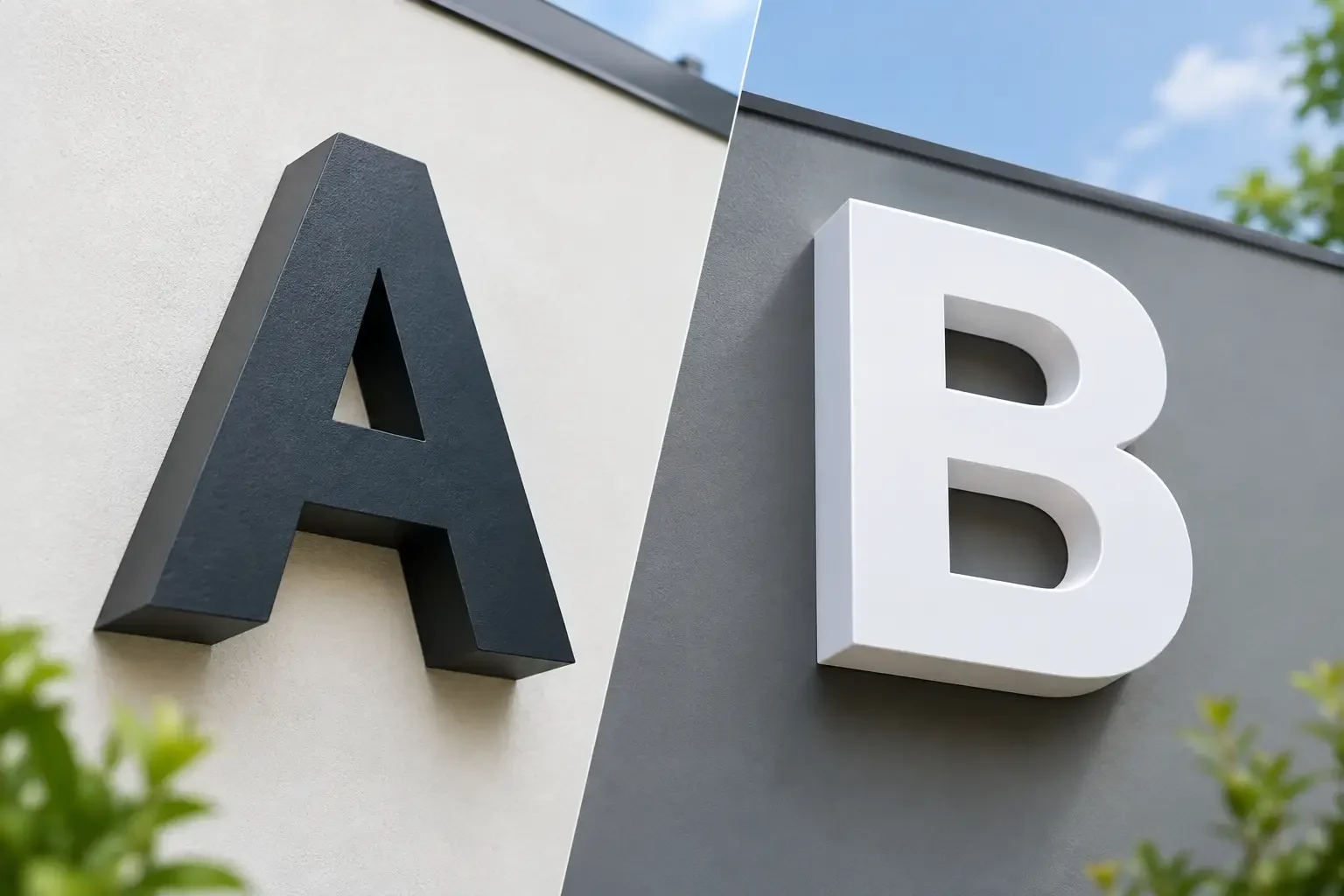
HDU and PVC can both be used for dimensional letters, but they suit different designs. Compare the required thickness, carving, finish, sun exposure and mounting method before choosing the material.
PVC is often useful for simple, flat-faced letters. HDU gives you more scope for deep carving, textured surfaces and thicker profiles. The best choice depends on the lettering and where it will be installed.
HDU Versus PVC Letters: Start With the Job
HDU, or high-density urethane, is a closed-cell urethane sign foam manufactured in densities suited to dimensional fabrication. It does not absorb moisture like wood, will not rot, and can be routed, carved, sandblasted, and shaped into custom profiles. For sign work, its advantage is not just weather resistance. It is the ability to produce depth, texture, and detail without introducing the grain movement and maintenance issues associated with wood.
PVC letters are commonly fabricated from expanded cellular PVC sheet. The material has a smooth, uniform face, routes cleanly, and is widely used for painted dimensional lettering. It is a practical option for simpler letterforms, particularly when the required thickness is modest and the project calls for a flat, consistent finish.
The distinction matters because the two materials are not interchangeable simply because both are lightweight, paintable plastics. A shallow set of painted tenant letters on a covered façade is a different fabrication problem from a freestanding monument sign copy panel, a sandblasted logo, or a large set of dark-finished letters exposed to full sun.
Exterior Durability Is More Than Water Resistance
Both HDU and PVC resist moisture, which makes either one more predictable outdoors than unsealed wood or MDF. But exterior durability includes thermal movement, UV exposure, impact risk, finish adhesion, mounting stress, and the amount of heat absorbed by the finished letter.
HDU is well suited to exterior architectural applications because it remains dimensionally stable through typical wet-dry cycles and can be sealed and coated as part of a controlled finishing system. Its closed-cell construction supports detailed fabrication without the edge swelling associated with wood-based products. Properly primed and painted, HDU is a proven material for long-term sign faces, routed letters, plaques, and textured architectural elements.
PVC also performs well in many outdoor applications, but it deserves more caution on oversized letters, high-heat elevations, and dark paint systems. Cellular PVC can expand and contract with temperature swings. On a large copy run, that movement can affect alignment, reveal consistency, and mounting stress if the design does not allow for it. Dark colors on south- and west-facing walls deserve particular attention because surface temperatures can climb well beyond ambient air temperature.
Impact performance is another job-specific consideration. Neither material should be treated as a structural substrate. Both can be damaged by concentrated impact, and both need adequate protection during freight and installation. HDU often offers a more substantial feel in thicker profiles, while PVC can be a sensible choice for smaller, flatter letters where heavy relief is unnecessary.
Finish Systems Drive Field Performance
A material can be appropriate and still fail early if the finishing process is wrong. HDU should be properly sealed, primed, and finished to the specified exposure level. Its surface can be prepared for smooth painted letters, simulated woodgrain, stone textures, or sandblasted backgrounds, giving fabricators more control over the finished appearance.
PVC requires compatible coatings and disciplined surface preparation. The smooth face can produce a clean paint finish, but inadequate cleaning, poor primer selection, or incompatible solvents can create adhesion problems or surface distortion. When the sign package calls for premium automotive-style finishes, metallics, or dark colors, material selection and paint-system compatibility should be resolved before production begins.
Where HDU Has a Fabrication Advantage
HDU earns its place when the artwork needs real dimension rather than a flat cutout. CNC routing can create prismatic edges, beveled profiles, recessed copy, raised borders, custom logos, and sculpted shapes with repeatable depth. Sandblasting adds another layer of capability, allowing background texture and raised copy that fit monument signs, wayfinding systems, municipal identification, and architectural branding programs.
If your design needs deep carving or texture, share the artwork with us so we can discuss the HDU components and finish. Have your installer define the mounting arrangement before manufacture, and confirm any sign-side provisions in the quote.
PVC is generally better suited to straightforward routed copy. It is efficient for flat-faced letters, simple logos, interior-exterior transitional applications, and projects where a smooth painted face is the primary visual requirement. It can be machined accurately, but it is not the preferred choice for deep-relief carving or sandblasted textures. Trying to force a highly dimensional design into PVC often produces a result that looks thinner and less architectural than the original concept.
For either material, clean production depends on the basics: approved vector files, defined thickness, edge profile, paint color, mounting method, and tolerance expectations. The more ambiguous the specification, the more likely the field team receives letters that technically match the artwork but do not fit the installation reality.
Mounting and Structure Cannot Be an Afterthought
Dimensional letters are only as reliable as their mounting system. Stud mounting, pattern mounting, raceway attachment, direct adhesive mounting, and concealed mechanical attachment all have different requirements. Material choice affects the details, but wall construction and letter size should drive the final mounting decision.
For smaller non-illuminated letters on a stable, smooth substrate, routed PVC or HDU can be drilled for studs and installed from a field pattern. As letters become larger, thicker, or more exposed, the connection needs more engineering. High wind loads, uneven masonry, EIFS, corrugated panels, and elevated installations may require aluminum backers, internal reinforcement, stand-offs, or a fabricated mounting structure.
Do not expect foam-based letters to solve a structural problem by themselves. If the copy needs to span an irregular wall, carry substantial wind load, or remain perfectly planar across a long elevation, build the support system into the quote. The most expensive rework often comes from treating mounting as an installer issue after fabrication is complete.
Freight Risk Is Part of the Material Decision
A letter set can leave the shop accurately fabricated and still arrive with chipped edges, cracked corners, or missing hardware if it is not packed for its geometry. This is especially relevant for large HDU letters with detailed profiles and for long PVC strokes that can flex under poor handling.
Freight-safe packaging should account for thickness, face protection, edge protection, nested spacing, hardware separation, and the risk of fork contact. Templates, labeled mounting diagrams, and organized stud kits reduce field confusion and keep installers from improvising around a preventable production omission. For trade buyers, that packaging discipline is not an extra. It protects schedule, labor, and customer confidence.
Cost: Compare Installed Value, Not Sheet Price
PVC often has the advantage when the project is simple, flat, and price-sensitive. If the letters are small to medium in scale, the paint is light, the wall is protected, and the design does not require texture or deep routing, PVC can deliver a clean result at a competitive cost.
HDU usually carries a higher material and fabrication cost, especially when the job includes thicker profiles, sandblasting, custom texture, or multi-step finishing. That premium can be justified when the sign is a long-term exterior asset, the design needs architectural depth, or the project would otherwise require labor-intensive workarounds. The relevant comparison is not HDU cost versus PVC cost in isolation. It is the cost of delivering a durable, accurate, installable sign without rework, remakes, or an underbuilt appearance.
Specify the Material Before Production Starts
Specify HDU when the design calls for carved detail, deep dimensionality, sandblasted texture, thicker architectural profiles, or demanding exterior exposure. Specify PVC when the job calls for economical flat-faced letters, clean routing, moderate scale, and a controlled installation environment. When the project sits between those two cases, evaluate the letter size, color, sun exposure, wall condition, mounting load, and expected service life before selecting a substrate.
Send us your artwork, letter dimensions, preferred thickness, finish and delivery address if you are considering HDU letters. Include your installer’s mounting requirements so we can discuss the sign components and give you a clear quote.
Choose the material that suits the design and exposure, and have your installer confirm how the finished letters will be supported.