
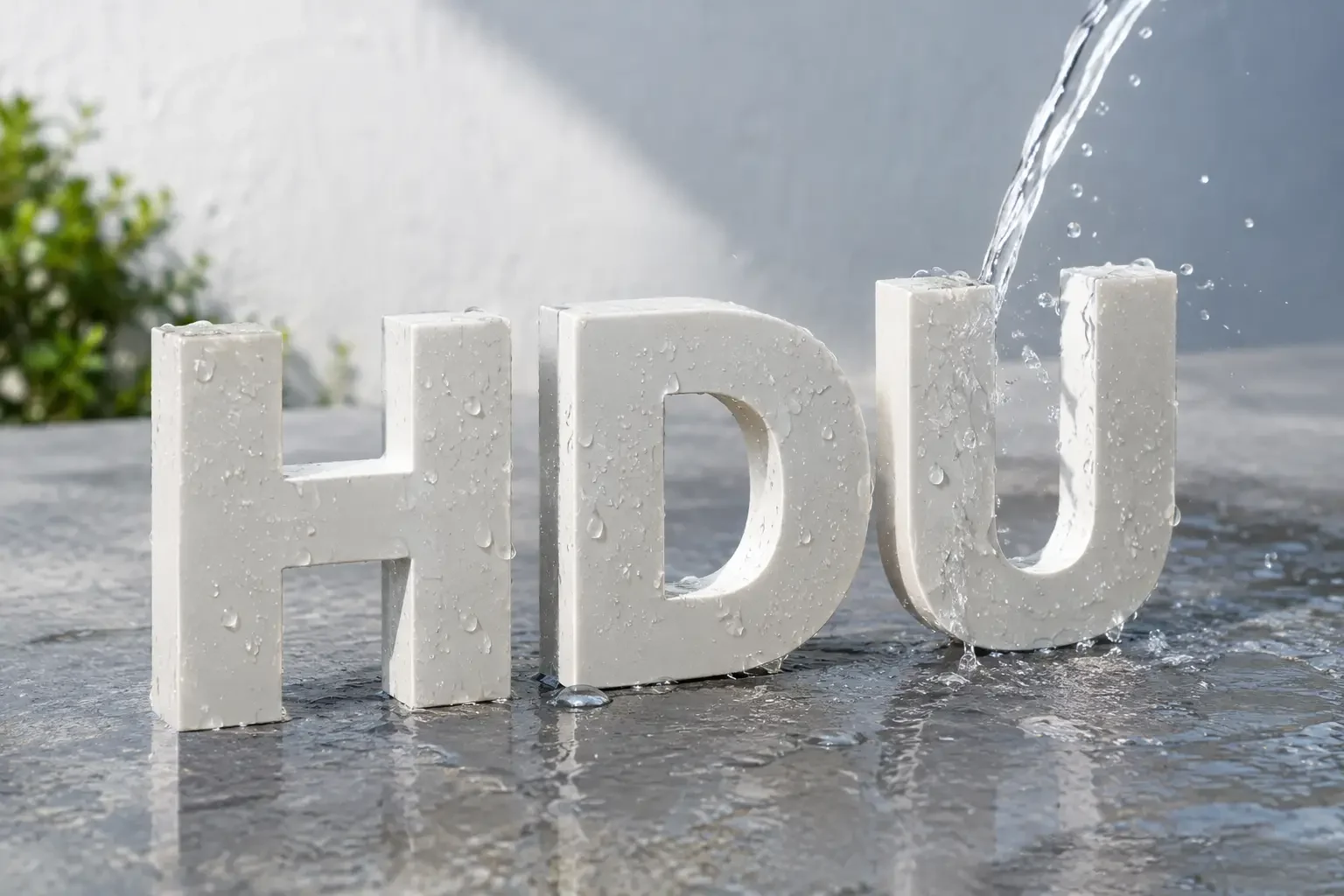
HDU is highly resistant to water, which makes it useful for exterior letters. The finished installation still needs suitable paint, sound mounting details and a way for water to drain away.
For sign shops, estimators, and commercial buyers, that distinction matters. HDU performs exceptionally well in exterior dimensional-sign applications because it does not absorb moisture like wood, swell at exposed edges, or rot after repeated wet-dry cycles. It is not a substitute for sound fabrication or field installation, however. Water can still work through unsealed fastener penetrations, failed paint films, open joints, and poorly detailed mounting surfaces.
Are HDU Letters Waterproof? The Material Answer
High-density urethane is a closed-cell foam material. Unlike wood, MDF, or lower-grade composite substrates, it has no grain structure or open fibers that pull in water. Rain, irrigation, humidity, and freeze-thaw exposure do not cause HDU to expand, delaminate, or decay in the way moisture-sensitive sheet goods can.
That is why HDU is a standard material for exterior routed letters, sandblasted signs, monument faces, address panels, and architectural identification systems. When the base material is properly selected for the letter size and application, it provides stable, predictable performance across wet climates, coastal regions, and high-humidity environments.
Still, calling every completed HDU sign waterproof without qualification is inaccurate. The substrate is water-resistant by design. The fabricated letter assembly may include primers, topcoats, stud pockets, aluminum backers, bonded elements, illumination components, or mounting hardware. Each of those interfaces requires process control.
Where Water Problems Actually Start
In the field, water-related HDU failures rarely begin with water soaking directly through the face of the urethane. They begin at a detail that was left exposed, poorly sealed, or installed without allowing for drainage.
Coating failure at edges and returns
Routed edges, deep returns, and sharp inside corners need complete primer and topcoat coverage. A light pass on the face is not enough for architectural letters that will see years of weather exposure. The paint system must cover every routed surface and maintain adequate film build at the edges, where handling and installation contact are most likely to damage the finish.
If coating adhesion fails, the HDU underneath still will not rot like wood. But moisture can migrate beneath the coating, create staining, trap dirt, and accelerate paint breakdown. The result is a sign that looks neglected long before the substrate reaches the end of its service life.
Unsealed hardware penetrations
Stud-mounted HDU letters require drilled or routed mounting locations. Those pockets should be clean, accurately located, and compatible with the specified stud and adhesive system. When a letter is mounted against masonry, EIFS, stucco, or another uneven surface, gaps behind the letter can become collection points for water and debris.
The concern is often not the HDU itself. It is corrosion at improperly selected hardware, water intrusion into the building facade, or movement caused by an installation that was not properly shimmed and sealed. Stainless hardware, corrosion-resistant components, and a disciplined installation method protect the full assembly.
Mixed-material joints
Many commercial letter sets incorporate metal returns, acrylic faces, aluminum backers, or internal reinforcement. These assemblies need compatible adhesives, controlled joint geometry, and allowance for different thermal movement rates. A joint that is cosmetically filled but not properly bonded can open after seasonal cycling, giving water a path into the assembly.
For fabricated letters with multiple materials, the production question is not simply whether HDU is waterproof. It is whether the assembly has been engineered to shed water and stay stable under exterior use.
The Coating System Determines Long-Term Appearance
A finished HDU letter should receive a coating system appropriate for exterior exposure, project location, color selection, and expected service life. Premium exterior primers and industrial-grade topcoats improve UV resistance, color retention, cleanability, and resistance to repeated moisture exposure.
Dark colors deserve additional attention. They can generate higher surface temperatures in direct sun, particularly on thick letters and dark monument panels. HDU remains dimensionally stable compared with moisture-sensitive substrates, but elevated heat can place greater stress on coatings, adhesives, and mixed-material details. Proper prep and compatible paint products matter more than a quick, low-cost finish.
Texture also affects finishing requirements. Sandblasted HDU panels and wood-grain textures have valleys, ridges, and recessed copy that can be missed during spraying. Those areas need full coverage, not just color on the high points. A production-grade finishing process accounts for the profile before parts reach the paint booth.
Mounting Details Matter as Much as the Letter Material
An exterior letter should not trap water behind itself. Flush mounting may be appropriate on a smooth, sealed wall, but rough masonry and irregular facade materials often require a different approach. Stud projection, spacer selection, adhesive type, and template accuracy all affect how the finished installation drains and how securely the letters remain aligned.
For larger HDU letters, thickness and mounting method must be evaluated together. HDU is durable, but it is not structural steel. Oversized letters, deep profiles, or installations exposed to wind loads may require metal reinforcement, an aluminum backer, or a fabricated support system. Specifying the right material thickness without addressing load paths is a common source of avoidable rework.
Illuminated applications require even more discipline. Electrical entries, raceways, cabinet interfaces, and service access points all need to be designed for exterior exposure. HDU can be part of the visual face or dimensional buildout, but the electrical enclosure and drainage plan must meet the demands of the complete sign system.
How to Specify Weather-Ready HDU Letters
A usable quote package should identify more than letter height and paint color. State the HDU thickness, whether letters are flat-cut or shaped, the required edge profile, finish requirements, mounting method, hardware type, and destination surface. If there are metal backers, laminated elements, or illumination components, identify those as part of the fabricated assembly rather than as afterthoughts.
For projects in coastal or high-moisture areas, call out the exposure conditions early. Salt air, sprinkler overspray, snow removal, and frequent washdowns can affect hardware and coatings even when the HDU itself remains stable. The fabricator can then match the material package to the job instead of producing a generic letter set that creates field risk later.
This level of detail also protects margin. A precise fabrication package reduces template errors, prevents last-minute hardware changes, and gives installers a system they can place correctly on the first visit. For wholesale buyers, repeatability is usually more valuable than a marginal savings gained by leaving key specifications open.
When HDU Is Not the Best Choice
HDU is an excellent exterior material, but it is not the correct answer for every dimensional-letter project. Locations subject to frequent direct impact, such as loading areas or low-mounted wayfinding near vehicle traffic, may require metal construction. Extremely thin strokes, very large unsupported elements, or applications requiring a high-impact metallic appearance may also point toward aluminum, steel, acrylic, or a hybrid fabrication.
The right question is not whether HDU can survive outdoors. It can. The better question is whether HDU, at the selected density and thickness, with the specified finish and mounting system, is the most efficient material for the job's exposure and performance requirements.
Buy the Finished System, Not Just the Foam
For trade buyers, reliable exterior performance comes from controlled production. Precision CNC routing establishes consistent letter geometry. Proper surface preparation and finishing protect the visual face. Accurate stud placement, templates, reinforcement, and freight-safe packing help ensure the parts that leave the factory can be installed without corrections in the field.
We can discuss the finish and sign-side mounting requirements for your HDU letters when quoting. Your installer should check the wall attachment, sealing and drainage at the site.
Before approving your letters for manufacture, review the finish and mounting details with your installer. Pay particular attention to penetrations and places where water could collect behind the letters.