
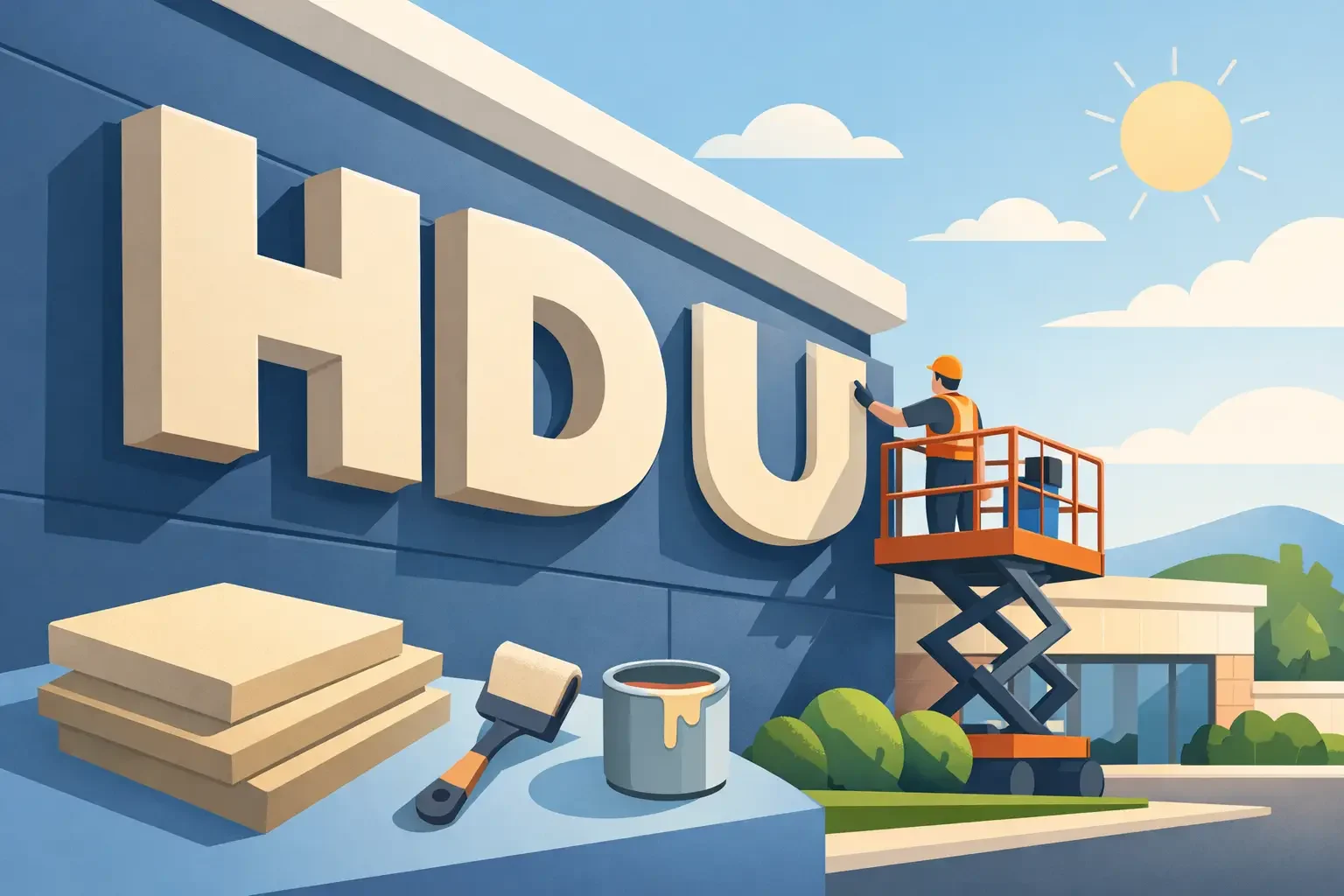
HDU letters work well for signs that need depth, painted color and routed detail. The board has no wood grain to work around, but thin strokes and delicate serifs still need care in the design, finishing and handling.
Start with the lettering size and style, then consider thickness, finish and mounting. A letter that looks clear on screen may need wider strokes or simpler detail to work at its finished size.
What makes HDU letters a practical exterior choice
High-density urethane is a closed-cell sign foam engineered for dimensional signage and carved applications. Unlike wood, it does not absorb moisture the same way, and it does not bring grain direction, knots, or internal inconsistencies into the routing process. That matters when you are producing letters with tight radiuses, bevels, prismatic faces, or custom profiles that need clean edges and predictable detail.
HDU letters are also much lighter than many alternative dimensional sign materials. That reduces handling issues in the shop, simplifies certain mounting conditions, and lowers some freight risks. Weight is not the only factor in an exterior sign system, but it becomes important fast when large letter sets need to be mounted to raceways, masonry, monument faces, or architectural panels.
Paint performance is another reason HDU stays in the conversation for outdoor signage. A properly fabricated and finished HDU letter set can take primers and topcoats evenly, with fewer substrate-related defects than porous or unstable materials. The result is a more controlled finish schedule and a more consistent final appearance across the full copy set.
Where HDU letters fit best
HDU is a strong fit for exterior dimensional letters used on retail centers, office parks, churches, municipal signs, monument signs, hospitality properties, and branded commercial developments. It is especially useful where the look calls for depth, routed detail, custom typography, or sandblasted-style dimensional character without the maintenance issues of wood.
That said, material selection still depends on application. HDU is not automatically the right answer for every sign package. If a project needs extremely thin strokes, very high abuse resistance in a pedestrian contact zone, or a metal-specific appearance, fabricated aluminum or cast options may make more sense. Experienced buyers know the best substrate is the one that fits the actual site conditions, visual standard, and install method, not the one that sounds best in a generic product pitch.
Design details that affect performance
The biggest mistakes with HDU letters usually start upstream in design and estimating. A font that looks clean on screen can create weak return sections, delicate serifs, or thin bridge areas that become vulnerable during finishing, packing, or installation. Stroke width, depth, face treatment, and mounting method all need to work together.
Letter thickness should be selected based on both visual intent and structural reality. A shallow profile may work for smaller wall-mounted copy, but larger letters often need more body to read correctly at distance and maintain better rigidity. Deep letters can produce a stronger architectural look, though they also require tighter process control in routing, edge finishing, and packing.
Mounting strategy matters just as much. Stud mounting, pad mounting, direct adhesive attachment, and panel mounting all create different stress points. If the letters are install-ready, hardware placement and embedment need to be planned during fabrication, not improvised on site. That reduces install time and helps avoid cracked letters, inconsistent spacing, or field modifications that cut into margin.
How routed HDU letters are manufactured
Good HDU production is not just cutting shapes out of foam. Precision repeatability comes from a controlled process that starts with approved vector art and clearly defined fabrication specs. Copy height, thickness, edge profile, finish requirement, mounting hardware, and tolerance expectations all need to be established before routing begins.
The letters are typically CNC routed from HDU board selected for the required density and thickness. Tooling choice affects edge quality, internal corners, and overall surface condition. If the design includes bevels, v-grooves, incised copy, or custom contours, those features need to be programmed with the final finish build in mind. A profile that looks sharp immediately after routing can soften once primers and topcoats are applied.
After machining, the letters move through surface preparation and finishing. Depending on the spec, that can include edge cleanup, primer systems, texture treatments, paint application, and hardware installation. Quality control is not a decorative step here. It is where copy accuracy, mounting layout, finish consistency, and pack-out readiness are verified before the job goes into a crate.
For sign companies outsourcing production, this process control is the real differentiator. The material itself matters, but consistent fabrication matters more.
HDU letters compared with other dimensional letter materials
Wood is the comparison many buyers make first. HDU generally offers better stability, more predictable machining, and less long-term moisture-related movement. If the goal is a carved or sandblasted look for exterior use, HDU usually delivers the appearance with fewer maintenance concerns.
Acrylic has advantages for interior work and some illuminated applications, but it fills a different role. Exterior dimensional acrylic letters can work well in the right conditions, though they do not offer the same carved depth language or rustic architectural character as HDU. They also behave differently in routing and mounting.
PVC is often considered for economy projects. It can be a practical material, but it does not always match HDU for premium exterior dimensional work, especially where routed detail, thicker profiles, or higher-end architectural presentation are required. Aluminum remains the better fit for some projects that demand impact resistance, metal finishes, or specific engineering requirements.
Choose the material for the desired appearance, exposure and mounting conditions. HDU is especially useful for painted lettering with carved depth.
What trade buyers should specify before ordering hdu letters
When ordering hdu letters for a commercial project, vague approvals create expensive mistakes. Fabrication should be quoted and approved from actual production information. At minimum, that includes copy size, thickness, quantity, finish color, edge profile, mounting method, and intended application. If the letters will mount to a curved surface, a rough substrate, or a multi-panel sign face, that should be addressed early.
Our quote includes fully finished letters or a finished sign, as specified in the order, and shipping to your delivery address. Confirm the colors, finish and any supplied mounting provisions before ordering. Installation is not included or provided.
Freight packaging is another point that should never be treated as an afterthought. Dimensional letters can be lightweight and still be vulnerable if they are packed poorly. Protective spacing, hardware isolation, face protection, and crate quality all affect whether the shipment arrives ready to install or ready to file a claim.
Why outsourcing HDU production protects margin
Many sign shops can route some HDU work in-house. The better question is whether they should. When the project volume rises, letter depth increases, finishing gets more complex, or the install date is fixed, in-house production can tie up equipment and labor that are better used elsewhere.
Outsourcing to a production-focused partner shifts the work to a facility built for throughput, tolerance control, and repeatable finishing. That reduces shop-floor bottlenecks and helps estimators bid with more confidence. It also limits the hidden costs that hurt profitability, like miscuts, paint failures, hardware inconsistency, and rushed packaging.
For buyers managing multi-location programs or franchise rollouts, the value is even clearer. Repeat copy sets need to match from order to order. Finish consistency needs to hold. Hardware needs to be placed the same way every time. That level of control is hard to maintain if production is split across changing internal schedules or inconsistent local vendors.
We make routed HDU letters to your approved design. After you place and pay for the order, we prepare the artwork proof for your approval before manufacture. Your installer should confirm the wall measurements and attachment requirements.
Choosing HDU letters with the install in mind
The best HDU letters are not just attractive in the shop. They are engineered for what happens after delivery. Exterior exposure, mounting substrate, service access, regional climate, and viewing distance should all shape the fabrication approach. A letter set that looks oversized in a proof can read perfectly once installed at height. A finish that looks smooth indoors may need a different coating strategy for long-term exterior use.
Share the site measurements and mounting details before the letters are made. That lets us review the design against the information your installer will use on site.
Send your artwork, desired letter size and finish with the quote request. A photograph of the intended wall or sign panel is helpful too.