
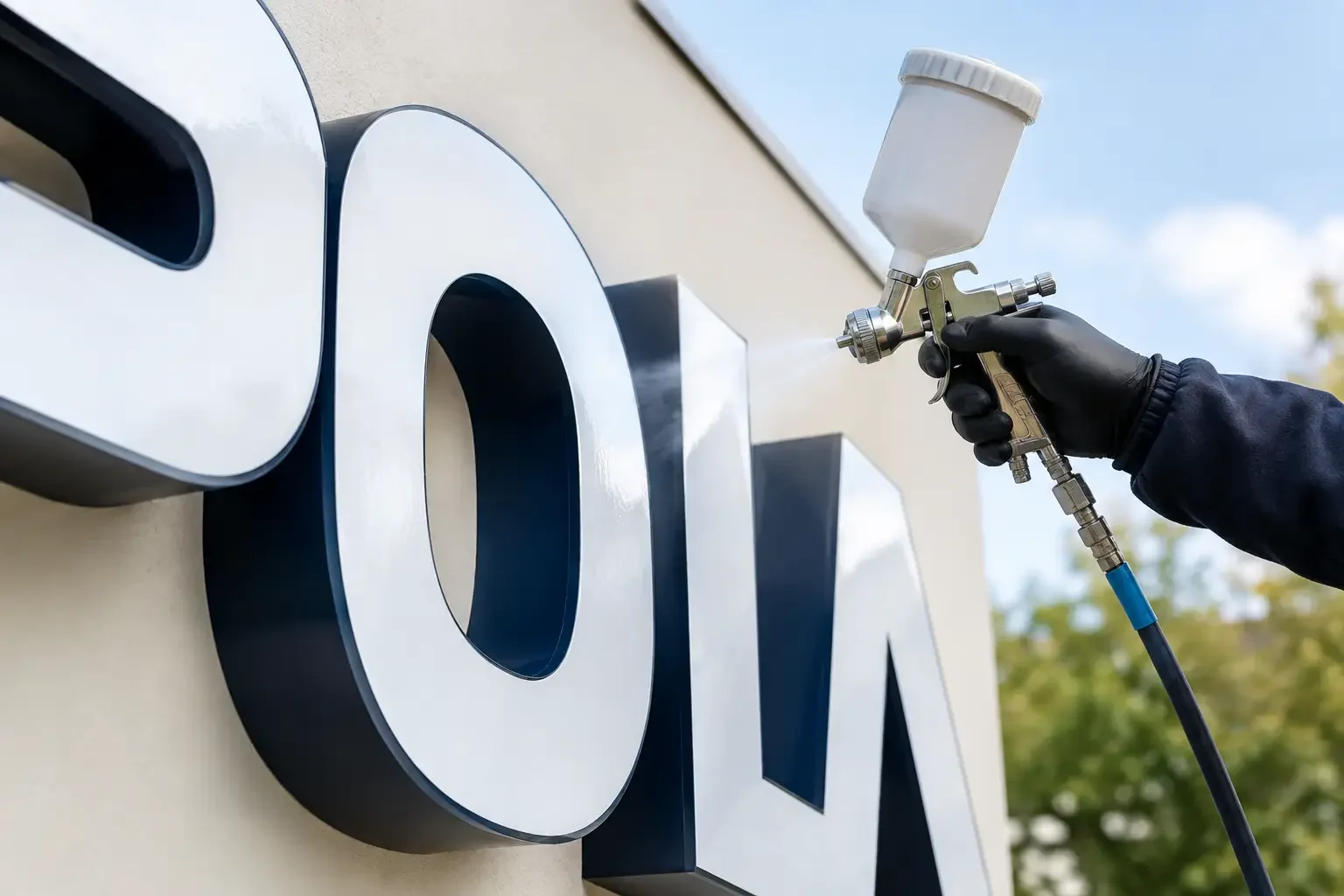
HDU signs can have smooth faces, carved letters or deeply textured backgrounds. Each needs an application method that covers the surface evenly without losing detail. Start by matching the primer and paint to the HDU product and the sign’s location.
Consider color retention, cleaning and future touch-ups as well as the initial appearance. The finish also needs to reach routed edges and recesses without becoming too thick.
What an HDU Coating System Must Do
HDU resists moisture absorption and does not rot like wood. Its routed or blasted surface still needs a suitable finish for the intended appearance and exposure. Use a compatible coating system and check coverage in recesses and along edges.
The coating system must also follow the sign's geometry. Deep V-carves, prismatic letters, simulated woodgrain, and sandblasted backgrounds create recesses and peaks that are harder to cover evenly than a flat panel. Thin coatings can leave holidays in routed copy. Overbuilt coatings can soften crisp edges, fill fine grain, and reduce the depth that gives an HDU sign its architectural character.
For most commercial work, think in terms of three functions: surface preparation, a compatible primer or sealer, and an exterior-grade finish coat. The exact products and dry-film build depend on the manufacturer's data sheets and the sign specification.
Best Coatings for HDU Signage by Application
Waterborne acrylic coatings: the production default
Quality exterior waterborne acrylic coatings are the practical default for a large share of HDU signage. They offer reliable adhesion when applied over an appropriate HDU primer, good UV performance, straightforward cleanup, and efficient shop handling. They are especially effective for painted monument faces, dimensional letters, sandblasted panels, and projects where consistent color matching matters across multiple locations.
Acrylic systems work well because they flex adequately with normal temperature movement while maintaining a clean finish. They also make field touch-up more manageable than many high-performance two-component systems. For standard commercial exterior signs with normal sun exposure, a properly primed and applied acrylic finish is often the right balance of durability, throughput, and cost.
The trade-off is that not all acrylic products perform equally. Consumer-grade house paint may be acceptable for limited applications, but it is not automatically a commercial sign coating. Use a product rated for exterior exposure, verify compatibility with the primer, and confirm that the selected sheen will hold up on the intended texture. Deep matte finishes can look excellent on a blasted sign, but they may retain dirt more readily than satin or semi-gloss surfaces.
Two-component polyurethane: for severe exposure and high-value finishes
Two-component polyurethane topcoats are a stronger choice when the project demands maximum color retention, chemical resistance, abrasion resistance, or a premium automotive-style finish. They are commonly specified for high-visibility commercial monuments, coastal installations, fuel and industrial environments, and signs with dark or saturated colors that see substantial UV load.
The performance benefit comes with process requirements. Two-component systems require accurate mixing, controlled pot life, appropriate spray equipment, ventilation, personal protective equipment, and disciplined recoat timing. They are not a casual brush-on upgrade. If the finishing operation cannot control those variables, the theoretical durability can turn into avoidable rework.
Polyurethane also makes sense where the sign incorporates metal fabrication, painted aluminum returns, or steel support components. Matching the coating technology across visible materials can improve color consistency and simplify the finish specification. The HDU substrate still requires its own compatible primer beneath that topcoat.
Waterborne industrial urethane and hybrid systems: a practical middle ground
Waterborne industrial urethane and acrylic-urethane hybrid coatings can provide a useful middle ground between standard acrylic paint and solventborne two-component polyurethane. These systems may offer improved hardness, washability, and weathering while reducing solvent handling compared with conventional industrial coatings.
They are worth considering for franchise rollouts, institutional signage, and multi-site programs where the finish must be repeatable but the production team needs manageable shop processes. As with any system, use the primer and topcoat combination approved by the coating manufacturer. Mixing brands or assuming compatibility based on generic chemistry is a preventable specification error.
Epoxy primers: useful below the finish, not as the exterior finish
Epoxy primers can provide excellent adhesion and build, particularly when an HDU assembly includes metal elements or requires a high-build substrate leveling step. However, epoxy is generally not the final exterior-facing answer. Unprotected epoxy can chalk and degrade under ultraviolet exposure.
If epoxy is used, cover it with a UV-stable exterior topcoat such as polyurethane or a compatible industrial acrylic. This is a system decision, not a one-can decision. The primer, intermediate coat, and finish must be evaluated together.
Match the Coating to the Surface Profile
A flat CNC-routed HDU face and a deeply sandblasted cedar texture should not receive the same application strategy. Texture increases surface area and creates shadowed recesses where incomplete coverage is easy to miss. The goal is full film continuity without burying the detail.
For smooth faces and raised letters, a spray-applied primer followed by controlled topcoats generally produces the sharpest appearance. Light sanding between coats, where allowed by the coating schedule, helps remove raised fibers, dust, and minor surface irregularities. Avoid aggressive sanding on HDU edges. It can round copy and create a different sheen after painting.
For blasted backgrounds and woodgrain textures, work the primer into the profile and inspect under angled light before applying finish coats. A light first pass can establish coverage, followed by additional controlled passes that reach low areas. Heavy coats intended to cover the texture in one operation can bridge fine detail and cause runs in recesses.
Routed letter edges deserve special attention. They are common points for thin film build, especially on small copy with narrow strokes. A separate edge pass before the main face coat is often more reliable than trying to correct missed areas after the sign is fully painted.
Color, Sheen, and Exposure Change the Specification
Dark colors are not just a design choice. They absorb more solar heat, which increases surface temperature and places greater demand on the finish. Black, deep blue, dark green, and saturated red panels should receive an exterior coating system with proven UV stability and adequate film build. If a project is in intense sun, high altitude, or a southern exposure, move the conversation beyond the lowest-cost paint option.
Sheen also affects how fabrication quality reads at installation distance. Gloss and semi-gloss can improve cleanability and make colors look richer, but they reveal surface imperfections, overspray, and inconsistent texture. Satin is often a strong commercial compromise. Flat finishes suit rustic or sandblasted aesthetics but demand careful application and realistic maintenance expectations.
Coastal salt exposure, road salt, industrial fallout, irrigation overspray, and frequent cleaning all justify a higher-performance finish. HDU itself remains stable, but the appearance layer takes the abuse. The coating should be selected for the service environment, not only for the substrate.
Common Coating Failures That Cost Sign Shops Money
Most HDU finish failures are process failures rather than material failures. The recurring problems are avoidable: inadequate cleaning before priming, applying coatings outside temperature or humidity limits, rushing recoat windows, using incompatible products, and leaving routed edges undercoated.
Another mistake is treating primer as a cosmetic step. Primer establishes adhesion and creates a uniform substrate for the finish. Skipping it, thinning it beyond specification, or using a low-build coat on heavily textured HDU can produce uneven gloss and inconsistent color even when the topcoat itself is premium.
Do not rely on a coating to correct poor fabrication. Fill seams, repair machining defects, and address exposed fastening details before the paint process begins. A high-gloss polyurethane will make those defects more visible, not less.
For outsourced components, the finish specification should state the HDU density, texture or routing method, primer system, topcoat system, color standard, sheen, coating method, and required coverage. That level of detail supports precision repeatability across production runs and protects both the fabricator and the buyer from assumptions.
Specify the Finish Before Fabrication Starts
The most efficient coating decision happens during estimating, not after the panel is routed. Confirm whether the sign will be paint-ready, fully finished, or finished after assembly with other materials. Establish whether the design includes dark colors, metallic accents, raised copy, sandblasted texture, or exposure conditions that justify an industrial topcoat.
Tell us the size, texture, colors and intended location of your HDU sign when you request a quote. We can discuss the finished appearance and confirm what will be supplied.
Keep a record of the agreed color, sheen and coating system. That gives you a useful reference for cleaning, touch-ups and future replacement panels.