
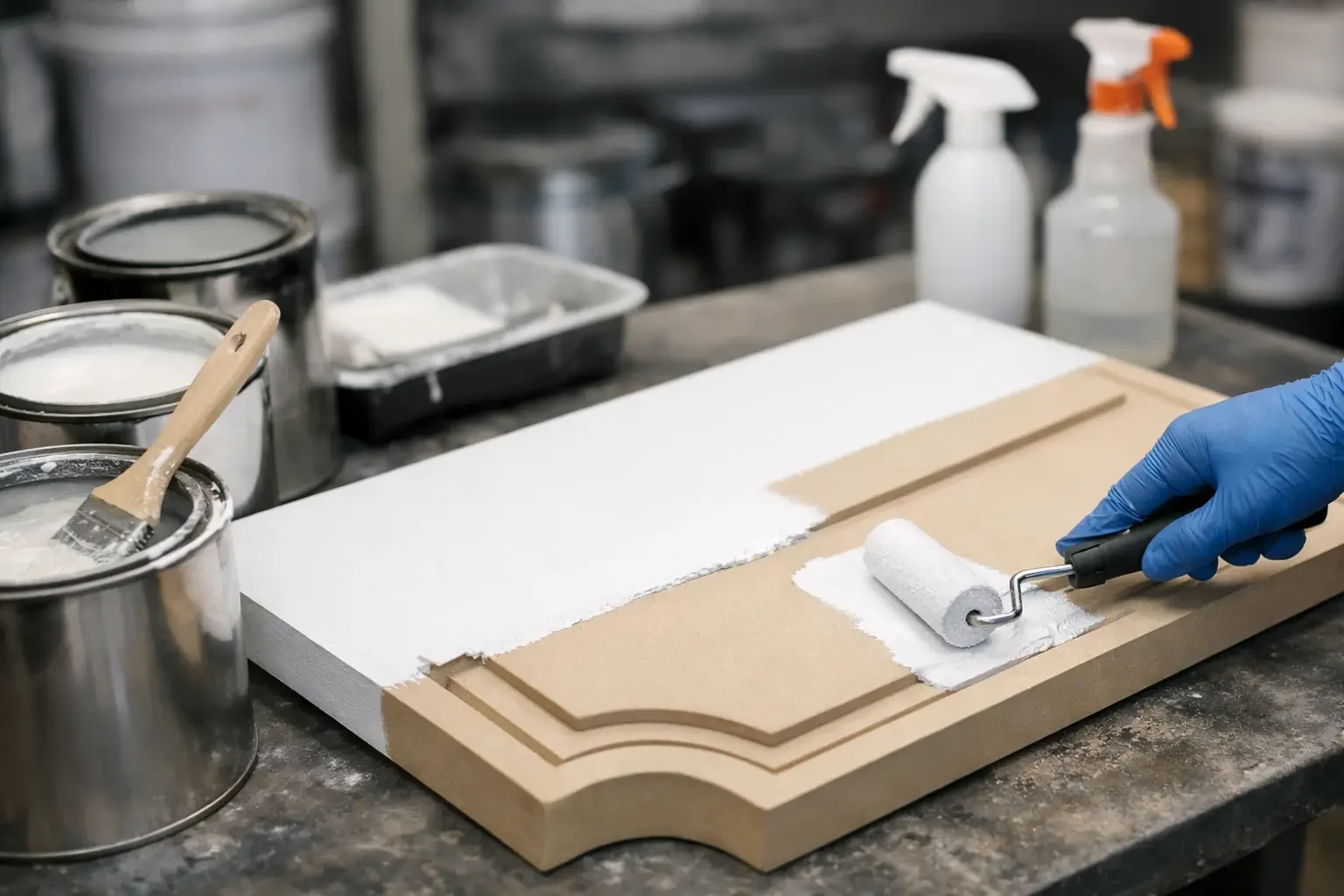
Primer helps turn a routed HDU surface into an even base for paint. It needs to cover cut edges and texture while keeping the lettering crisp. Choose it as part of a coating system approved for the board and the intended topcoat.
For production shops, primer should be selected as part of a complete coating schedule, not as an afterthought. The right choice depends on the HDU density, surface profile, level of routed detail, paint system, and required service environment. A deep sandblasted monument panel needs a different approach than smooth dimensional letters or a tightly routed logo with small interior details.
What an HDU Primer Must Do
High-density urethane does not behave like wood. It will not swell, rot, or pull moisture through the face grain, but its surface still needs a compatible coating that creates a uniform, paint-ready film. HDU can have slight porosity, machining marks, open cells at cut edges, and surface variation from sandblasting or texture applications. Primer is the layer that manages those variables.
A suitable HDU primer should provide strong adhesion without relying on aggressive solvents, adequate film build to level minor surface irregularities, and enough flexibility to remain stable through normal thermal movement. It also needs to accept the finish coat without lifting, wrinkling, fisheyes, or gloss variation.
The practical objective is simple: create a consistent substrate so the topcoat performs as specified. If the primer is too thin, rough edges and cell structure can telegraph through the paint. If it is too heavy, it can soften crisp copy, bridge fine detail, or trap moisture before the finish coat is applied.
Best Primers for HDU by Application
There is no single primer that is automatically best for every HDU sign. The strongest option is the one matched to the fabrication method and finish schedule. In commercial sign production, these are the categories worth specifying.
Waterborne HDU-Specific Primers
Waterborne primers formulated specifically for urethane sign foam are the default choice for most exterior HDU work. Products in this category are designed to wet out the substrate, build consistently, and avoid solvent compatibility issues common with general-purpose coatings. They are particularly effective on smooth HDU faces, routed letters, carved panels, and projects receiving waterborne acrylic or urethane finish coats.
For most sign shops, this is the most dependable starting point because it reduces system variables. Apply it in multiple controlled coats rather than attempting to bury surface texture in one heavy pass. Two lighter coats, with proper dry time and sanding where needed, usually produce better paint uniformity than a single high-build application.
For repeat work, record the primer, preparation and application instructions with the paint specification. That gives later batches a consistent starting point.
High-Build Waterborne Acrylic Primers
High-build acrylic primers are useful when the job requires extra surfacing before a smooth architectural finish. They can help fill minor machining marks, reduce edge texture, and improve the appearance of large flat areas on lower-density HDU. This category is often appropriate for monument sign faces, cabinet-mounted HDU panels, and oversized dimensional components that will receive a satin or gloss topcoat.
The trade-off is detail loss. A high-build product applied too heavily can round over letter edges and fill fine V-carve work. On a panel with tight copy, thin serifs, or detailed texture, use a lower-build primer or reduce the wet-film thickness. The goal is to improve the surface, not reshape the fabrication.
High-build acrylic primer should also be sanded strategically. Sand broad, smooth fields and exposed edges where a refined finish is required. Do not aggressively sand sandblasted or simulated wood-grain areas unless the design calls for a softened texture. That texture is part of the sign face and should remain visible under the coating system.
Two-Component Urethane or Epoxy Primer Systems
Two-component primers can be appropriate for demanding commercial environments, especially when the specified topcoat is part of a professional automotive, industrial urethane, or high-performance architectural coating system. These primers can offer excellent film integrity and chemical resistance, but they require more process discipline than standard waterborne HDU primer.
Compatibility is the deciding factor. Some solvent-rich products can adversely affect urethane foam, especially if applied too wet, too heavily, or directly to freshly machined surfaces. Others may perform well when applied according to the coating manufacturer's HDU or foam-substrate recommendations. Do not assume that a primer suitable for metal, fiberglass, or automotive plastic is automatically safe for HDU.
For a two-component system, verify the complete schedule before production: substrate preparation, induction time if required, mix ratio, reducer, spray viscosity, flash time, recoat window, and approved finish coats. Run a sample panel before committing to a large monument package or a multi-location rollout. The cost of a test panel is minor compared with stripping failed coatings from assembled dimensional letters.
Primer Selection by Sign Type
Smooth routed letters generally benefit from a waterborne HDU-specific primer with enough build to seal cut edges but not enough to soften returns, bevels, or sharp corners. Spray application usually gives the most even film on fabricated letters, especially where face details and perimeter edges must match across a full set.
Sandblasted HDU panels require a different mindset. The primer has to seal the exposed texture without pooling in recessed areas or creating a plastic-looking face. Spray several light, even coats from varied angles so the coating reaches the valleys without flooding them. Excess material in the recesses can obscure the blasted pattern and create uneven sheen after topcoating.
For large monument panels, consistency across seams and separate fabricated components matters as much as the primer itself. Prime all related pieces with the same product, batch control, application method, and cure schedule. A panel and its dimensional copy may receive the same paint color but look different if their primer film builds vary significantly.
Application Practices That Prevent Rework
Primer performance starts with surface preparation. Remove machining dust thoroughly, particularly from routed pockets, letter returns, and sandblasted recesses. Compressed air can help, but it should be clean and dry. Dust left in a carved detail becomes a weak boundary layer between HDU and primer.
Apply within the product's recommended temperature and humidity range. Waterborne primers need enough airflow and time to coalesce properly. Rushing the next coat can trap water in the film, leading to poor sanding, slow cure, or finish-coat defects. In a high-throughput shop, controlled drying conditions are often more valuable than trying to force a faster coating cycle.
Use spray equipment sized for the coating viscosity and desired finish. Brushing and rolling are acceptable for small touchups, field repairs, or textured work, but they can leave stipple on broad smooth faces. If a premium smooth finish is part of the specification, spray is the better production method.
Film thickness should be verified by outcome, not guesswork. After cure, inspect edges, routed details, broad faces, and texture under angled light. If cells remain visible where a smooth finish is required, apply another controlled coat. If details appear rounded or recesses are filling, reduce the application rate before proceeding.
Avoid These HDU Primer Mistakes
The most common failure is treating HDU like wood and reaching for a generic wood primer. Some can work in limited conditions, but many are not designed to create a stable coating system over urethane foam. Results may vary by formulation, application method, and finish coat.
Avoid unverified solvent-based primers, especially heavy wet applications. Strong solvents can soften or attack some foam surfaces, while incompatible reducers can create adhesion problems that do not appear until after topcoating. Also avoid mixing coating families without confirming compatibility. A good primer can still fail when paired with the wrong finish system.
Do not skip edge coverage. Routed edges and cut returns are where inconsistent application becomes visible first, particularly on dark colors, high-gloss coatings, and illuminated dimensional elements. Prime these areas intentionally rather than assuming face passes will cover them.
Specify the Primer as Part of the Build
Include any required primer and topcoat in your quote request, along with the texture, colors and outdoor exposure. Our quote includes the fully finished sign and shipping, so confirm any specified coating requirements before placing the order. Related: HDU thickness guide
Follow the coating manufacturer’s preparation, application and cure instructions. Check a sample first when the primer, board or finish combination is unfamiliar.