
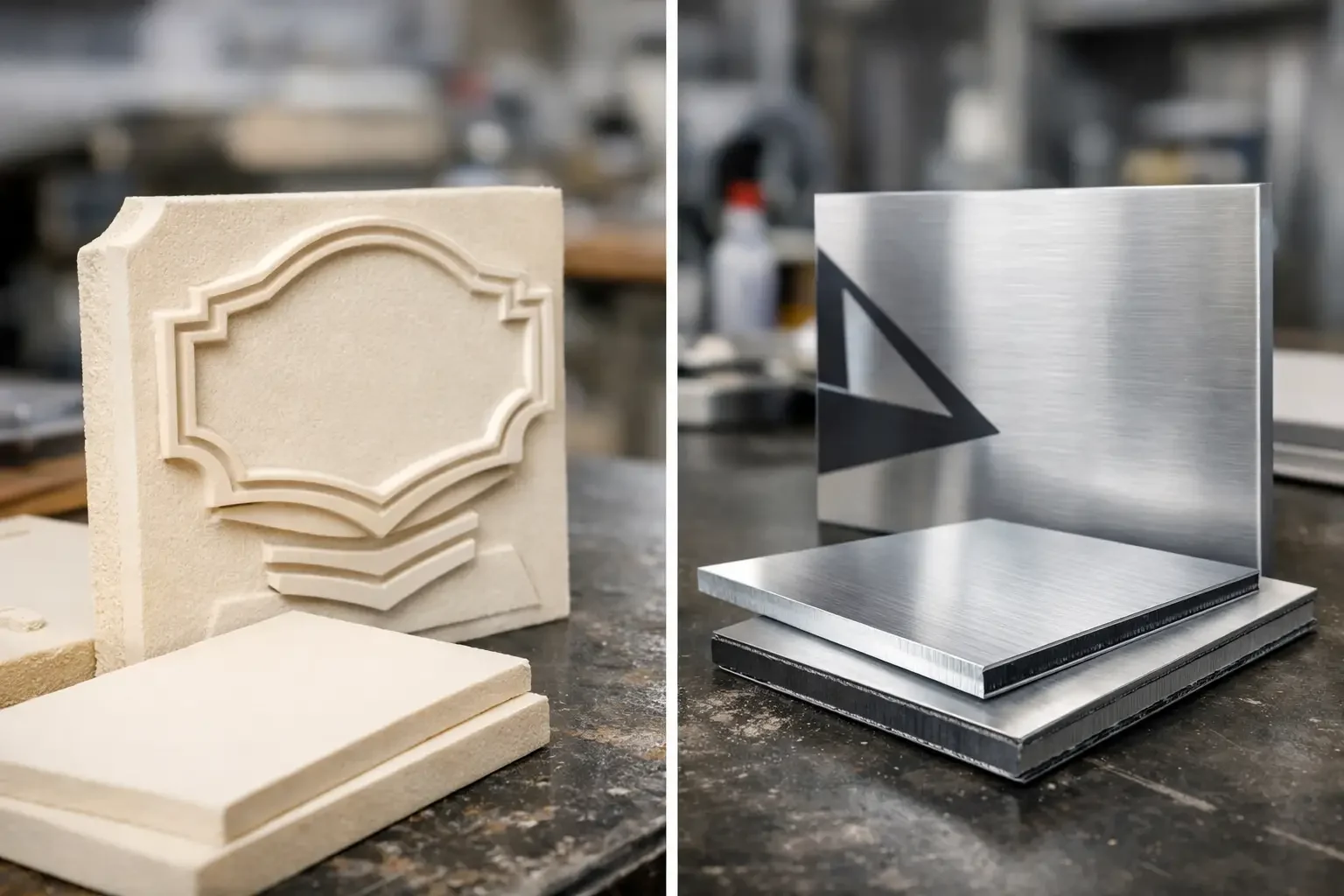
A deep carved sign face and a thin flat direction panel need different construction. Choose between HDU and aluminum by looking at the depth, finish, support and exposure your sign needs.
Both materials have a place in commercial signage. High-density urethane delivers dimensional relief, routed detail, and a substantial architectural appearance without the weight and maintenance issues associated with wood. Aluminum provides thin, rigid sheet construction, metal-specific finishing options, and excellent utility for flat panels, cabinets, and fabricated systems. The right specification depends on what the finished sign must do.
HDU Versus Aluminum Panels: Start With the Sign Type
HDU is typically the stronger choice when the panel itself is expected to carry visual depth. Routed backgrounds, raised copy, V-carved details, blasted textures, faux woodgrain, and sculpted borders are all natural applications for HDU. It machines cleanly on CNC equipment and accepts architectural coatings well, allowing a sign shop or design team to specify a dimensional face without building up multiple flat layers.
Aluminum panels are generally specified when a project calls for a flatter, thinner sign component. Directional signs, regulatory panels, tenant directories, post-and-panel systems, equipment labels, cabinet skins, and printed graphics often benefit from aluminum's predictable sheet profile. Aluminum can also serve as a structural backing or return component within a larger sign assembly.
This distinction matters in estimating. If a design requires a 1-inch-deep routed background, aluminum is not a direct substitute for HDU. Producing that appearance in metal may require fabricated layers, welded elements, specialty finishing, and more labor. Conversely, using a thick HDU panel where a lightweight flat aluminum panel will meet the specification can add unnecessary material thickness and freight volume.
Material Performance in Exterior Exposure
HDU is a closed-cell board that resists water absorption and does not rot like wood. Its coatings, joints, hardware and supports still need to suit the outdoor setting.
Its performance still depends on proper fabrication and coating. Edges, routed areas, and faces should receive a compatible exterior finish system. Mounting details must avoid creating stress concentrations, and large panels should be adequately supported. HDU is durable, but it is not intended to function as a structural beam.
Aluminum does not rust, which makes it a reliable exterior sign material. However, aluminum is not maintenance-free in every environment. Coastal exposure, industrial pollutants, dissimilar-metal contact, failed coatings, and trapped moisture can all affect long-term appearance or contribute to corrosion at connections. The alloy, thickness, finish system, and hardware selection need to match the project environment.
For many exterior applications, both materials will perform well when properly specified. The meaningful question is not which one is universally more durable. It is whether the panel is exposed to impacts, requires unsupported spans, needs relief carving, or will interface with a steel frame, masonry wall, or post system.
Thickness and rigidity are not interchangeable
Aluminum has far greater stiffness than HDU at comparable thicknesses. A thin aluminum sheet can function effectively as a face skin when attached to a frame, cabinet, or backing structure. HDU requires more thickness to create the same visual presence, and wide panels need a sound support strategy to prevent movement.
HDU is useful when you want carved depth and a substantial edge. Thin aluminum is useful for a flat face with the right support behind it. Compare the complete construction, rather than thickness alone.
Fabrication Differences Affect Margin and Lead Time
Material choice changes the production path. HDU is highly compatible with CNC routing, sandblasting, hand finishing, and layered dimensional construction. It can be machined into raised lettering, recessed fields, decorative borders, custom shapes, and complex relief work. For sign shops outsourcing this work, precision repeatability matters: clean toolpaths, controlled depths, consistent panel density, and properly prepared surfaces reduce finishing labor after delivery.
Aluminum fabrication may involve CNC routing, shearing, bending, welding, brake forming, fastening, or composite-panel processing, depending on the product. It is an efficient choice for repeated flat shapes and formed components, but the workflow becomes more specialized as bends, returns, seams, and structural attachments are added.
Finishing also differs. HDU is commonly primed and painted with high-performance coatings. Its surface can be finished to resemble carved wood, stone, painted architectural trim, or a clean dimensional panel. Aluminum can be painted, powder coated, anodized, or finished with applied graphics and films. A metal finish may be the correct aesthetic for a contemporary commercial project, while HDU is often specified where texture and dimensional character are central to the design.
For trade buyers, the labor question is direct: which material produces the approved design with the fewest operations and the lowest rework risk? The answer is often clearer after reviewing shop drawings than after comparing raw sheet prices.
Mounting and Installation Require Different Planning
HDU panels are commonly installed over steel structures, aluminum frames, masonry, or treated support systems. Because the material is nonstructural, mounting points, concealed reinforcement, and attachment locations should be planned during engineering rather than improvised in the field. Through-bolts, stud systems, brackets, and routed provisions can be incorporated before finishing.
Aluminum panels offer more flexibility for thin-face installations, especially where a panel is mechanically fastened to an existing frame or used as part of a fabricated sign cabinet. They are also appropriate where weight reduction is a major installation concern. But thin metal can oil-can, dent, or telegraph uneven support conditions if the substrate and fastener spacing are poorly designed.
Freight should be considered early as well. Large HDU panels need protective packaging that prevents edge damage and face abrasion. Aluminum sheets need protection from bending, corner damage, and finish scratching. A factory-built crate and clear handling instructions are not minor details when replacement freight can erase the margin on a commercial sign package.
Cost: Compare the Finished Component, Not Raw Material
Raw material pricing rarely tells the full story. HDU may carry a higher cost than a thin aluminum sheet, but it can eliminate the fabrication steps required to create a dimensional, carved-looking face in metal. It can also reduce finishing complexity when a routed relief design is the approved concept.
Aluminum may be the more economical option for large quantities of flat signs, straightforward cut panels, or signs integrated into a metal framework. Its cost advantage is strongest when the design uses the material efficiently and does not demand extensive forming or layered fabrication.
Compare the complete supplied item, including machining, finish, mounting provisions and delivery. For our finished signs, the price we quote includes your fully finished sign and shipping to your delivery address. Site structures and installation are separate work arranged by the buyer. Related: HDU thickness guide
When a Hybrid System Makes More Sense
The material decision does not always need to be either-or. Many durable exterior signs use HDU and aluminum together. An HDU sign face can deliver the routed depth and visual hierarchy, while aluminum provides trim, backs, structural skins, or fabricated support components. Aluminum dimensional letters may also be mounted to an HDU panel when the design calls for contrasting material finishes.
Hybrid construction is especially useful for monument signs and multi-tenant projects. It allows each component to perform the job it is best suited for rather than forcing one substrate to solve every design and structural requirement. The key is coordinated fabrication: attachment points, drainage, material expansion, finish compatibility, and installation sequencing must be resolved before production begins.
Specify the result, then choose the substrate
Start the quote package with the finished sign requirements: overall dimensions, panel thickness, desired relief depth, color system, copy style, mounting method, support structure, exposure conditions, and delivery condition. From there, the substrate becomes a production decision supported by real project constraints.
We can review whether HDU suits the carved depth and finish you want. If your project specifically requires aluminum or another material, include that requirement before ordering rather than assuming a painted appearance identifies the substrate.
Send the design and the mounting location with your request. We manufacture and ship custom HDU signs nationwide. Installation is not included or provided.