
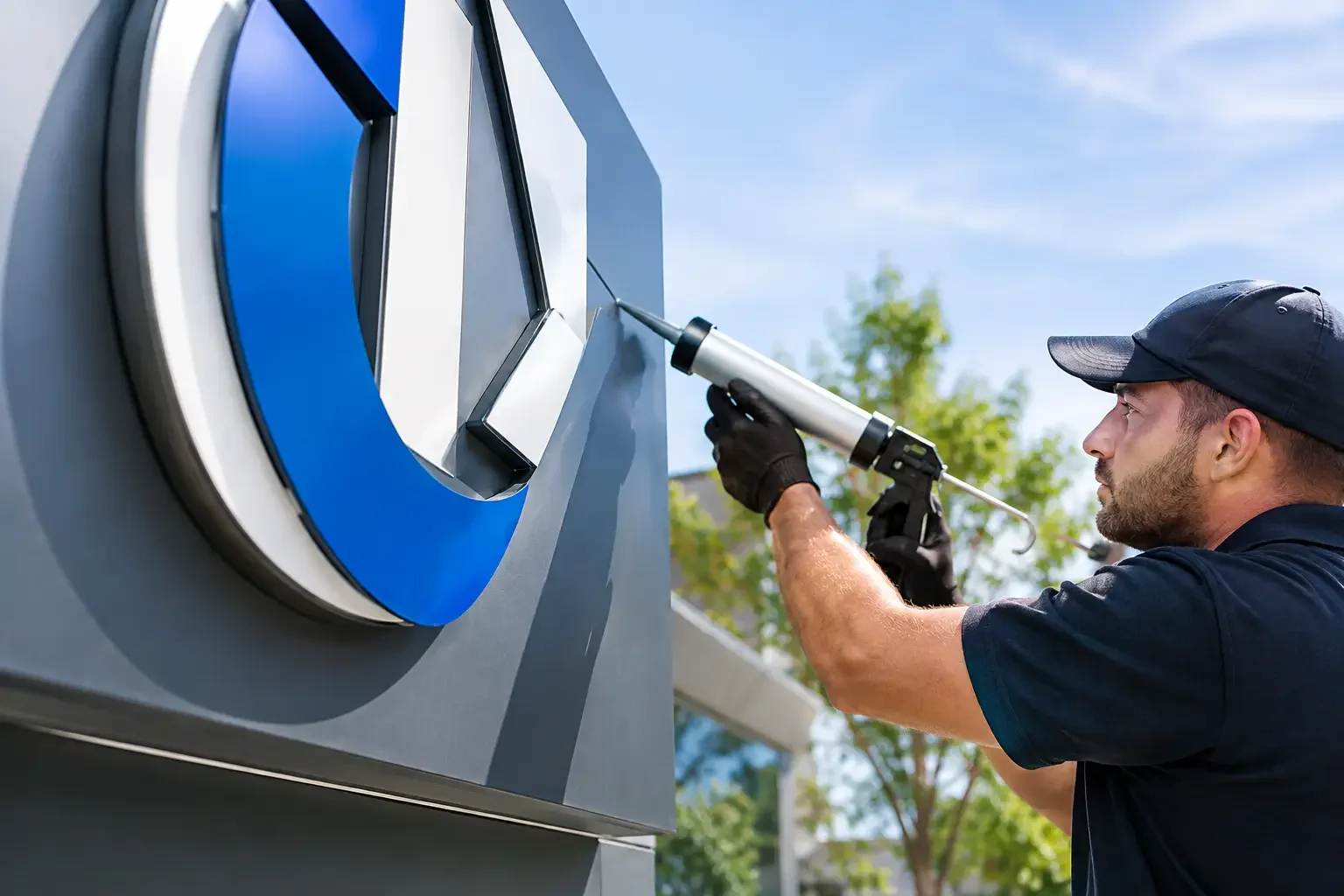
Sealant helps keep water out of joints around a sign, its hardware and the wall behind it. The right product depends on the surfaces it touches and how much the joint needs to move.
Check adhesion, exterior exposure, joint dimensions and paint compatibility before choosing a sealant. A weather seal also needs the right joint design; it should never be assumed to provide structural support.
What Makes an Exterior Sign Sealant Perform
Exterior signage sees conditions that indoor construction sealants do not: direct sun, wide temperature swings, wind-driven rain, vibration, dissimilar materials, and frequent repainting. A sealant must remain bonded and flexible after the sign face, frame, fasteners, and mounting surface expand at different rates.
For most fabricated sign assemblies, prioritize five performance factors: adhesion to the actual substrates, movement capability, UV resistance, paintability, compatibility with adjacent coatings, plastics, and metals. Product data sheets matter, but the installation conditions matter just as much. A premium sealant applied over oxidation, chalking paint, wet substrate, or shop dust is still a failed joint waiting to happen.
Sealant is also not a substitute for drainage, flashing, welded closure, or proper attachment. If a sign cabinet is designed to hold water, no perimeter bead will correct the fabrication problem. Use sealant to close controlled joints and manage water entry, not to compensate for poor joint design.
Best Exterior Sign Sealants by Application
There is no single chemistry that wins every exterior sign application. The following categories cover the most common commercial fabrication and installation conditions.
Hybrid Polymer Sealants for General Sign Fabrication
Silyl-terminated polymer, often called hybrid polymer or SMP sealant, is frequently the best all-around choice for exterior sign work. These products generally bond well to painted metal, aluminum, HDU, PVC, wood, masonry, and many composite surfaces. They remain flexible, resist UV exposure well, and are commonly paintable after cure.
For a sign shop assembling painted dimensional letters, HDU panels, aluminum composite components, or formed-metal details, hybrid sealants offer practical versatility. They are especially useful where a finished joint must accept a compatible topcoat or blend visually with the sign face.
The trade-off is that performance varies materially by manufacturer and formulation. Do not assume every hybrid product has the same movement rating, cure speed, or paint compatibility. Confirm that the specified paint system will adhere to the cured sealant, particularly with high-performance urethane or fluoropolymer coatings.
Polyurethane Sealants for High-Movement Joints
Polyurethane sealants remain a strong option for demanding expansion joints, metal-to-masonry transitions, and other areas where adhesion and movement are the primary concern. They offer durable, elastic joints and often perform well in commercial exterior conditions when installed correctly.
Their limitation is finish control. Some polyurethane formulations can discolor, collect dirt, or require coating for long-term UV appearance. Many are paintable, but cure time and coating windows must be managed. If the sealant will remain exposed on a high-visibility architectural sign, use a product rated for that exposure and test the final appearance.
Polyurethane is well suited to larger perimeter gaps at wall-mounted signs, raceways, pylon sign trim interfaces, and expansion-prone assemblies. It is not the right answer for every narrow cosmetic seam, where tooling quality and color match may matter more than maximum joint movement.
Neutral-Cure Silicone for Glass, Metal, and Wet Exposure
Neutral-cure silicone is a reliable choice where glass, anodized aluminum, finished metal, or high-moisture exposure is involved. It provides excellent UV stability and retains flexibility for years, making it useful for glazing-related details, metal caps, and weather-exposed interfaces that do not need repainting.
The major drawback is paintability. Standard silicone is generally not paintable, and silicone residue can create coating adhesion problems well beyond the original joint. Avoid using it near components scheduled for field paint unless the exact system has been proven compatible. For shops producing painted HDU signs or custom architectural panels, that restriction alone often makes hybrid polymer the cleaner production choice.
Use neutral-cure products rather than acid-cure silicone around sensitive metals and finishes. Acid-cure formulations can release corrosive byproducts during cure and are a poor fit for many sign assemblies.
Butyl Sealant for Concealed Compression Joints
Butyl tape and butyl sealant serve a different purpose from exposed finish sealants. They are effective behind trim, under cap flashing, around fastener penetrations, and within overlapping metal details where a compressed, concealed water barrier is needed.
Butyl stays tacky and works well in controlled lap joints, but it is not a finished exposed bead. It can attract dirt, creep under heat, and look unprofessional when used at visible edges. Use it behind the detail, then finish exposed perimeter joints with a UV-stable sealant designed for tooling and appearance.
Acrylic Latex for Low-Stress, Paintable Details
Acrylic latex products are easy to apply, easy to paint, and acceptable for some protected trim details. They are not the preferred choice for commercial exterior signage exposed to sustained weather, movement, or standing water. Their lower movement capacity and reduced long-term durability make them a weak choice for cabinet perimeters, monument signs, and routed HDU assemblies.
If the project calls for a paintable joint in a sheltered location with minimal movement, acrylic may be sufficient. For a sign expected to perform for years on an exposed elevation, the upfront savings rarely justify the service risk.
Sealant Selection for HDU Signs
HDU does not rot, but the complete sign system can still fail at joints, fasteners, coatings, and embedded structures. The material’s stability makes it an excellent platform for dimensional exterior signage, yet HDU panels often interface with aluminum, steel, PVC, wood, masonry, or acrylic elements. Those junctions require a sealant that can accommodate movement without pulling away from the finished surface.
For painted HDU panel seams and attached dimensional elements, a paintable hybrid polymer is usually the most production-friendly specification. It supports clean tooling, adheres to properly prepared coatings, and can be integrated into a controlled finishing sequence. Where HDU meets a wall or masonry base, select a higher-movement hybrid or polyurethane product based on gap size and expected substrate movement.
Do not seal over raw foam dust, uncured primer, or glossy contaminated paint. HDU surfaces should be fully coated according to the paint system, allowed to cure, cleaned, and lightly abraded only if the sealant manufacturer calls for it. The same discipline applies to metal returns and aluminum frames: remove oils, oxidation, and masking residue before application.
Joint Design Determines Whether the Sealant Can Work
A sealant joint needs room to stretch and compress. Packing a thin smear into a deep, narrow crack creates a three-sided bond, which restricts movement and can tear the bead from one substrate. For wider or deeper joints, install closed-cell backer rod to control depth and create a two-sided bond.
As a field rule, the sealant bead should be tooled to make full contact with both joint faces, with a profile that sheds water rather than traps it. Avoid feathered edges. They look clean initially but are prone to early edge lift.
On sign-to-wall installations, do not seal the bottom edge unless the engineering detail specifically requires it. Leaving a drainage path allows moisture that enters behind the sign to escape. Sealing all four sides can create a water reservoir behind the assembly, particularly on uneven masonry or EIFS surfaces.
Production Checks Before the Sign Ships
Sealant selection should appear on the work order, not become a field decision made from whatever is in the installer’s truck. Specify the product category, color, approved substrates, paint requirement, and intended joint location. For repeatable commercial programs, keep a tested compatibility matrix for common coatings, HDU finishes, aluminum composites, PVC, acrylic, and powder-coated steel.
Before crating, inspect all exposed beads for continuity, adhesion, voids, skipped corners, and clean tooling. Verify that sealant has reached the required handling cure before applying masking, protective wrap, or face-to-face packaging. Fresh sealant can be damaged by freight protection materials, creating defects that do not appear until the sign is uncrated on site.
When you order an HDU sign from us, tell us about the proposed mounting and exposure. Your installer is responsible for the site attachment and any sealant needed between the sign and the building; we do not provide installation.
Check the sealant manufacturer’s instructions for both surfaces, the joint size and the planned coating. If you change the paint or primer, check compatibility again before applying sealant to finished work.