
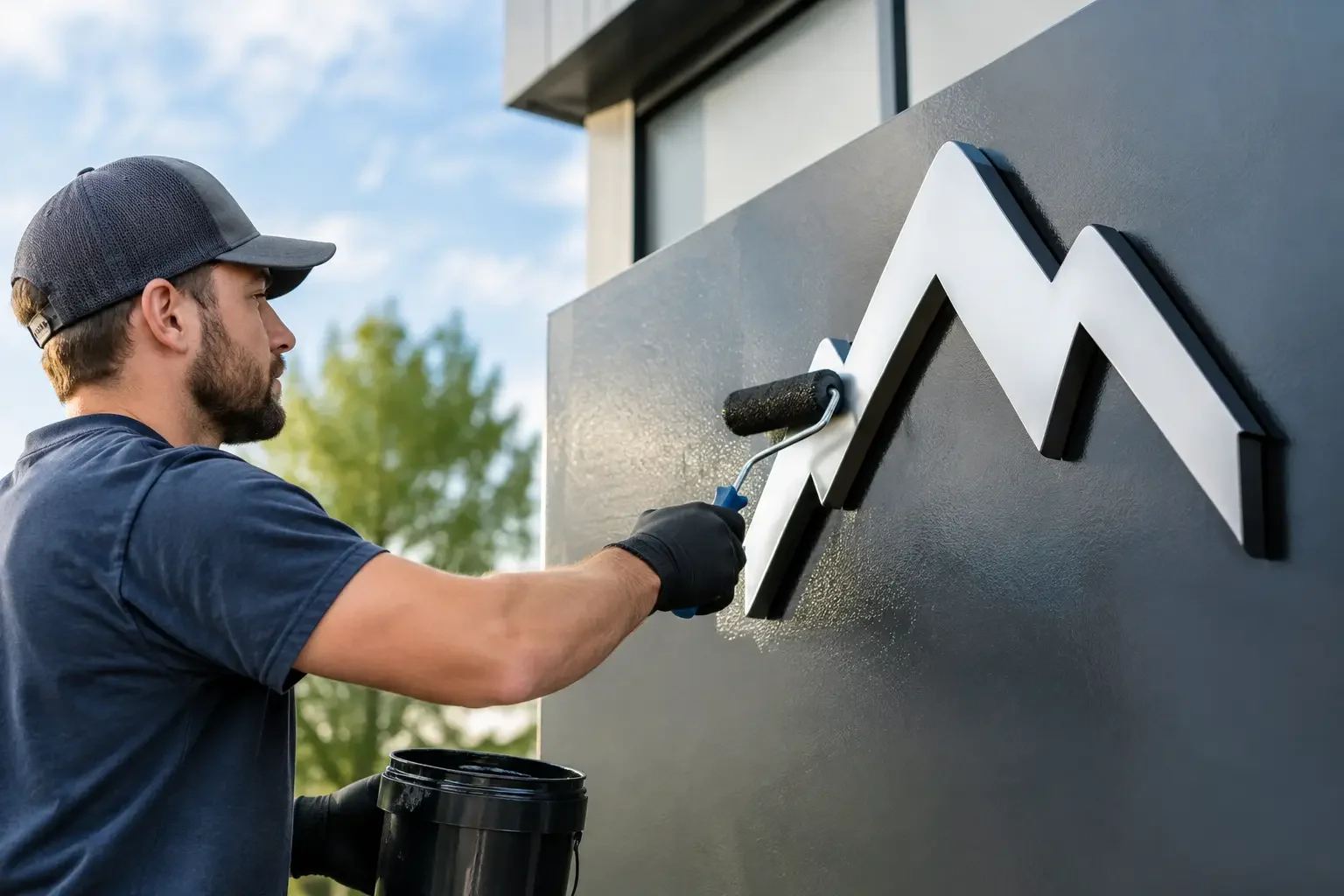
An exterior sign’s finish needs to suit its material and location. Sun, rain, irrigation and road salt all affect the choice of coating, and the preparation beneath the color is just as important.
A sheltered tenant panel and an exposed monument sign can face very different conditions. Tell us where your sign will be installed and the color and sheen you want so the finish can be considered as part of the order.
How to Choose Exterior Sign Coatings by Service Conditions
Start with where the sign will live. Exterior exposure is not a single condition. A covered entry sign in a dry climate sees a very different load than a coastal wayfinding system, a municipal sign near de-icing chemicals, or an illuminated cabinet in direct sun.
UV exposure is typically the first driver. High UV breaks down binders and pigments over time, causing gloss loss, fading, and chalking. Dark colors can intensify the problem because they absorb more heat, creating greater movement across the sign face and coating film. For projects with long expected service life, specify an exterior-grade topcoat with documented UV resistance rather than relying on a general-purpose architectural coating.
Moisture is the second major driver. Rain alone is manageable when edges, joints, fasteners, and seams are properly sealed. Standing water, repeated wet-dry cycles, irrigation, salt air, and freeze-thaw conditions are harder on a finish system. These conditions require better surface preparation, compatible primers, controlled seam treatment, and careful attention to any exposed substrate transitions.
Chemical exposure deserves the same level of attention. Fuel vapors, cleaning chemicals, urban pollution, fertilizer, and salt spray can attack finishes that perform well in mild environments. If the installation is near a roadway, marina, loading area, pool deck, or heavily maintained landscape, build that exposure into the specification before fabrication begins.
Identify the substrate before selecting the finish
Coatings do not perform independently of the material beneath them. HDU, aluminum, steel, acrylic, PVC, and composite panels each require different preparation and primer strategies. Treating every sign face as if it were raw wood or painted metal creates predictable failures.
HDU is dimensionally stable, moisture resistant, and well suited to dimensional exterior signage, but it still needs a coating system designed to seal and protect the routed surface. CNC-cut edges, blasted textures, deep copy, and carved backgrounds create more surface area than a flat panel. The finish must reach recesses and edge details without bridging fine texture or leaving thin spots in corners.
Metal components introduce another set of requirements. Aluminum needs correct cleaning and pretreatment for adhesion. Steel requires corrosion control at cut edges, welds, and penetrations before topcoating. When HDU panels are integrated with fabricated aluminum or steel structures, the coatings should be selected as a coordinated system. Differing film thicknesses, incompatible materials, or untreated metal interfaces can create failures that appear to originate in the sign face.
Specify a Coating System, Not Just a Color
A color callout is not a coating specification. It does not state how the substrate will be prepared, which primer will be used, how many finish coats are required, or what dry film build is needed. Those details determine whether a coating adheres, covers evenly, and holds up under weathering.
For most architectural exterior signs, a practical system includes substrate preparation, a compatible primer or sealer, and a premium exterior topcoat. The exact products vary by material and finish type, but the sequence matters. Primer supports adhesion and helps create a uniform surface. The topcoat provides the visible color, gloss level, and primary weathering protection.
Do not assume that more paint automatically means more durability. Excessive film build can soften routed detail, fill sandblasted texture, crack at edges, or create uneven sheen. Insufficient coverage leaves porous areas, sharp edges, and recessed copy vulnerable. Production control is the goal: complete, even coverage at the film thickness appropriate for the coating manufacturer and the sign's geometry.
Gloss level is part of the performance decision. High-gloss finishes deliver a crisp, polished appearance and can be easier to clean, but they show scratches, surface irregularities, and repair work more readily. Satin and low-luster finishes can better suit architectural environments and textured HDU surfaces. Matte finishes reduce glare but may hold dirt more visibly and can be harder to touch up without flashing.
Choose for the Failure Mode You Need to Prevent
The most useful question is not, "What is the best exterior coating?" It is, "What is most likely to damage this sign first?" That answer changes by project.
For intense sun exposure, prioritize UV stability and color retention. Specify colors carefully, particularly bright reds, deep blues, and saturated dark tones. Some color families inherently show fade sooner than others, even with high-quality coatings. If brand standards require a difficult color, establish realistic maintenance expectations rather than promising permanent color match.
For water-prone locations, prioritize sealing and edge protection. Horizontal ledges, routed pockets, post penetrations, seams, and mechanical attachment points should be designed so water can drain instead of collect. No topcoat can compensate for a detail that traps water against the sign structure.
For high-contact signs, such as campus directories, tenant monuments, and retail entry identifiers, evaluate abrasion resistance and cleanability. A finish that looks correct on an elevated sign may not be appropriate at hand level where it will be touched, cleaned, bumped by equipment, or tagged with adhesives.
For coastal or industrial environments, consider the full assembly. Corrosion at a steel frame, fastener, or concealed bracket can compromise an otherwise sound HDU face. Coating performance is tied to fabrication details, material isolation, drainage, and the quality of the protective system applied to every exposed component.
Protect Detail Without Burying the Fabrication
Dimensional signs are not flat walls. Raised letters, V-carved copy, blasted grain, prismatic borders, and layered panels all create shadow lines that give HDU signage its architectural value. The wrong coating process can reduce that definition.
Heavy spray application may be efficient on broad backgrounds, but detailed areas need controlled coverage. Deep recesses can receive too little material while outside corners build up too heavily. Masking, staged spraying, and proper cure time between colors help maintain clean copy edges and prevent overspray contamination.
Texture also changes color perception. A color on a smooth sample may read darker or lighter once applied to a sandblasted background. Low-angle sunlight can amplify texture and reveal thin coverage. For branded projects with strict color requirements, approve samples that use the actual substrate, texture, coating system, and sheen intended for production.
Multi-color signs require a practical repair strategy. Ask whether a field touch-up will be acceptable, whether an exact color match is required, and whether the sign can be removed for refinishing if damaged. A highly custom metallic or specialty finish may be appropriate for a flagship project, but it can increase replacement and repair complexity.
Put the Finish Requirements in the Quote Package
A reliable fabricator should not have to guess what "painted exterior finish" means. The quote package should state the substrate, color standard, sheen, texture, coating type if known, exposure conditions, and any special performance requirement. If the sign includes a metal structure, identify whether the frame, posts, brackets, and hardware need matching finish treatment or a separate protective coating process.
Include the installation environment. State whether the project is coastal, high-altitude, subject to irrigation, near traffic, or located in a freeze-thaw region. These notes let the production team identify coating risks before the job moves into routing, blasting, fabrication, and finishing.
Also define what is visible after installation. A shop may finish exposed edges and faces differently from concealed mounting surfaces, but that distinction needs to be intentional. Clear documentation prevents the common problem of approving a rendering that does not account for the actual sight lines at installation height.
We discuss the finish alongside the carving and layout. Confirm the color, sheen and any special appearance in the written order before manufacture.
Make Coating Decisions Early Enough to Matter
The best time to select a coating system is before final artwork, structural detailing, and production release. Finish requirements affect edge profiles, texture depth, color sequencing, masking allowances, drainage details, and the choice of compatible materials. Waiting until the sign is routed limits the options available to correct a specification problem.
Start with the location, substrate, color and sheen, then check that the primer and topcoat are compatible. Allow the specified drying and curing time before packing or fitting the sign.