
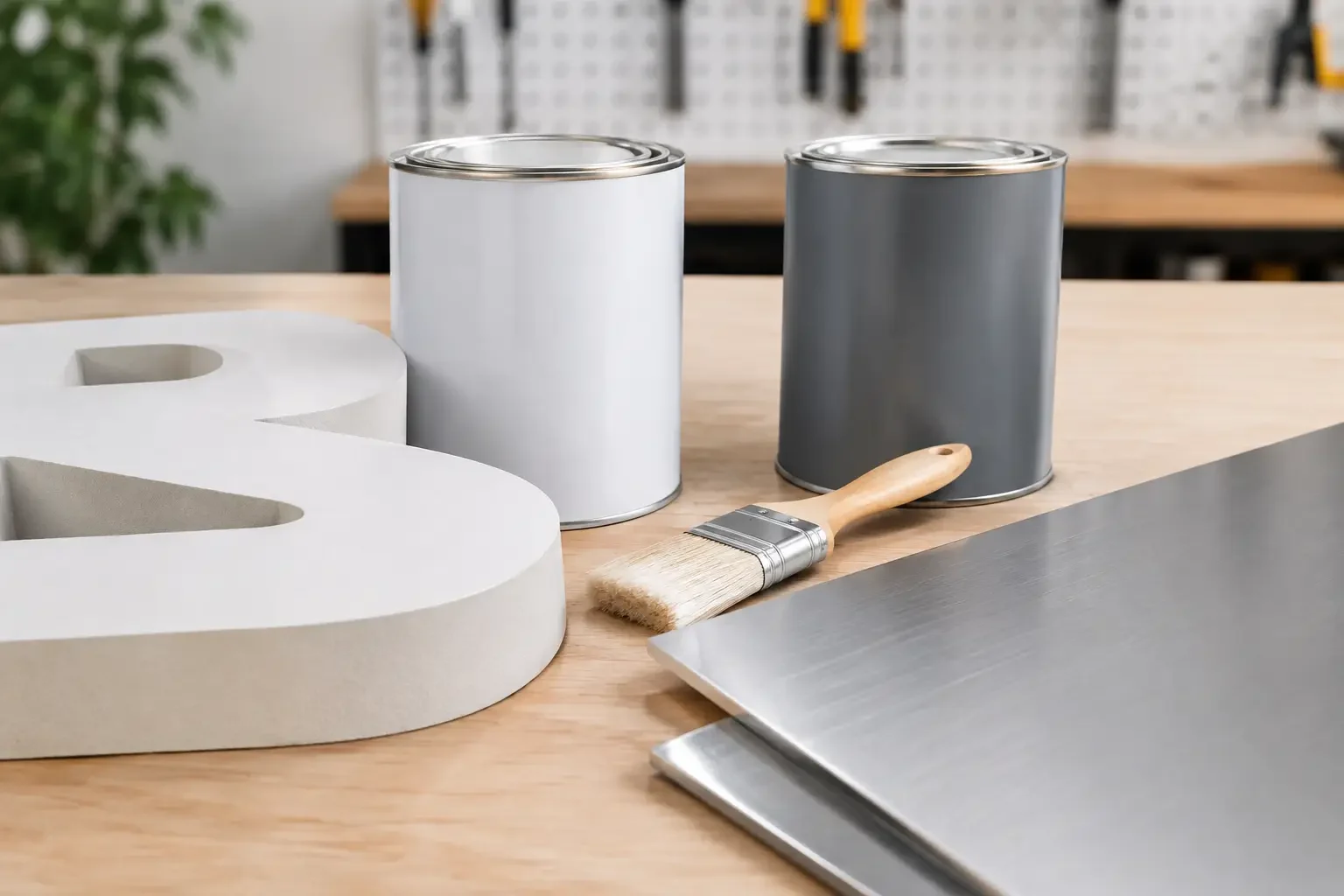
Choose a sign primer to suit the substrate and the topcoat you plan to use. Surface preparation, exterior exposure and application conditions also matter: a good topcoat cannot make up for poor adhesion underneath.
For a one-off sign, you may have time for more filling and sanding. For a repeated design, application and drying times also affect the workflow. In either case, use a primer the coating manufacturer approves for the substrate and finish system.
Start With the Substrate, Not the Topcoat
Primer selection starts with the material being coated. HDU, aluminum, steel, acrylic, PVC, ACM, and wood do not absorb, expand, corrode, or release coatings the same way. Treating every fabricated component with one general-purpose primer invites avoidable rework.
HDU is a closed-cell urethane material, but its routed surfaces, blasted textures, seams, and filled areas still require a controlled coating approach. A quality exterior-grade primer helps create a uniform base for finish paint, especially where machining has opened the surface texture. The goal is not simply coverage. It is to stabilize porosity differences and give the finish system a consistent surface profile.
Raw aluminum presents a different problem. It does not rust like steel, but oxidation and surface contamination can interfere with adhesion. Aluminum components generally require cleaning, abrasion, and a primer designed for nonferrous metal. For architectural sign cabinets, fabricated returns, dimensional letters, and metal frames, the primer must be compatible with both the alloy and the final coating system.
Steel requires the most attention to corrosion control. If steel is part of a welded structure, post-fabrication preparation matters as much as the primer itself. Weld scale, spatter, oils, flash rust, and sharp edges can undermine a premium coating system before the first topcoat is applied. A corrosion-inhibiting epoxy or industrial metal primer is often appropriate, but it cannot compensate for poor surface preparation.
Composite panels, PVC, and acrylic may need specialty adhesion-promoting primers, particularly when a high-performance topcoat is specified. Always confirm that the primer is approved for the exact substrate rather than assuming broad product labeling covers every sign material.
How to Select Sign Primers by Exposure Level
A protected interior lobby sign and an exterior pylon cabinet do not need the same primer system. Define the installed environment early, then select the coating build around that condition.
For interior signs, the main priorities are adhesion, finish uniformity, dry time, and compatibility with the topcoat. A production-friendly primer may be sufficient if the sign will not experience direct weather, frequent washing, or significant temperature cycling.
Exterior architectural signs need stronger performance. Rain, standing moisture, freeze-thaw cycles, airborne contaminants, UV exposure, and thermal movement all affect coating longevity. HDU itself will not rot, but joints, mechanical attachments, exposed metal reinforcement, and edge details still need protection. The primer should support an exterior-rated finish system, not serve as a standalone weather barrier.
Coastal, industrial, and high-humidity applications require another level of caution. Salt exposure, chemical pollutants, and persistent condensation accelerate corrosion on metal substructures and can find weaknesses in seams or unsealed edges. In these conditions, coating specifications should identify surface-preparation standards, primer type, mil thickness, and topcoat compatibility. Vague directions such as “prime and paint” are not adequate for commercial work with a long service expectation.
Match the Primer to the Complete Coating System
A primer is only one layer in a system. It must work with body fillers, seam sealers, texture coatings, topcoats, and clear coats where used. Selecting each material independently is a common cause of adhesion failures and finish defects.
For example, a two-component urethane topcoat may require a compatible epoxy or urethane primer. A waterborne finish may require a specific waterborne bonding primer. Mixing coating technologies without verifying compatibility can result in wrinkling, soft film, solvent attack, poor intercoat adhesion, or unpredictable cure times.
Review the technical data for each coating product before release to production. Confirm the recommended substrate preparation, reduction ratio, induction period if applicable, recoat window, spray settings, dry film thickness, and approved topcoats. These details are operational requirements, not fine print. Missing a recoat window can force additional sanding, delay assembly, and put a scheduled shipment at risk.
When specifying a multi-part sign package, keep the finish system consistent across materials whenever possible. The primer may differ between HDU faces, aluminum returns, and steel support members, but the completed assembly should achieve a uniform color, gloss, and weathering profile. This is especially important for monument systems where routed HDU panels, fabricated metal trim, and dimensional letters are viewed as one architectural unit.
Surface Preparation Determines Primer Performance
The best primer cannot adhere to dust, release agents, machining residue, oil, or oxidation. Surface preparation needs to be built into the production sequence instead of treated as a quick pre-paint task.
For HDU, remove routing dust thoroughly and inspect for damaged edges, tool marks, voids, or areas requiring filler. Sand filled areas flush and ensure the panel is clean and dry before priming. If a textured finish is planned, test the primer and texture sequence on a sample piece. The order of operations can affect both appearance and paint consumption.
For aluminum and steel, clean first, then abrade or blast as required by the coating specification. Pay close attention to welds, corners, routed cutouts, exposed edges, and fastener locations. Sharp edges do not hold coatings well. Breaking those edges slightly before priming improves film build and reduces the chance of early edge failure.
Do not overlook shop conditions. High humidity, cold substrate temperatures, contaminated compressed air, and poor filtration can damage an otherwise sound finishing process. If a primer is applied outside its temperature or humidity range, cure and adhesion may suffer even when the surface preparation was correct.
Balance Production Speed Against Long-Term Durability
Fast-dry primers can improve throughput, but speed should not override application requirements. A one-hour dry-to-sand time may be valuable for short-run interior components. For a large exterior sign program, a slower-curing industrial primer with higher corrosion resistance may provide the better lifecycle result.
The right choice depends on the job’s risk profile. If the component is easy to repaint after installation, a standard exterior system may be adequate. If it is a 12-foot monument face mounted above masonry, or a fabricated letter package installed on a multistory façade, the cost of coating failure is much higher than the cost of specifying a stronger primer system.
Coverage and material cost also deserve a realistic review. A lower-cost primer that requires extra coats, extensive sanding, or frequent gun cleaning is not necessarily economical. Measure labor, cure time, waste, touch-up requirements, and reject rate alongside per-gallon pricing. Production profitability is determined by the full process, not a single material line item.
Use Sample Panels Before Releasing a Large Run
For new coating combinations, custom colors, textured finishes, or demanding environments, produce a sample panel first. This is particularly useful when a sign package combines HDU with metal fabrication or when the specified topcoat has not been used over that exact primer.
A useful sample should duplicate actual production conditions: the same substrate, routed detail, filler, primer, topcoat, film build, and cure schedule. Evaluate adhesion, gloss consistency, coverage, edge holdout, texture, and color appearance. If the project includes metal, inspect for any sign of contamination or inadequate coverage around welds and corners.
A sample can reveal adhesion or finish problems before you coat the whole sign. When ordering a finished sign from us, tell us the color, sheen and exposure so we can discuss the finish requirements.
Check the primer and topcoat instructions together, prepare the surface as specified and test unfamiliar combinations on a sample. Keep a record of the products and application conditions for future work.