
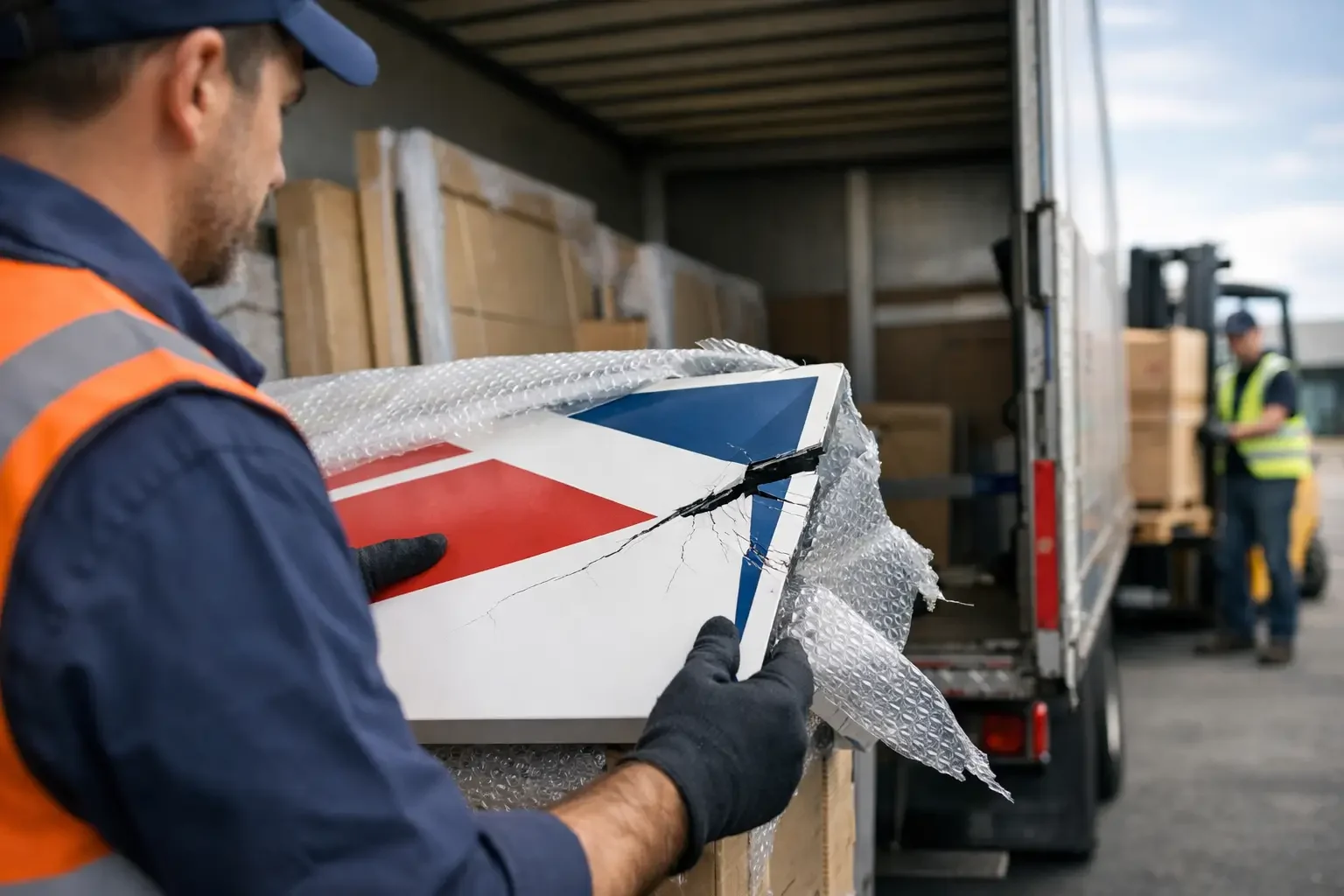
A finished sign needs protection around its corners, painted faces and raised details. We plan the packing around those vulnerable areas and the size of the shipment, rather than waiting until the sign is ready to leave.
Damage can mean a remake and a delayed installation. Tell us where the sign will be received, who will unload it and whether there are access restrictions so we can plan the shipment properly.
Start With the Sign's Actual Failure Points
Every sign package should be built around the product geometry and material behavior. A flat HDU panel may resist moisture well, but its routed edges, raised copy, painted faces, and attached hardware still require protection from point impacts and abrasion. Dimensional letters have a different risk profile: narrow strokes, serif tips, stud-mounted returns, and painted edges can be damaged when pieces shift against each other.
Do not treat all finished sign components as generic freight. Identify what can crack, bend, scuff, crush, or detach. That assessment determines whether the job needs foam separation, a reinforced carton, a palletized skid, a fully enclosed crate, or a combination of all four.
Large-format signs create another issue: flex. A panel can survive a direct hit yet suffer damage when a fork truck lifts the shipment improperly or when a long crate spans an unsupported area. Crate runners, internal blocking, and panel support locations need to prevent movement along the full length of the shipment.
For fabricated signs that include metal frames, raceways, or welded structures, protect both the finish and the protrusions. A steel frame may be structurally sound after transit, while a finished HDU face, mounted letter, or threaded attachment point is not. Packaging must protect the complete assembly, not just its heaviest component.
How to Prevent Sign Freight Damage With Correct Crating
A crate is not automatically freight-safe. Poorly designed crates can allow the sign to rack, rub, settle, or absorb impacts directly through thin sheathing. The crate has to become a controlled shipping enclosure, with the sign restrained inside it and the structure built to handle stacked freight and mechanical handling.
For high-value or irregular architectural signage, use a rigid wood crate with adequate perimeter framing, cross bracing, and a skid base designed for fork access. The base should keep forks away from the sign face and provide enough clearance for safe movement. If a crate can only be lifted from one side, mark the approved fork entry clearly.
Inside the crate, separate the sign from the exterior walls. Closed-cell foam, padded blocking, corrugated edge protectors, and rigid internal spacers all have a role, but they serve different purposes. Foam cushions impact. Blocking prevents movement. Edge protection prevents compression damage. No single material replaces the others on a fragile or large-format sign.
Avoid placing finished faces directly against loose bubble wrap or cardboard. Vibration can turn seemingly soft packaging into an abrasive surface over several hundred miles. Use clean, non-marking protective layers against painted faces, and prevent those layers from shifting during transit.
Crates should also be built for the shipment's orientation. A sign intended to ship vertically needs internal support at the bottom edge and lateral restraint across the face. A sign intended to ship flat needs broad, evenly distributed support to prevent flexing. Marking "This Side Up" is useful, but the package should be capable of surviving reasonable handling mistakes when possible.
Secure Components Before They Enter the Crate
Loose hardware is a common source of avoidable damage. Studs, mounting templates, standoffs, fasteners, and installation parts should never float around inside the same compartment as finished letters or panels. Bag hardware, label it by component or location, and secure it in a dedicated internal box or partition.
For multi-piece dimensional letter sets, keep each letter isolated. Nesting letters together may reduce carton size, but it often creates paint rub, chipped corners, and broken thin elements. Individual cavities or separated layers take more packing time, yet they cost far less than remaking a logo letter or matching a custom paint finish under deadline.
Mounting patterns and paper templates should be protected from moisture and folding. When a template is essential to field installation, ship it in a labeled tube or rigid flat pack instead of placing it loosely under the sign face. The receiving crew needs the full install package intact, not merely the visible sign components.
For assemblies with removable faces, trim, or electrical elements, decide whether shipping fully assembled is actually the lowest-risk option. A complete assembly may reduce field labor, but separate protected subassemblies can be safer where a protruding component is especially vulnerable. The right answer depends on the product, installation sequence, and available receiving labor.
Palletize for Forklift Reality
Freight moves through terminals, cross-docks, trailers, and jobsite staging areas. Packages are handled by people who did not fabricate the sign and may not recognize its fragile areas. A pallet or skid must make correct handling easy and incorrect handling harder.
Build the footprint so no crate wall or carton edge overhangs the pallet. Overhang invites fork strikes and crush damage when shipments are placed beside other freight. Use a pallet sized to the crate, not whatever is closest to the shipping station.
Heavy crates should be mechanically secured to the pallet with screws, lag fasteners, or appropriate strapping. Stretch wrap alone is not a structural restraint. It can keep dust out and labels attached, but it will not reliably prevent a crate from shifting under braking or trailer vibration.
If the shipment has an uneven center of gravity, mark it. If it must not be double-stacked, use visible handling labels and crate design that makes stacking difficult. Labels do not control every carrier action, but clear visual instructions improve the odds that the shipment receives appropriate treatment.
Document Condition Before Pickup
Packaging prevents damage. Documentation protects the claim position when damage occurs anyway. Photograph the finished sign, all vulnerable details, the internal packing arrangement, the sealed crate, labels, and the completed pallet from multiple angles. These records establish that the product was complete and properly protected before carrier pickup.
Record dimensions, weight, and freight class accurately. Understated dimensions can lead to rebills, handling changes, or a carrier selecting equipment that is not suitable for the shipment. Freight planning is part of production control, especially for oversized panels, monument components, and crated architectural systems.
The bill of lading should describe the freight clearly. For example, identify a shipment as crated architectural signage or fragile finished dimensional signage rather than using a vague description. This does not guarantee special handling, but it creates a clearer shipping record and helps receivers understand what they are accepting.
We pack each sign for its size, shape and delivery arrangements. The price we quote includes your fully finished sign and shipping to your delivery address. Let us know about unloading and access requirements before the quote is finalized.
Give the Receiver a Damage Inspection Procedure
Damage is often discovered after the driver has left, which can complicate recovery. The consignee should know before delivery that freight needs inspection at the time of arrival. This is particularly critical on commercial jobsites where a receptionist, warehouse employee, or general laborer may sign for a crate without opening it.
Ask the receiver to follow a short, practical process:
- Inspect the crate, pallet, corners, banding, and wrap before signing.
- Photograph punctures, crushed areas, broken skids, water exposure, or visible fork damage.
- Note specific damage on the delivery receipt rather than signing "clear" or "subject to inspection."
- Open damaged or suspicious crates promptly and photograph concealed damage before moving components.
- Keep all packaging materials until the carrier's claim process is resolved.
A note such as "crate crushed on lower left corner, possible panel damage" is more useful than a generic statement. The delivery receipt is a key document, and vague notation can weaken a claim.
Control the Handoffs That Cause Most Problems
Freight damage is frequently a handoff problem. A sign may be packed correctly but left outside in rain, transferred to a liftgate truck that cannot safely manage the crate, or delivered to a site without a forklift or protected storage area. Confirm delivery conditions before the shipment leaves.
For commercial sites, verify whether a dock, forklift, pallet jack, or receiving crew will be available. A liftgate can be useful for small palletized shipments, but it is not a substitute for proper equipment on oversized or heavy crated signs. If the consignee cannot unload safely, arrange the appropriate delivery method rather than leaving the decision to the day of arrival.
Weather also matters. HDU itself is a durable exterior material, but exposed packaging, paper templates, unsealed cartons, and finished surfaces can still be affected by standing water or condensation. A weather-resistant outer barrier and enclosed crate are worthwhile when freight may sit on a dock or travel through wet conditions.
Check the shipment when it arrives, document any damage and keep the packaging while the order is reviewed. Store the sign safely until your installer is ready for it.