
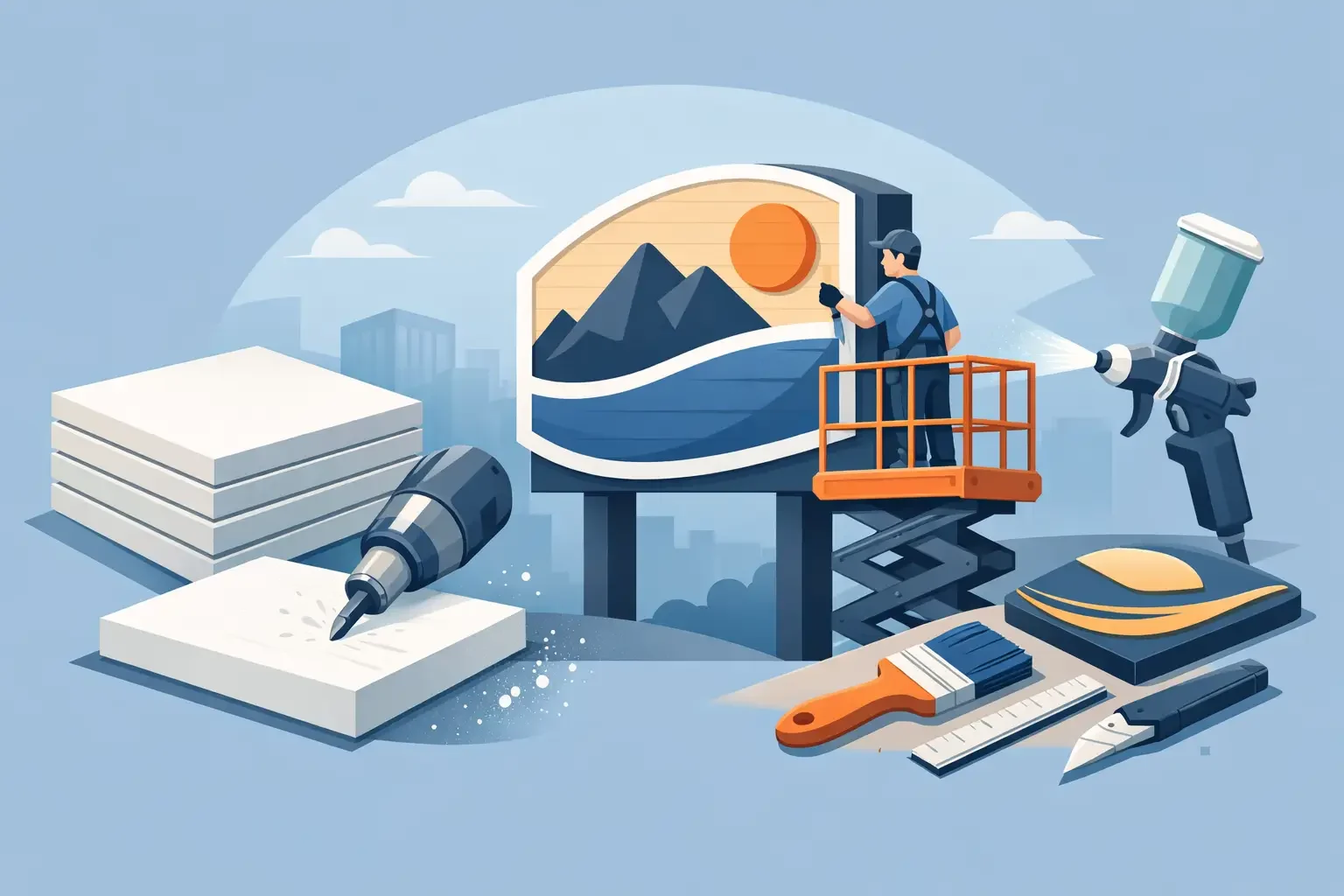
HDU boards are useful for carved letters, textured backgrounds and shaped sign panels. Choosing the board means looking at the design as well as the material: how deep it will be carved, how it will be finished and how the finished sign will be supported.
HDU has no wood grain or knots to work around, which makes it useful for detailed routing and repeat designs. It still needs suitable coatings and mounting provisions for the intended location.
What HDU boards are
High-density urethane boards are rigid sign foam panels manufactured for machining, carving, texturing, and finishing. They are closed-cell, moisture resistant, and available in multiple densities and thicknesses depending on the application. In practical shop terms, they give you a stable substrate that can be CNC routed with tight detail, shaped without grain-direction issues, and finished for long-term exterior use.
That matters because many common sign materials carry limitations that show up later in production. Wood can warp, split, absorb moisture, and vary from sheet to sheet. PVC machines cleanly in some situations but can fall short when deep carved relief, sandblasted texture, or a more substantial architectural look is required. HDU boards sit in a useful middle ground - lighter than many traditional substrates, easier to machine than hardwood, and better suited to dimensional exterior signage than generic foam products.
Why signmakers use HDU boards
For trade buyers, the value starts with process control. HDU boards machine consistently, which supports cleaner routing, better detail retention, and fewer surprises when you are producing repeat work across multiple locations or sign faces. If you are quoting franchise rollouts, monument faces, or dimensional letter packages, consistency is not a luxury. It protects margin.
The closed-cell structure also changes the finishing conversation. Because the material does not absorb moisture like wood, it is less prone to the swelling, cracking, and substrate movement that can shorten service life outdoors. That does not mean finishing is optional. Surface prep, primer selection, coating system, and edge treatment still matter. But the base material starts from a more stable position.
Weight is another operational advantage. On many projects, HDU reduces handling strain in the shop and can simplify installation compared with heavier carved alternatives. That benefit becomes more noticeable on larger wall signs, freestanding faces, and multi-component assemblies where dead load affects mounting design, freight cost, and field labor.
Density, thickness, and performance trade-offs
Not all HDU performs the same way. Density selection affects detail quality, structural behavior, finish appearance, and price. Lower-density material can be appropriate for larger shapes, thicker profiles, and applications where ultra-fine detail is not the priority. Higher-density material generally supports sharper edge quality, cleaner small copy, and more refined carved surfaces, but it comes at a higher material cost.
Thickness matters just as much. A thicker panel may be needed for deep relief carving, substantial dimensional edges, or freestanding sign faces that require a heavier visual profile. On the other hand, overspecifying thickness can increase cost and shipping volume without improving performance. Good fabrication planning starts with the actual use case - routed logo panel, sandblasted tenant sign, cabinet accent face, or laminated dimensional build.
This is where experienced production input saves money. If the board density is too low, the finish and detail may not meet expectations. If it is too high for the application, the project may be paying for performance it does not need. The right call depends on copy size, carving depth, coating schedule, mounting strategy, and viewing distance.
Best applications for HDU sign boards
HDU boards are most effective where appearance and machinability both matter. Dimensional letters are a common example. Routed HDU letters can be fabricated in custom thicknesses, primed, painted, and delivered install-ready for exterior branding packages. They work well when the project needs a substantial profile without the weight or cost structure of metal fabrication.
They are also a strong fit for sandblasted or faux-sandblasted panels. The material accepts carved backgrounds, raised copy, and textured surfaces that give signs a more traditional or architectural character. For developments, municipal projects, retail centers, churches, medical campuses, and hospitality properties, that look often matters as much as basic legibility.
Monument and post-and-panel faces are another practical use. HDU can serve as the routed face component in a larger fabricated sign system, often paired with aluminum structures, steel supports, or integrated raceways. In those builds, the sign face needs to look premium while remaining manageable in production and shipping.
Interior applications are possible too, but HDU usually earns its keep on exterior projects where moisture resistance and shape stability are worth paying for.
What HDU does better than wood and where it does not
Compared with wood, HDU boards remove several common failure points. There is no grain to fight during routing. There are no knots, inconsistent hardness zones, or natural splits that show up in finishing. The material is generally more predictable across sheets, which is critical when a production run has to match from one sign to the next.
It also reduces some of the maintenance concerns tied to exterior wood signage. Properly fabricated and finished HDU will typically hold up better against moisture exposure and environmental cycling than carved wood signs in the same conditions.
Still, HDU is not structural framing. It is a sign substrate, not a substitute for engineered metal support systems where span, wind load, or attachment stress are involved. It also requires correct finishing and handling. Poor priming, inadequate edge sealing, weak fastening design, or rough freight packaging can compromise a good material fast. The board itself is only one part of the system.
Fabrication considerations that affect the final result
The difference between average and professional HDU output usually comes down to fabrication discipline. CNC toolpath quality affects edge finish and letter clarity. Lamination methods matter when thicker builds are required. Surface prep before priming affects paint holdout and final appearance. Mounting hardware needs to be planned around the material, not improvised after paint.
Shipping is another area where trade buyers should pay attention. HDU is lighter than many alternatives, but finished sign components still need freight-safe packaging, especially with carved faces, raised copy, and extended shapes. Damage in transit can wipe out the savings gained from outsourcing. For wholesale production, packaging is part of manufacturing quality control, not an afterthought.
Allow time for artwork preparation, routing, cleanup, priming, painting and packing. Ask for a production estimate based on the actual sign and finish, especially if you have an installation date to meet.
How to source HDU boards the right way
If you are buying raw boards, the main concerns are density availability, sheet quality, and usable thickness options. If you are outsourcing fabricated components, the questions get more specific. Ask how the parts will be machined, what finish system is being applied, whether mounting is included, how pieces are packed, and what tolerances the shop works to.
This is especially important on repeat programs and multi-site deployments. Precision repeatability is what separates a production partner from a shop that occasionally works with HDU. If your project needs matching tenant panels, consistent routed logos, or install-ready dimensional letters across multiple destinations, process control matters more than a low initial number.
If you want us to handle the routing and finishing, send the artwork, dimensions, colors and delivery location. Our quoted sign price includes the fully finished sign and shipping. Your local installer handles installation.
Where HDU boards make the most financial sense
The cheapest substrate on paper is not always the cheapest sign delivered and installed. HDU boards often make the most financial sense when labor, rework, refinishing, and production cleanup are part of the equation. If a material saves a few dollars up front but costs more in routing time, sanding, paint issues, remake risk, or field complications, it is not actually protecting margin.
HDU tends to perform best in that middle zone where appearance, machining efficiency, and exterior durability all have real value. For simple flat panels, another substrate may be more cost-effective. For heavy structural elements, metal may be required. But for dimensional architectural signage, HDU remains one of the most practical materials available because it balances design flexibility with production efficiency.
Choose the board around the finished sign. The depth of the carving, the size of the lettering, the finish and the mounting arrangement are more useful starting points than thickness or density alone.