
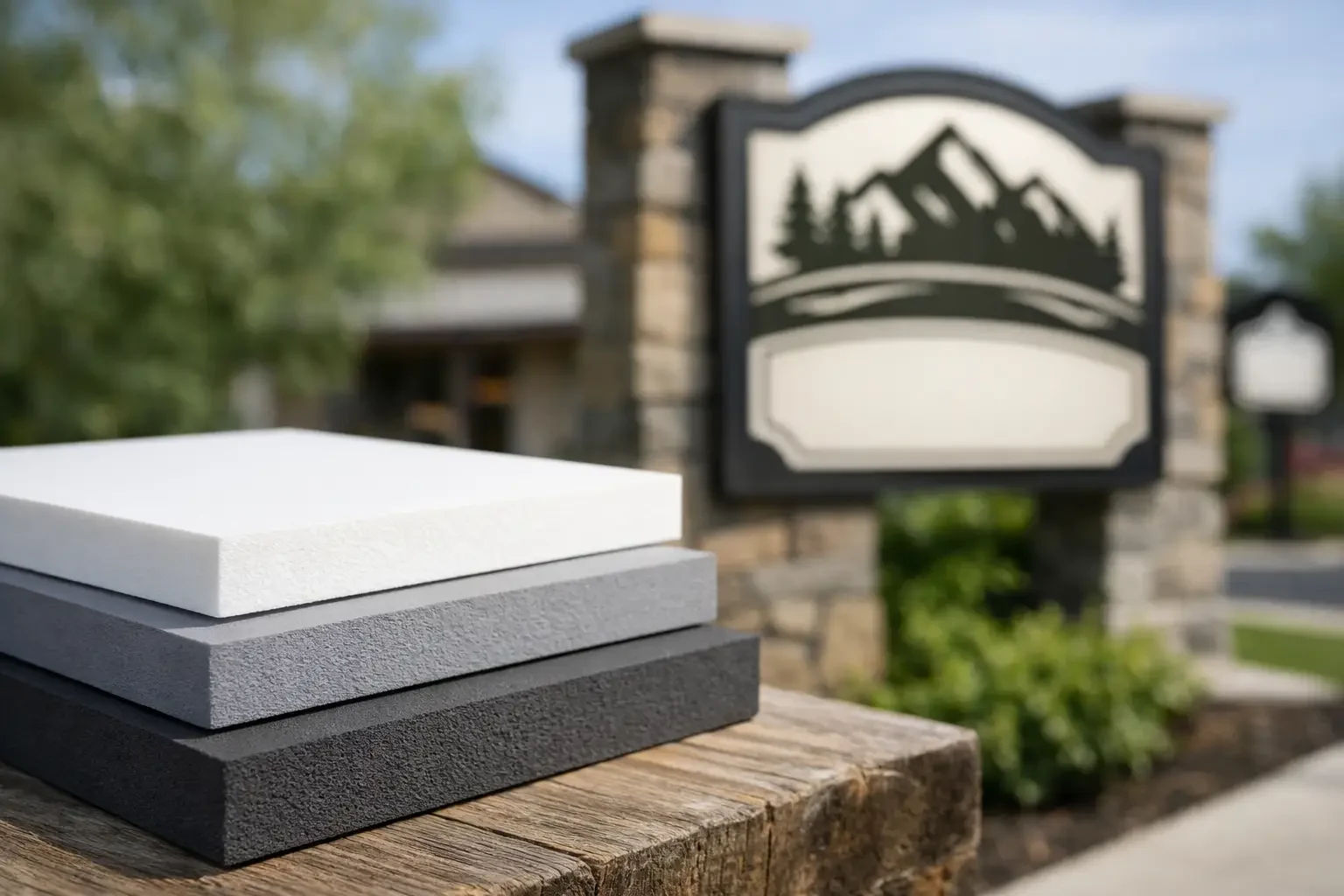
HDU density should suit the detail you want to cut and the way the sign will be supported. Panel size, thickness, relief depth and finish matter alongside density. A higher number alone does not make a complete sign stronger.
For most dimensional exterior signage, 15 lb, 18 lb, and 20 lb HDU cover the practical working range. Higher-density material, including 30 lb HDU, has a place where fine machining, crisp edge definition, and increased impact resistance justify the added cost. The objective is not to buy the densest board available. It is to select a material that holds the required detail and remains stable in the finished sign system.
What Density HDU for Outdoor Signs Should You Specify?
For standard outdoor routed and sandblasted signs, 15 lb HDU is often the economical baseline. It machines cleanly, will not rot, and performs well when the design uses broad copy, moderate relief, and a properly sealed paint system. It is a practical choice for monument faces, wall signs, directional panels, and larger-format graphics where the visual effect comes from depth and finish rather than extremely sharp micro-detail.
Denser grades such as 18 lb HDU can improve edge definition for some designs. We normally use 15 lb HDU; if your specification calls for another density, confirm availability and pricing with us before ordering.
20 lb HDU is the better call when a project has finer lettering, detailed logos, thin routed elements, or a finish that will expose every machining imperfection. It holds a tighter edge than lower-density board and provides more resistance to incidental damage during crating, delivery, and installation. It is especially useful for premium monument signs, tenant identification systems, municipal graphics, and designs with sharp V-carving or precise recessed copy.
30 lb HDU is not automatically necessary for exterior signs, but it earns its cost in high-detail applications. Think small serif lettering, intricate emblem work, deeply machined relief, or panels where a crisp machined surface is central to the final appearance. It can also be appropriate when fabricating smaller standalone elements that will be handled frequently before installation. For large, simple panels, however, specifying 30 lb material can add cost without delivering a meaningful field-performance advantage.
Density Controls More Than Carving Detail
HDU density is measured in pounds per cubic foot. As density increases, the material generally becomes harder, more compact, and better able to retain crisp routed edges. That affects the appearance of the sign, but it also affects fabrication speed, finishing behavior, handling, and freight exposure.
Lower-density HDU cuts efficiently and is well suited to broad areas of removal. It is forgiving for large background textures and can reduce material cost on oversized panels. The trade-off is that it is easier to dent, its edges are more vulnerable to damage, and very small details can soften during routing, sanding, priming, or painting.
Higher-density HDU provides a firmer surface for machining and finishing. Fine copy stays cleaner, narrow strokes hold shape better, and routed edges require less correction before coating. That does not mean high-density HDU is structurally equivalent to solid wood, aluminum, or steel. HDU is a foam substrate, not a load-bearing panel. When a sign must resist wind loads, cantilever forces, or large unsupported spans, the structure behind the HDU matters more than simply increasing density.
Thickness and support are separate decisions
A common specification error is trying to solve a structural problem with denser foam. A 1-inch 30 lb HDU panel may have a harder face than a 1-inch 15 lb panel, but neither should be treated as a substitute for proper metal reinforcement, a framed cabinet, or engineered attachment points.
For large monument faces and freestanding panels, thickness should be selected with the sign geometry and support system in mind. Routed HDU panels are frequently backed by aluminum composite, steel, aluminum tube, or other structural components depending on the application. Through-bolting, concealed stud placement, perimeter framing, and expansion considerations should be resolved before fabrication starts.
If a panel will ship long distance, freight-safe construction is also part of the density decision. A denser board can better tolerate normal handling, but crating, edge protection, and properly located mounting hardware prevent the type of transit damage that density alone cannot solve.
Match HDU Density to the Sign Design
Let the design guide the material choice. A wide entrance sign with large letters and a textured background may not benefit from the densest board. Consider the carving detail, panel thickness and support together, and have the installer or engineer confirm the support needed for the site.
By contrast, a small architectural plaque with a detailed seal, narrow borders, and 1-inch serif copy may benefit from 20 lb or 30 lb HDU. The denser material helps preserve sharp transitions between the raised and recessed areas. It also makes the finishing process more predictable, particularly when the design uses metallic coatings, high-gloss paint, or contrasting colors that make defects visible.
Dimensional letters require the same evaluation. Large block letters can be routed from 15 lb or 18 lb HDU when they are adequately thick and securely mounted. Smaller letters, thin script fonts, and intricate logo shapes often warrant 20 lb material because narrow strokes are more likely to suffer edge damage during finishing, packing, or installation.
Dark finishes and high-visibility locations raise the standard
Dark colors, gloss finishes, and raking light reveal surface variation. A sign installed at a main entrance, close to pedestrian traffic, or under strong architectural lighting will receive more scrutiny than a distant wayfinding panel. In those cases, use a density that supports the finish quality the customer expects, then pair it with disciplined surface preparation and a commercial-grade coating system.
HDU itself does not absorb water like wood, and it will not rot, split, or delaminate from moisture exposure. Exterior longevity still depends on the full finish system. Routed edges, deep pockets, and dimensional components need complete coating coverage. Primer selection, coating thickness, cure time, and paint compatibility all affect field performance. A premium-density board with an incomplete finish is still a poor exterior specification.
Do Not Over-Specify Density Without a Reason
Over-specifying HDU can quietly erode margin on repeat programs and multi-location rollouts. If the copy is broad, the panel is properly supported, and the finish is matte or textured, moving from 18 lb to 30 lb may not improve the installed result enough to justify the material and machining cost.
The better approach is to identify where density creates value. Use it where the project needs crisp detail, a harder finished edge, or additional resistance to handling damage. Use a lower practical density where the sign face is large, the design is simple, and the supporting structure carries the load. This produces a more accurate estimate and a fabrication package that is easier to repeat across multiple locations.
For sign shops outsourcing routed panels or install-ready systems, the quote package should clearly identify panel dimensions, thickness, HDU density, relief depth, edge treatment, finish requirements, mounting method, and whether structural reinforcement is included. Those details prevent the familiar problems of a panel that looks right in a proof but arrives without the support, detail retention, or attachment strategy required in the field.
A Practical Specification Starting Point
Our usual starting material is 15-pound exterior-grade HDU. We review the lettering, relief, size and support requirements with the design. If a project specifies another density, include that requirement before quoting so availability and suitability can be confirmed.
Send the design and finished dimensions if you are unsure which density to specify. We can review the material and carving details, while your installer or project engineer confirms the structure and attachment requirements.