
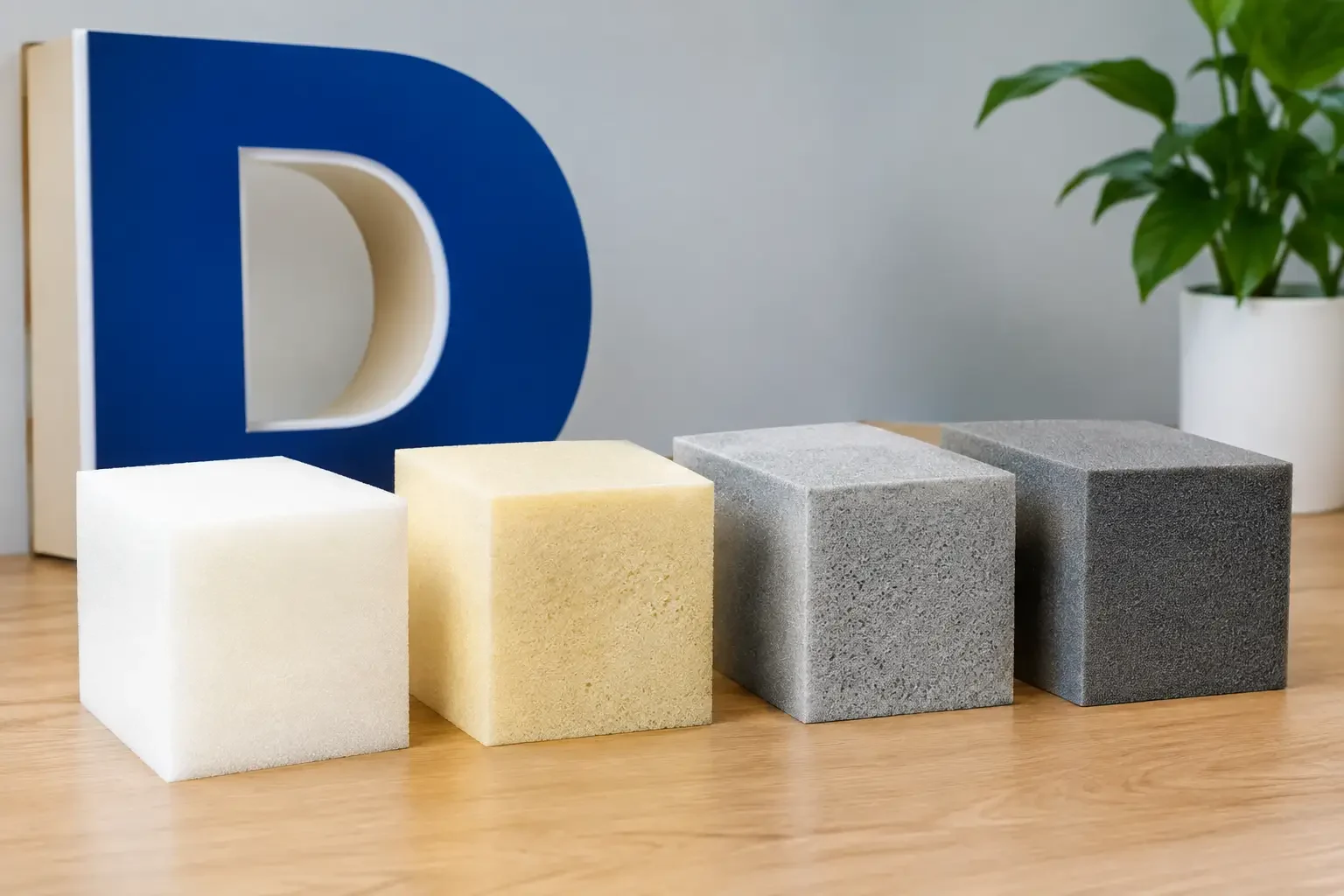
Two routed letters can have the same dimensions but behave differently if they are cut from different HDU densities. Density affects edge strength, fine detail, handling and finishing. Here is what to consider when choosing board for a sign.
High-density urethane is a closed-cell foam used for dimensional letters, sandblasted panels, monument sign faces, architectural accents, and carved exterior signage. Density affects how the material machines, how crisp it holds a profile, how it tolerates handling, and how much labor is required to deliver an install-ready component. It is one of the first specifications that should be settled before production begins.
What Urethane Foam Density Actually Measures
HDU density is commonly stated in pounds per cubic foot. A 15 lb. HDU board weighs approximately 15 pounds per cubic foot of material, while a 20 lb. board weighs approximately 20 pounds per cubic foot. Higher density means more material is packed into the same volume, producing a firmer board with better resistance to dents, edge damage, and aggressive machining.
Density is not a standalone structural rating. A higher-density board is more durable at the face and edge, but it is still foam. Large panels, deep projecting letters, and monument structures may require aluminum backers, internal steel, welded frames, threaded inserts, or other engineered reinforcement. The correct question is not "What density is strongest?" It is "What density, thickness, and support system will hold up for this sign application?"
For exterior sign work, density also has a direct effect on production efficiency. Softer material can be quicker to cut, but it is more vulnerable to cutter marks, handling damage, and finish defects that require touch-up. Denser material costs more upfront, yet it can reduce rework when a project demands sharp copy, fine texture, or a clean, durable edge.
Urethane Foam Density Comparison by Sign Application
Most commercial HDU signage falls into a practical range from 10 lb. to 30 lb. density. The right selection depends on letter size, panel thickness, routing depth, finish system, shipping exposure, and installation method.
10 lb. HDU: Lightweight Work With Limited Detail
Ten-pound HDU is a low-density option suited to applications where weight matters more than fine detail or impact resistance. It can work for large-format decorative forms, thick background elements, interior graphics, or oversized letters with broad strokes and minimal routing. It is also useful when a project needs substantial thickness without creating unnecessary weight.
The trade-off is surface durability. Narrow serif details, sharp interior corners, thin stroke letters, and deep carved copy are more likely to show damage or compression. A 10 lb. board also requires more care through sanding, priming, packaging, and field handling. For exposed commercial signage, it is rarely the best default specification when the face will receive regular contact, close inspection, or rough freight conditions.
15 lb. HDU: The Common Exterior Sign Baseline
Fifteen-pound HDU is often the working baseline for dimensional exterior signs. It offers a practical balance between machinability, weight, cost, and finish quality. Routed letters, logo shapes, basic sandblasted panels, and medium-duty architectural sign components are frequently specified in this range.
For sign shops, 15 lb. material is familiar because it supports clean CNC routing without adding the cost and machining resistance of denser grades. It is a solid choice for copy with reasonable stroke width, painted dimensional letters, and panel signs where the design does not rely on extremely fine carved detail.
That said, 15 lb. HDU should not be treated as a universal answer. If the sign includes small copy, a deeply carved background, thin projecting edges, or a high-abuse installation environment, stepping up in density can protect both the finish and the margin. Saving a small amount on raw material does not help if a damaged edge requires remanufacture after freight or during final inspection.
18 lb. to 20 lb. HDU: Better Detail, Better Edge Control
Eighteen- and 20-pound HDU are strong choices for premium routed signage, sandblasted panels, precision-cut letters, and projects where the face quality is part of the sale. The denser cell structure supports cleaner edges, more controlled V-carving, sharper borders, and improved resistance to incidental dents during fabrication and installation.
This range is especially effective for signs with detailed logo work, smaller routed copy, prismatic edges, simulated woodgrain, or carved textures that need to remain crisp after coating. It also performs well for install-ready letters that will be handled repeatedly during paint, packaging, layout, and mounting.
The material is heavier and more expensive than 15 lb. HDU, and it may require adjusted tooling, feeds, and finishing procedures to maintain production speed. Those costs are justified when the job carries a higher visual standard or when rework would be more expensive than the density upgrade. For wholesale production, 18 lb. to 20 lb. HDU often provides a dependable balance of presentation quality and manufacturing repeatability.
30 lb. HDU: High-Detail and High-Contact Components
Thirty-pound HDU is used where durability, definition, and machining precision take priority over weight and material cost. It is appropriate for highly detailed carved panels, thin or intricate dimensional elements, premium architectural plaques, and components likely to receive close public contact.
The density supports fine features better than lower-density grades, but it is not automatically necessary for every sign. Broad, uncomplicated letters do not gain enough functional benefit to justify the added cost in many cases. A production-focused specification uses 30 lb. HDU selectively - where the design, finish requirement, or exposure level makes it the right investment.
Density Must Be Matched to Thickness and Geometry
A density number alone cannot prevent failure. A 20 lb. letter with a narrow stroke and excessive projection can still break if it is mounted poorly or handled without support. Likewise, a large 15 lb. panel may perform well when it is properly backed, framed, sealed, and installed with appropriate fastening intervals.
Thickness determines how much routing depth is available, how substantial a letter appears from the street, and how much material remains behind a carved face. Geometry determines weak points. Tight internal corners, thin bridges, long unsupported projections, and narrow strokes need to be evaluated before the file reaches production.
This is where a fabrication partner should review the entire build rather than quote only square footage. CNC routing can reproduce complex artwork accurately, but the artwork must be converted into a manufacturable component. Tool diameter, edge radius, depth of cut, substrate thickness, mounting hardware, and freight packaging all affect the final result.
Finish Quality Starts With the Right Density
HDU does not absorb water like wood, but its surface still needs a proper coating system for exterior service. Primers, texture coats, paint, and protective finishes should be selected around the intended appearance and exposure. Density influences how much surface preparation is needed to achieve a uniform finish.
Lower-density foam can require more attention around routed edges and machined details. Denser HDU generally provides a firmer surface for finishing, which is valuable when a project calls for smooth painted faces, metallic coatings, faux finishes, or sharply defined sandblasted texture. It does not eliminate prep work, but it gives the finishing process a more consistent foundation.
For multi-component signs, finish planning should also account for material movement and attachment. HDU faces paired with aluminum returns, steel frames, acrylic elements, or fabricated cabinets need compatible fastening and expansion details. The best-looking routed panel can still fail in the field if the support assembly was treated as an afterthought.
Specify Density Around Real Jobsite Risk
Think about where the sign will go and how it will be handled. A protected lobby sign, an exposed entrance panel and a trailhead sign within reach of visitors can need different details and support.
Consider the project’s handling path. Will the component move through several hands before installation? Is it being crated or boxed with adequate edge protection? Will installers drill, through-bolt, or use stud-mounted patterns? Is the copy small enough that a chipped edge will be visible from normal viewing distance? These questions often point to the correct density more reliably than a generic material preference.
We normally use 15-pound exterior-grade HDU and review the thickness, lettering and mounting needs with each design. If your specification calls for another density, include it with the quote request so we can confirm availability and suitability.
Send the artwork, intended size and setting before choosing a density. We can help you decide where the design needs more material, wider strokes or additional support.