
An outsourced sign order can go wrong when a size, color or mounting detail is left to assumption. Checking those details before manufacturing helps both shops avoid remakes and delays.
You do not need a finished technical package to ask for a quote. Start with what you know, then work through the undecided details with the fabricator before approving production.
Top Mistakes in Outsourced Sign Production
Sending a concept instead of a buildable specification
A customer rendering, a rough dimension, and a request for "something like this" are enough to begin a conversation. They are not enough to release a fabricated sign. Outsourced production becomes expensive when the buyer assumes the fabricator will fill in critical details such as final thickness, copy depth, letter spacing, paint system, mounting method, or tolerance requirements.
This is especially common with dimensional HDU signs. A drawing may show a carved border and raised copy, but not identify the panel thickness, relief depth, edge treatment, background texture, or required overall thickness after finishing. Each missing detail creates a decision point. If that decision is made after production begins, the schedule and margin are already under pressure.
A production-ready specification should establish final width and height, material, thickness, finish, color references, artwork version, mounting configuration, and delivery requirements. If a dimension is field-critical, label it as such. If a finish is intended to match an existing sign family, provide a physical sample or a defined color standard rather than relying on a screen image.
Choosing material by appearance alone
Not every sign that resembles carved wood should be built from the same material, and not every outdoor panel needs the same thickness or internal support. HDU is a strong option for many exterior dimensional applications because it does not absorb moisture like wood and machines cleanly. That does not mean it is a universal substitute for every structural sign component.
Material selection needs to follow the application. Consider sign size, unsupported spans, wind exposure, mounting points, illumination, routed depth, temperature swings, and the weight limits of the receiving structure. A large HDU panel may require a metal frame, backer, or embedded reinforcement depending on its dimensions and installation method. Routed letters may need stud locations coordinated with wall conditions, electrical runs, and field templates.
The mistake is not using HDU. The mistake is specifying HDU without defining what the completed system must withstand. A qualified fabricator can recommend an appropriate construction, but only if the installation conditions are disclosed early.
Approving artwork without controlling revisions
A surprising amount of production rework comes from an old logo file, an unmarked proof change, or an email instruction that never made it into the approved artwork. When multiple stakeholders are involved, verbal changes and informal markups are not production control.
With us, you agree to the order and pay before we prepare the artwork/proof. Check the wording, dimensions, layout, colors and agreed construction details on that proof. We manufacture after your approval and confirm any later changes before proceeding. Related: Artwork requirements
Approval also needs a defined cutoff. Once material is routed, changes to copy, logo proportions, thickness, or mounting can require new components instead of a simple adjustment. That is not a fabricator being difficult. It is the practical result of custom manufacturing.
Comparing unit prices while ignoring total production cost
The lowest quote can become the highest-cost option when it produces inaccurate parts, missed freight windows, inconsistent finishing, or field modifications. A cheap panel that arrives with incorrect dimensions can consume more margin than the original job generated.
Compare quotes for the same supplied work. Check the size, finish, backing, hardware and any templates. The price we quote includes your fully finished sign and shipping to your delivery address. Installation is not included or provided.
Lead time deserves the same scrutiny. A lower price may reflect a production queue that does not align with your install date. For a franchise rollout, a municipal package, or a commercial opening, schedule reliability often has more value than a small unit-price difference. The right choice depends on the job, but the comparison has to account for rework exposure and field labor, not just purchase cost.
Treating mounting as an installation problem
Discuss mounting with your local installer before the sign is made. We need the agreed backing, hole positions or supplied hardware requirements in time to include them in the order.
For dimensional letters, define whether the letters are stud-mounted, rail-mounted, pad-mounted, or installed with another engineered method. For panel signs, identify posts, frames, brackets, wall substrates, and any requirement for concealed attachment. If there is a field template, establish whether it must be included with the shipment and how it will be labeled.
If a separate contractor supplies a frame or support, coordinate its dimensions and fixing points with the sign face. Confirm the fit before either part is manufactured.
Waiting until the end to plan freight
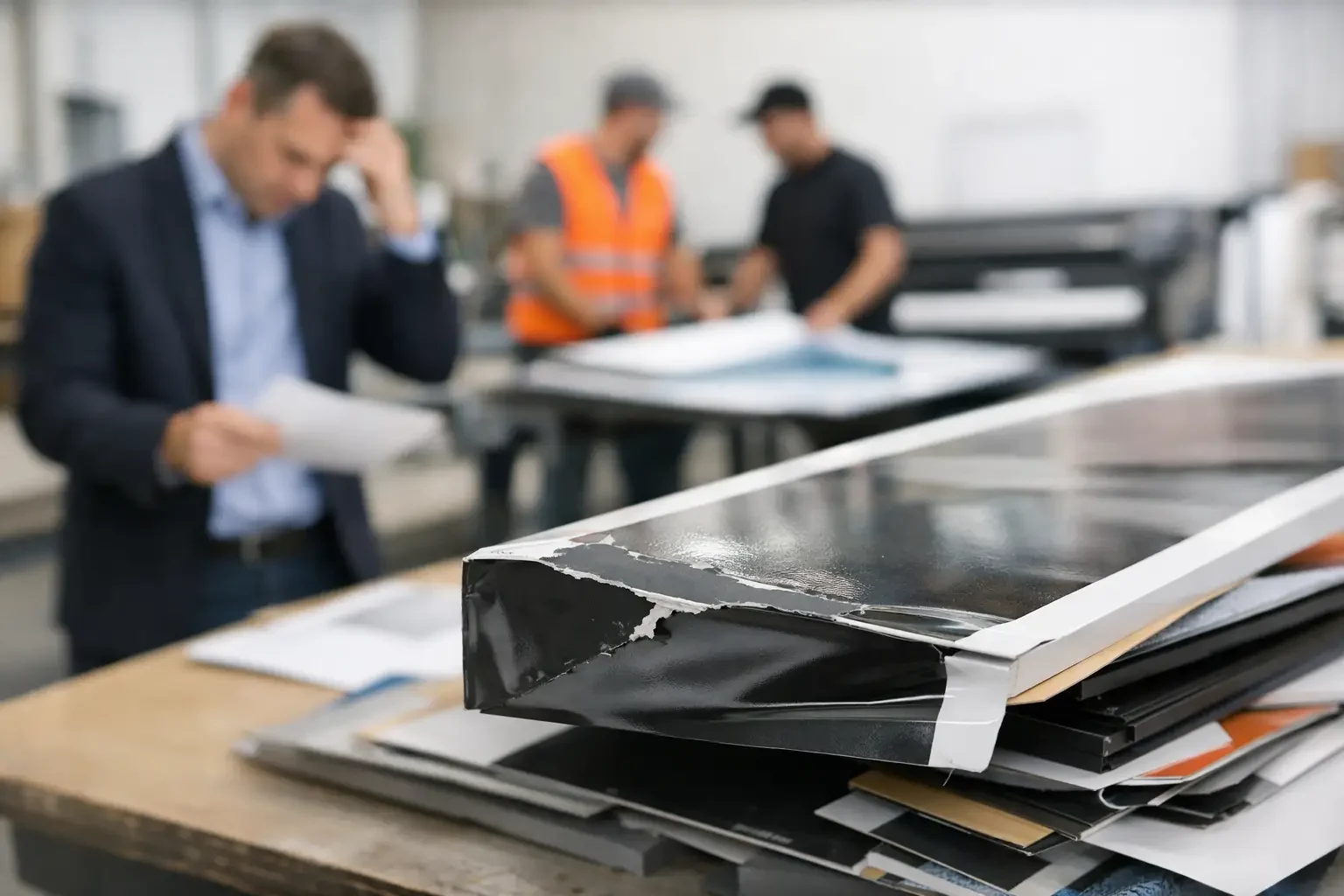
Custom sign fabrication is vulnerable during shipping because dimensional faces, projecting elements, painted surfaces, and fabricated metal components do not tolerate casual packaging. Freight damage is often blamed on the carrier, but poor crate design and weak handling instructions can create the same result.
Freight planning starts with the final sign geometry. Large panels may need skid mounting, edge protection, rigid blocking, or a fully enclosed crate. Routed letters require separation and labeling so they cannot shift into one another. Multi-piece systems should be packed in installation sequence when possible, with corresponding hardware and templates protected inside the same shipment or clearly identified as separate packages.
Tell us whether delivery is to a shop, warehouse, residence or jobsite, and mention limited access or unloading needs when requesting your quote. That information helps us include the right delivery arrangements in the agreed price.
Failing to vet production capability and accountability
A fabricator may be capable of producing a clean sample but unable to maintain consistency across a multi-location order. If the project includes repeat signs, phased releases, or large-format HDU panels, ask how the supplier manages routing files, color standards, quality checks, and packaging across the run.
Look for evidence of controlled production: CNC-based repeatability, documented material specifications, finishing standards, fabrication capacity, and an accountable point of contact who can answer technical questions. A supplier that only responds with a price may not be prepared to resolve a mounting conflict or clarify a relief-depth detail before it becomes a problem.
This does not mean every project requires a complex procurement process. A simple set of routed letters can move quickly. Higher-risk jobs need more discipline because the cost of being wrong rises with size, complexity, and installation consequences.
Build a Better Outsourced Production Release
Before releasing a custom order, confirm the essential information in one controlled package:
- Final approved artwork with revision identification and exact dimensions
- Material, thickness, routed depth, finish, and color requirements
- Mounting method, hardware, templates, and structural support details
- Required ship date, receiving conditions, packaging needs, and delivery address
Add photos of the install location when field conditions are unusual. Identify existing obstructions, wall substrates, electrical access, post locations, and clearance limits. A few accurate jobsite photos can prevent a fabrication assumption that no drawing reveals.
Before approving production, make one final check of the artwork, dimensions, supplied parts and delivery address. Keep the approved version with the order so everyone is working from the same instructions.