
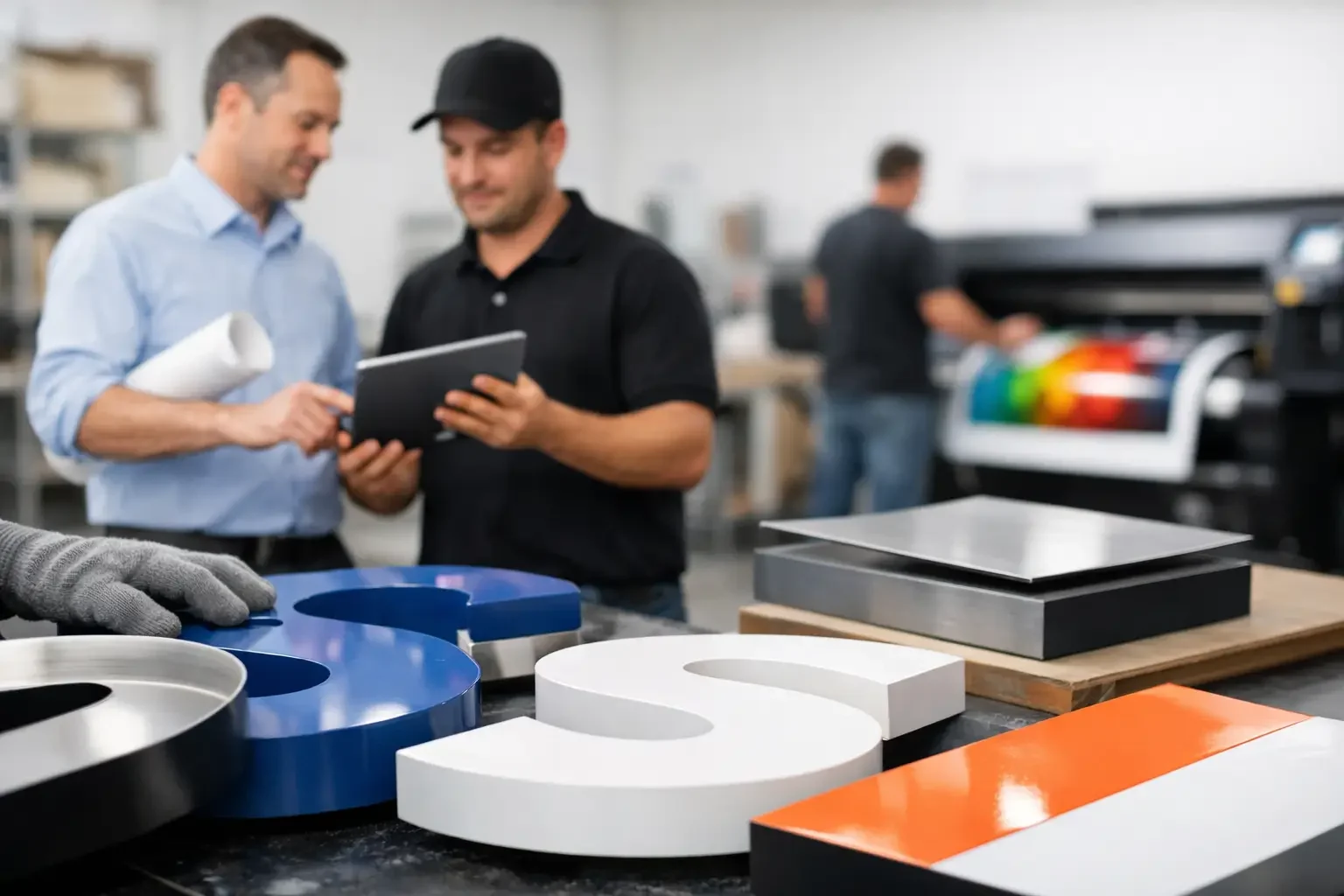
A smooth outsourced order starts with clear dimensions, artwork and mounting requirements. Missing information is much easier to resolve before the panel is routed or the letters are painted.
Agree on the supplied work and keep the approved instructions together. That gives your shop and the fabricator a common reference from quoting through delivery.
Start With a Buildable Scope, Not a Concept
A rendering or rough sketch is enough to start a quote discussion. We can help work through the size, thickness, lettering, texture and finish. Those details need to be confirmed before manufacturing.
For a carved HDU panel, discuss the thickness, background texture and whether lettering is raised, recessed or applied. For gold-colored details, we offer a gold-leaf appearance achieved with durable metallic gold paint. Your installer should also confirm the mounting requirements. Related: HDU thickness guide
The same discipline applies to routed letters. A production-ready request identifies letter height, face thickness, edge profile, finish, stud locations, pattern requirements, and whether returns, backers, or raceway components are involved. If the installer needs a drill pattern, specify that before production starts, not after the letters are packed.
A capable fabricator can identify gaps and ask the right questions. But repeated interpretation is not a substitute for a controlled scope. Every unresolved item increases the chance of revision, rework, or a component that technically matches the proof but does not work in the field.
Agree on the order, then approve the artwork
Keep the order agreement and artwork approval as separate steps. With us, you request a quote, agree to the order and pay, then approve the artwork/proof before manufacturing.
First, confirm the size, construction, finish and any supplied mounting parts. The price we quote includes your fully finished sign and shipping to your delivery address. Installation is not included or provided.
After payment, we prepare the artwork/proof for approval. Check the wording, layout, dimensions, colors and agreed construction details. We confirm the proof timing with you; do not book installation around an assumed same-day turnaround.
The third gate is fabrication release. At this point, material thickness, machine files, finish schedule, and any structural requirements must be locked. Changes after release may still be possible, but they should be treated as change orders with a documented cost and schedule effect. That is not rigid process for its own sake. It is how a production partner protects capacity and prevents one late revision from disrupting multiple jobs.
Confirm the delivery address, receiving hours, contact and unloading needs during quoting. Check them again before dispatch, especially if the jobsite arrangements have changed.
Convert Artwork Into Manufacturing Instructions
Sign professionals often receive customer artwork that is visually acceptable but unsuitable for routing, laser cutting, or finishing. Production files must be evaluated for vector quality, scale, minimum stroke widths, enclosed shapes, overlaps, and layer organization. A logo with hairline details may need adjustment before it can be machined cleanly in HDU or cut consistently from metal.
This is particularly important with dimensional signage. What appears as a subtle shadow in a rendering may require a separate backer, stand-off system, or layered fabrication approach. A brushed-metal appearance may call for real aluminum, painted HDU, or a laminated face depending on exposure, budget, and intended viewing distance. Those are different products with different production requirements.
Material selection should follow performance, not just appearance. HDU is valued for exterior durability, moisture resistance, and its ability to accept routed texture and dimensional detail. It is not a structural substitute for steel where long spans, wind load, or heavy mounted components are involved. When a sign system requires structural support, the HDU components should be designed around a properly fabricated frame, post system, or mounting substrate.
A production partner should also identify tolerances that matter in the field. Hole placement, panel alignment, stud length, mating surfaces, and frame dimensions all need practical tolerances based on the installation method. On a large multi-panel sign, a fraction of an inch across each component can become a visible alignment issue once the system is assembled.
Protect the Schedule With Real Production Visibility
A stated lead time is only useful when it reflects the full job, not just machine time. Routing may take hours, while hand finishing, paint curing, metal fabrication, inspection, and crating add days. Freight transit can add more variability, especially for oversize panels, palletized letters, and destination locations without a loading dock.
The right workflow establishes the required-in-hand date first, then works backward through installation, delivery, crating, finishing, fabrication, proof approval, and material procurement. This is more reliable than issuing a purchase order and asking for the fastest possible ship date.
It also helps to separate fixed milestones from flexible ones. An install date tied to a grand opening, inspection, tenant turnover, or franchise rollout is fixed. A color selection that remains under customer review is flexible until it begins to threaten production release. The buyer needs to know which open decisions are consuming schedule before the deadline becomes impossible.
For repeat orders, keep the approved dimensions, colors, artwork and mounting details together. Refer to that record when ordering another location and clearly identify anything that needs to change.
Inspect for Installability, Not Just Appearance
Quality control should verify more than paint coverage and surface finish. The real question is whether the component will install as expected. That means checking finished dimensions, routed depth, letter count, hardware, stud placement, frame geometry, mounting templates, and component labeling.
For multi-piece packages, labeling is operationally critical. Installers should be able to identify panels, letters, brackets, and hardware without opening every box or comparing loose parts to a proof on site. A simple marking system can prevent costly field delays, particularly when an installation crew is working after hours or coordinating with other trades.
Packaging is part of quality control as well. Routed HDU faces need protection from abrasion and edge damage. Dimensional letters need spacing that prevents face-to-face contact. Structural components must be blocked and secured so they do not shift inside a crate. Freight-safe packaging is not cosmetic. It is the final production operation before the job enters a handling environment the fabricator cannot control.
When damage or a discrepancy does occur, documentation matters. Photographs of the package, labels, damaged areas, and receiving conditions create a faster path to resolution. More importantly, they reveal whether the failure occurred in fabrication, packing, carrier handling, or jobsite receiving.
Measure the Workflow by Margin, Not Purchase Price
The lowest initial quote is not always the lowest production cost. A supplier with unclear proofs, inconsistent tolerances, weak packaging, or unpredictable communication can create expensive internal labor: project management time, customer explanations, emergency remakes, expedited freight, and installer callbacks.
Evaluate outsourced production against the cost of owning the work internally and the cost of recovering from mistakes. Consider the hours your team spends preparing files, routing, sanding, painting, assembling, packing, and solving exceptions. Then consider whether your shop has the equipment, floor space, finishing capacity, and shipping discipline to produce the same result consistently during peak volume.
Your shop can manage the customer, local requirements and installation while we manufacture the agreed HDU panels or dimensional components. Send the design and quantity so we can discuss the work we can supply.
Before moving to the next stage, make sure the previous decision is recorded: order agreed and paid, artwork approved, manufacturing completed, then shipment arranged. Clear approvals make questions easier to resolve.