
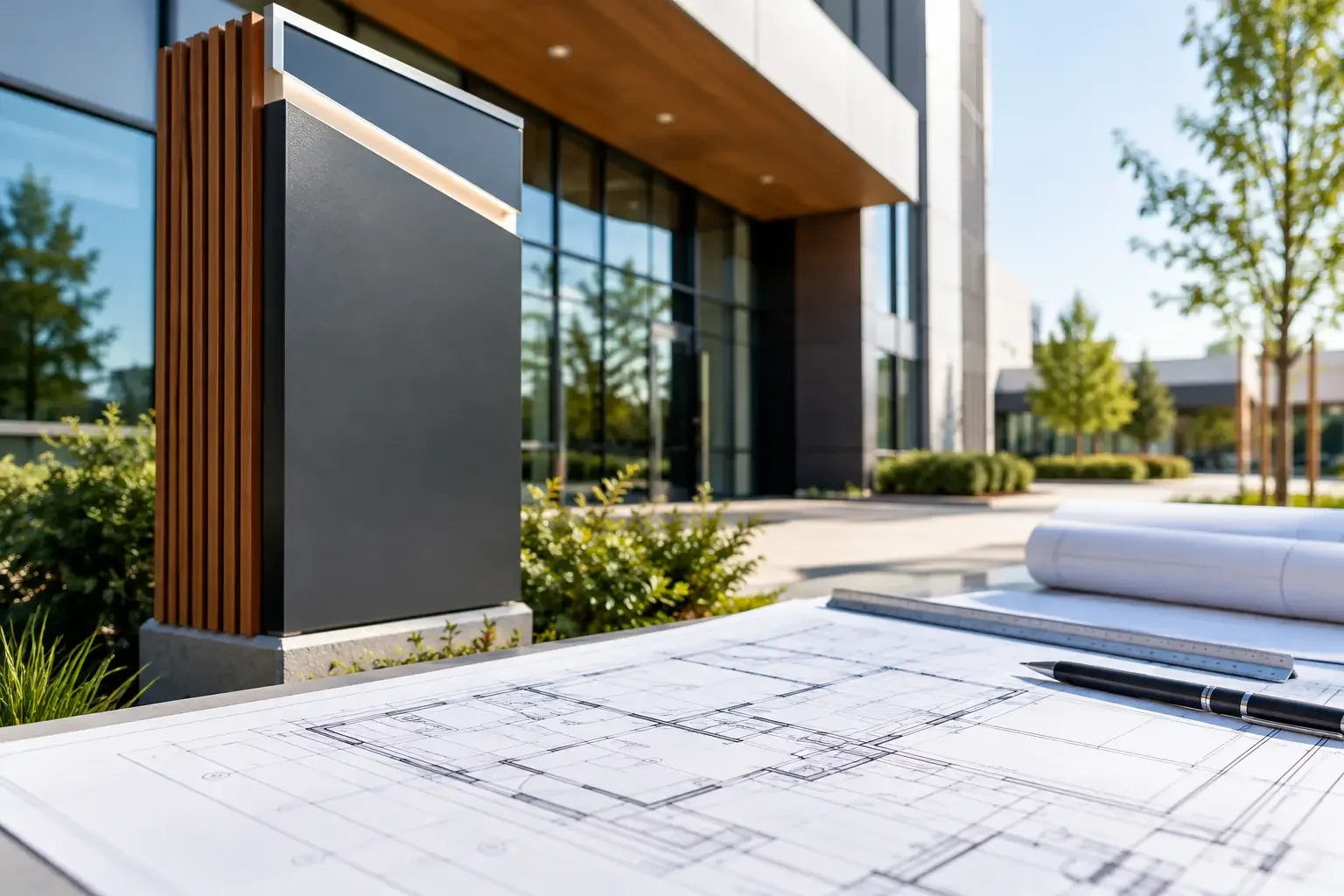
A sign can look correct on a rendering and still fail in fabrication, freight, or installation. That gap is usually created by incomplete architectural sign specifications. For sign shops, estimators, architects, and commercial buyers, the specification package must do more than describe the intended appearance. It must establish a buildable system: material, thickness, copy construction, finish, mounting, structural support, and shipment requirements.
When those details are resolved before production, dimensional signage moves through quoting, fabrication, and field installation with fewer change orders. When they are left open to interpretation, the cost typically returns as rework, schedule pressure, and margin loss.
What Architectural Sign Specifications Must Control
A useful sign specification is not a catalog description. It is a production document that tells the fabricator what must be built and tells the installer what must be supported. It should define visible requirements and hidden conditions with equal care.
At minimum, the package needs coordinated drawings, a sign schedule, elevation details, color and finish callouts, mounting details, and location information. A message such as “HDU monument sign, painted” is not enough for an accurate quote. The fabricator still needs the overall panel size, thickness, edge profile, copy depth, paint system, post arrangement, and whether the project requires a freestanding structure, masonry attachment, or concealed raceway.
The goal is precision repeatability. If a development has twelve tenant signs, three monument signs, and multiple wayfinding panels, the specification should prevent each item from becoming a separate interpretation of the same design intent.
Start With the Sign Type and Performance Requirement
Identify the sign category first: wall-mounted dimensional letters, routed panel, monument, pylon cabinet, directory, wayfinding blade, or post-and-panel system. Each category carries different structural and fabrication requirements.
A low-profile HDU panel mounted beneath a covered entry can be engineered very differently from a freestanding sign exposed to wind, irrigation, lawn equipment, and direct sun. A monument sign may require internal steel, aluminum composite faces, routed HDU overlays, concrete footings, or a combination of these components. The visual face material does not always carry the load.
Specifications should state the intended service environment. Exterior exposure, coastal conditions, high-traffic public areas, and locations subject to vandalism or vehicle impact may require heavier-gauge metal, upgraded finishes, protective clear coats, or a separate structural barrier. The right material depends on the job, not on a generic preference.
Specify Materials by Function, Not Appearance Alone
HDU is a strong architectural choice because it is moisture resistant, dimensionally stable, and capable of deep routed relief or sandblasted texture without the cracking and rot associated with wood. But “HDU” is still incomplete as a material specification.
Call out density, panel thickness, finished dimensions, and construction method. Lower-density material may be appropriate for lightweight decorative applications, while thicker, denser HDU is often better suited to large routed panels, dimensional backgrounds, and exterior signs that need crisp detail and long-term stability. A 1-inch routed panel and a 2-inch sandblasted panel do not perform or price the same way.
Where letters or logos are applied to an HDU background, define each component separately. Identify whether copy is flat-cut, prismatic, raised, recessed, or push-through. State letter thickness, edge treatment, return depth where applicable, and attachment method. This prevents a common quoting problem: a drawing indicates dimensional copy, but no one has identified whether the letters are painted HDU, acrylic, aluminum, PVC, or fabricated metal.
Metal should be specified where strength, span, or mounting loads require it. Aluminum is frequently selected for corrosion resistance and manageable weight. Steel can provide structural reinforcement in monuments and frames when properly protected. A fabrication partner should be able to combine routed HDU faces with welded metal support components, rather than treating the sign face and the structural system as unrelated scopes.
Do Not Leave Thickness or Edge Detail to Assumption
Thickness drives more than appearance. It affects routing depth, weight, mounting hardware, crating needs, and the visual shadow line after installation. It also affects whether a panel can remain flat at larger sizes without intermediate support.
Likewise, edge details need a written callout. A square edge, eased edge, routed border, V-groove, or sandblasted background produces a different fabrication path. If the design requires a carved look, identify the background depth and the required relief of raised copy. If the perimeter receives a contrasting color, show exactly where that color breaks.
For projects with a branded prototype, include a reference sample or approved photograph. Drawings control dimensions; physical references often clarify texture, sheen, and the degree of hand-finished appearance expected.
Finish Specifications Need Measurable Direction
Color names are not finish specifications. Provide standard color references when available, and identify whether the finish is matte, satin, semi-gloss, gloss, metallic, textured, or distressed. A painted HDU face with satin raised copy reads differently than the same colors in full gloss.
Exterior coating systems should match exposure and service life expectations. A basic paint treatment may suit a protected location or short-term program. A commercial monument or multi-site brand rollout generally deserves a premium exterior-grade finish system with proper surface preparation, primer, topcoat coverage, and controlled curing.
If the sign includes simulated wood grain, sandblasted texture, antiqued edges, or faux metal effects, define the acceptable variation. These finishes are intentionally less uniform than a solid-color panel, but they should still be repeatable across a sign family. Establish an approved standard before the production run begins.
Mounting Details Are Part of the Product
Mounting is where many otherwise complete sign packages break down. The sign face may be fully dimensioned while the field team receives no clear direction on how it attaches to the wall, posts, or footing.
Specify mounting hardware, stud locations, rail systems, stand-offs, concealed brackets, post sizes, and base connections. For wall signs, confirm the substrate: masonry, EIFS, metal panel, wood framing, tilt-up concrete, or another condition. The mounting approach for a routed HDU plaque on brick is different from dimensional letters installed over insulated metal panels.
For freestanding signs, coordinate the structural frame and foundation requirements early. Post diameter, wall thickness, embedment, internal reinforcement, and footing dimensions should be reviewed against local wind loads and site conditions. The sign manufacturer can fabricate an install-ready assembly, but the final structural and permitting requirements may depend on jurisdiction, engineer review, and the actual site.
It is also smart to specify how hardware will be delivered. Loose components, labeled mounting templates, predrilled holes, welded attachment points, and packaged hardware kits can save hours in the field. They also reduce the installer’s incentive to improvise around a missing detail.
Write Specifications That Quote Cleanly
A bid-ready package protects both the buyer and the fabricator. It allows comparable quotes and reduces the number of assumptions buried in exclusions. The most effective sign schedule identifies each sign type, quantity, dimensions, materials, finish, copy treatment, illumination if any, mounting method, and shipping destination.
For custom work, include artwork files with usable vector paths and clearly marked scale. A beautiful PDF rendering may not contain production-ready geometry. If logos, tenant names, or messages will change across locations, identify the variable fields and establish a consistent layout rule.
Freight deserves a line item in the planning process, particularly for large HDU panels, welded frames, and multi-piece monuments. Specify whether the shipment must arrive crated, palletized, labeled by sign location, or sequenced by installation phase. A factory-built component is only profitable if it arrives intact and can be identified on site without opening every crate.
Wholesale HDU Signs approaches these requirements as fabrication controls, not paperwork. Accurate inputs allow CNC routing, finishing, structural fabrication, and freight packaging to be planned as one production workflow.
Review for Conflicts Before Release
Before issuing the package for production, compare the drawings, sign schedule, renderings, and installation details side by side. Look for conflicting dimensions, finishes that differ between sheets, copy shown as raised in one view and flat in another, and mounting hardware that has no corresponding structural support.
This review is especially valuable when architectural teams, branding agencies, sign contractors, and property owners have each contributed information. Someone must own the final production intent. A fabricator can flag buildability concerns, but cannot reliably resolve a conflict that the project team has not decided.
The best architectural sign specifications make the finished result predictable before the first toolpath is created. That is where durable signage, clean installations, and protected project margins begin.