
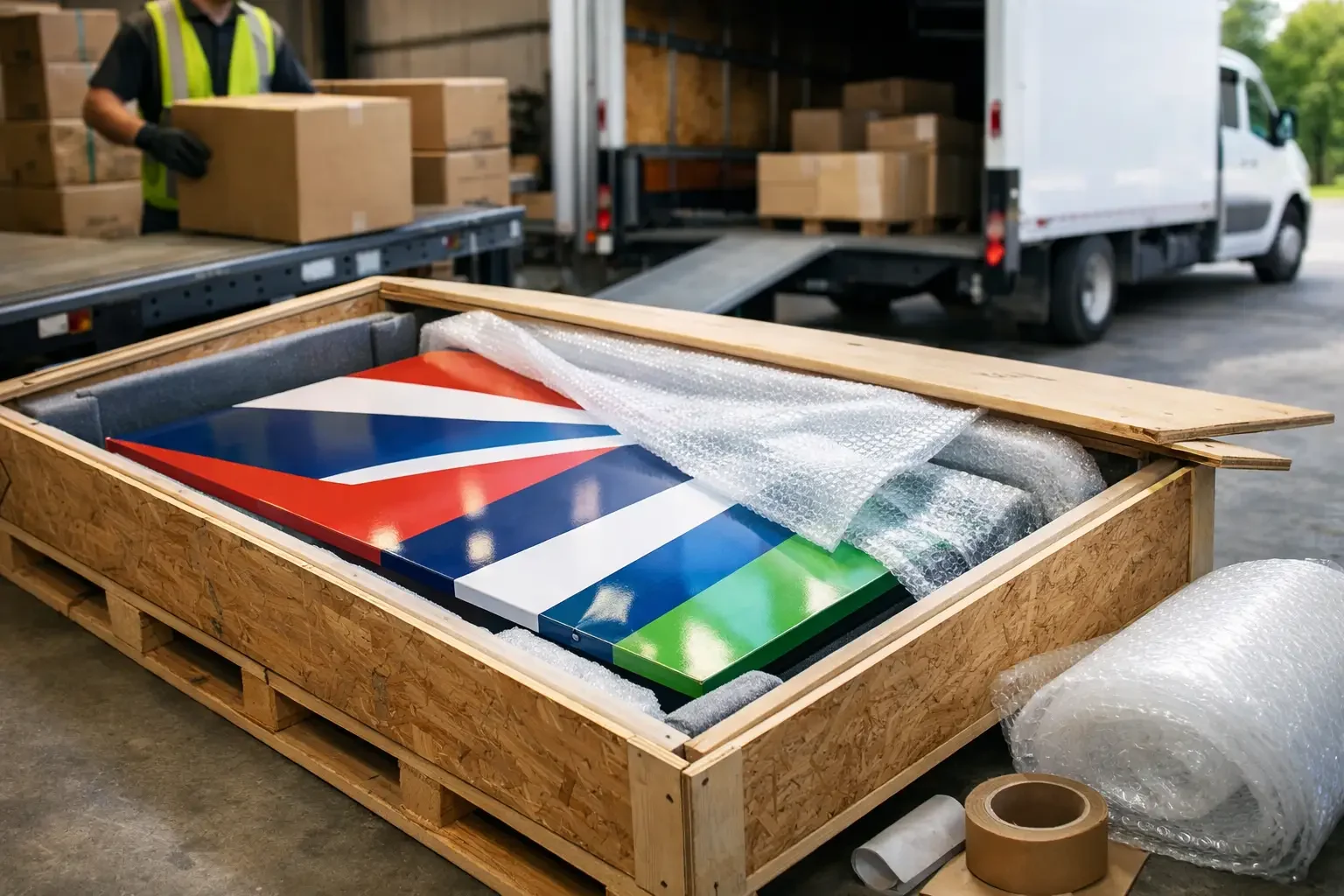
A finished sign needs protection all the way from our workshop to your delivery address. Raised letters, painted faces and projecting corners can be damaged by a loose part or a poorly supported crate. We plan the packaging around those vulnerable details before shipment.
For dimensional HDU signage, the risk is not limited to total loss. Corner impacts, crushed crate rails, finish abrasion, cracked raised elements, bent steel support components, and missing hardware can all create field delays. The correct shipping plan protects the fabricated assembly, gives the carrier clear handling instructions, and gives the receiving party a defensible process for documenting damage before the truck leaves.
Large Format Sign Shipping Begins at the Design Stage
Freight protection is most effective when it is considered before the sign enters production. Overall dimensions, thickness, panel shape, relief depth, weight distribution, hardware projection, and finish type all affect how a piece should be packaged and moved.
A flat HDU panel with painted copy may ship safely in a reinforced face-to-face pack or a standard custom crate. A tall routed panel with applied letters, sculpted relief, or projecting metal elements may require a deeper crate, internal blocking, and a protected no-contact zone around the face. When the product has dimensional features, the crate must support the assembly at structural points rather than allowing pressure to transfer through finished lettering or decorative details.
This is where production coordination prevents avoidable expense. A fabricator should know whether the shipment is going to a commercial dock, a jobsite, a sign shop, or a residential-style location with limited truck access. A 12-foot architectural sign panel may be straightforward to load at a dock but difficult to unload at a site without a forklift, liftgate capacity, or a clear staging area.
The shipping method also affects fabrication decisions. Removable mounting components, separated post systems, protected stud packages, and field-assembled trim can reduce crate size and limit transit risk. That approach is not always the right choice. More field assembly can reduce freight cost, but it also shifts labor and installation responsibility to the receiving crew. The right balance depends on the project schedule, installer capability, and tolerance for field fit-up.
Build the Crate Around the Actual Failure Points
A crate is only effective when it is engineered for the load inside it. Oversized empty space allows a sign to shift. Undersized packaging puts pressure on vulnerable edges. Thin lumber may look adequate at pickup but fail when a shipment is double-stacked, moved repeatedly through terminals, or exposed to fork impacts.
For large-format fabricated signs, crating should account for the assembly's center of gravity and its most damage-prone features. Internal blocking should immobilize the product without marring the finish. Protective foam, padded contact points, edge guards, and isolated hardware packs all serve different purposes. They are not interchangeable.
HDU is a strong exterior sign substrate with excellent machining characteristics, but finished panels still require disciplined handling. Deep-routed areas, sharp corners, raised copy, and painted surfaces need protection from concentrated force and rubbing. If steel frames, aluminum trim, or routed letters are included, those components must be restrained independently. A loose bracket inside a crate can do more damage than a rough carrier ride.
A freight-ready crate should also provide practical handling direction. Clearly marked fork pockets or lift points help prevent improper lifting. Center-of-gravity markings are useful for uneven assemblies. Labels such as "Do Not Stack," "This Side Up," and "Fragile Finished Surface" do not replace structural protection, but they give warehouse personnel information they need before moving the load.
For high-value or unusually large units, exterior protection may include corner reinforcement, banding, weather-resistant wrapping, and a skid designed for the anticipated equipment. A skid that cannot be safely lifted is not a shipping base. It is a liability transferred to the next handler.
Choose Freight Service Based on Risk, Not Just Rate
The lowest freight quote is rarely the lowest delivered cost. Standard LTL service can be a practical option for crated sign components moving to a commercial location with a dock or forklift. It also involves multiple terminal transfers, repeated loading events, and greater exposure to handling damage.
When a shipment is oversized, highly finished, time-sensitive, or headed to a difficult site, a dedicated truck, partial truckload, or direct service may be worth the additional cost. Fewer transfers usually mean fewer opportunities for damage. The premium can be justified when replacement would delay an opening, inspection, tenant move-in, or scheduled installation crew.
Accessorial requirements must be identified before dispatch. Liftgate service, appointment delivery, limited-access delivery, jobsite delivery, inside delivery, and notification calls can all change the cost and execution plan. Do not assume a carrier will provide unloading equipment or wait while a crew searches for a forklift.
Accurate shipment data matters as well. Provide final crate dimensions, weight, piece count, consignee contact information, site restrictions, and the correct delivery hours. Understated dimensions or weight can produce reclassification charges and billing disputes after delivery. Missing contact information can result in storage fees, redelivery charges, or freight sitting at a terminal while an installation date slips.
Documentation Protects the Claim and the Schedule
Good packaging reduces damage. Good documentation controls what happens if damage occurs.
Before release, photograph the finished sign, its protected surfaces, the internal crate arrangement where practical, the closed crate, labels, and final condition at pickup. These photos establish that the item left the factory complete and properly packaged. They are also useful for confirming component count and orientation when the crate reaches the field.
The bill of lading should match the shipment precisely. The carrier, consignee, piece count, crate dimensions, weight, declared handling requirements, and delivery instructions should be consistent across production paperwork and freight documents. If a job includes multiple crates, label each unit clearly by sequence and identify which hardware or sign component it contains.
Receiving procedures matter just as much. The consignee should inspect the exterior before signing a clean delivery receipt. If there is visible damage, punctures, broken bands, crushed corners, water exposure, or evidence of mishandling, the receipt should be marked with specific exceptions. "Damaged crate, puncture on sign face side" is useful. "Subject to inspection" is often too vague to support a strong claim.
A practical receiving process includes four actions:
- Photograph all exterior damage before the driver departs.
- Record specific damage or shortage exceptions on the delivery receipt.
- Open and inspect the crate as soon as practical, especially when packaging is compromised.
- Report concealed damage immediately with photos, shipment details, and retained packaging.
Do not discard damaged packaging until the claim process is complete. The crate, padding, bands, and blocking may be evidence of how the damage occurred. Carriers may inspect the materials before resolving a claim.
Coordinate the Receiving Site Before the Truck Arrives
Many freight problems happen at the last 100 feet. A carrier may arrive with a long trailer at a site with narrow access, soft ground, restricted turning space, or no unloading equipment. The product may be intact, yet the crew still faces an unsafe unload or an expensive redelivery.
Confirm who will receive the shipment, what equipment is available, where the crate will be staged, and whether the route from truck to storage area is clear. For large panels, the receiving crew should know the crate dimensions and weight before delivery day. That allows them to plan for forklifts, pallet jacks, rigging, labor, and weather protection.
If the sign is moving directly to an installation site, keep it crated until the crew is ready to inspect and install it. Uncrating a finished HDU panel days early and leaning it against a wall creates a new set of damage risks. Store the product on stable, supported surfaces and protect it from standing water, jobsite traffic, and unsecured materials.
Shipping Is Part of the Fabrication Standard
We plan the packaging around the finished sign, including its size, raised details and any supplied hardware. The price we quote includes your fully finished sign and shipping to your delivery address. Tell us about delivery access and unloading needs before we finalize the quote.
Arrange a receiving contact and suitable unloading equipment before delivery. Check the packaging when it arrives, photograph any damage and contact us promptly if something is wrong. We manufacture and ship custom HDU signs nationwide. Installation is not included or provided.