
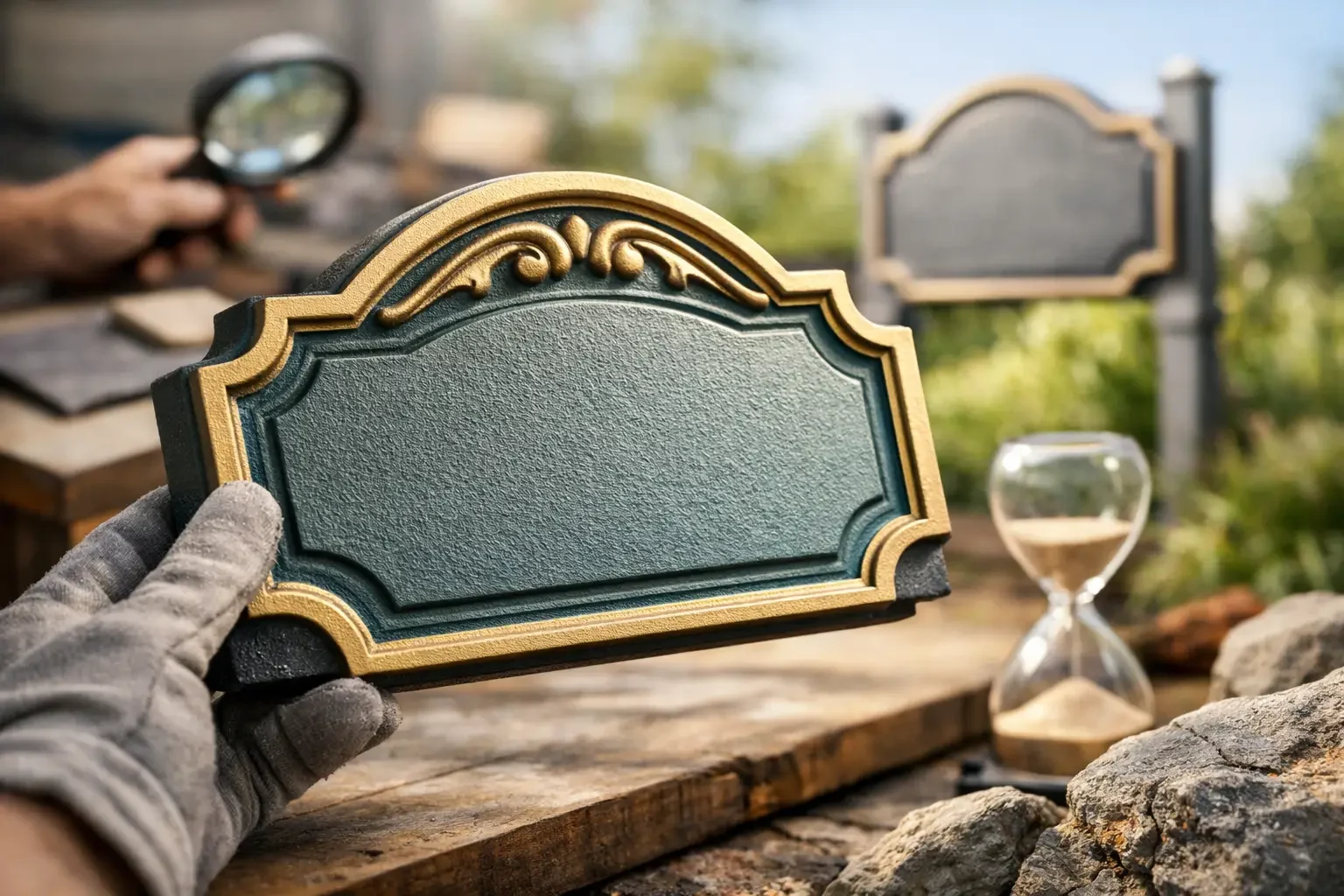
An HDU sign’s useful life depends on its finish, design, mounting and exposure as well as the material itself. A well-made panel still needs suitable support and occasional care once it is outside.
High-density urethane is widely specified for exterior dimensional signage because it does not rot, swell, or delaminate like wood-based substrates. It can hold routed detail, sandblasted texture, and raised copy while remaining substantially lighter than many alternative materials. Still, HDU is not maintenance-free and it is not indestructible. Service life depends on how the sign is engineered and finished before it ever reaches the jobsite.
What Is the Expected HDU Sign Lifespan?
A properly finished and installed HDU sign can give many years of service. There is no single lifespan that applies to every sign: direct sun, weather, accidental damage and maintenance all affect how long the finish and the complete assembly remain in good condition.
That range is not a warranty term or a universal rule. A monument sign in coastal Florida, an unshaded cabinet face in Arizona, and a wayfinding panel in a protected corporate campus all experience different weather loads. The useful question is not simply, “How long does HDU last?” It is, “What will this particular sign system face over its service life?”
HDU resists the moisture damage associated with wood. Coating wear, impact damage and problems with mounting or adjoining materials can still shorten the life of the sign. Good fabrication, suitable installation and regular checks all help.
The Main Factors That Determine HDU Sign Lifespan
Density and panel thickness
HDU is available in multiple densities, and the correct selection depends on the fabrication method and application. Lower-density material can be suitable for some protected dimensional elements, while higher-density HDU is generally preferred for exterior routed panels, sandblasted signs, and components that need improved edge durability.
Thickness matters just as much. An underspecified panel may flex under wind load, especially when installed between posts or used in a large-format freestanding sign. Repeated flexing can stress coatings, fasteners, seams, and applied elements. The panel should be sized for its span, mounting points, face treatment, and local exposure rather than chosen solely on initial material cost.
Coating system and surface preparation
The finish is the primary environmental barrier. HDU requires a compatible primer and exterior-grade coating system that fully seals routed areas, blasted texture, edges, and back surfaces. Incomplete coverage can leave vulnerable areas where moisture, dirt, and thermal cycling accelerate finish failure.
Detailed sandblasted backgrounds and deep CNC-routed copy require additional attention because their profiles create more surface area. Coating must reach the bottom of grooves, inside sharp corners, and around raised copy. A finish that appears uniform from several feet away can still have thin spots in recessed areas.
For high-UV installations, topcoat selection is especially important. Strong sun exposure eventually dulls gloss, fades certain colors, and reduces coating flexibility. Lighter colors and high-quality exterior coatings generally hold up better than dark, highly saturated colors exposed to constant direct sun. If brand standards require a difficult color, specify the finish accordingly and set realistic maintenance expectations.
Sign design and water management
HDU does not absorb water in the same way as wood, but water still matters. It can enter joints, collect behind applied letters, work into fastener penetrations, and affect adjacent materials such as wood trim, steel frames, or mounting hardware. Poor water management turns a durable panel into part of a failure-prone assembly.
Design details should give water a path to drain and dry. Avoid horizontal ledges that trap standing water. Use properly sealed penetrations. Where an HDU face connects to metal, use compatible sealants and fastening methods that account for movement between materials. Exposed seams, caps, and trim transitions should be designed as exterior assemblies, not treated as cosmetic afterthoughts.
Large signs may require internal structure or a metal frame. HDU has excellent stability for a foam-based sign substrate, but it is not intended to function as the sole structural member in every application. When signs become large, carry heavy applied elements, or face high wind exposure, structural reinforcement protects both appearance and service life.
Mounting and hardware
Many premature field failures begin at the mounting point. Fasteners that are too close to an edge, too small for the load, or improperly sealed can damage the panel and allow movement. Over-tightening is another common problem. HDU should be mechanically secured without crushing the material or creating a stress point that eventually telegraphs through the finish.
Post-mounted, wall-mounted, and monument applications all need different engineering. A wall sign may require stand-offs and a layout that avoids concentrated loads. A post-and-panel sign needs sufficient panel thickness, rail support, and controlled attachment locations. A monument face must account for frame movement, access for service, and water exposure at the base.
For sign shops and contractors, install-ready fabrication reduces risk here. Predrilled locations, embedded reinforcement where required, accurate hardware layouts, and clear mounting provisions help eliminate improvised field modifications that can compromise the finished system.
Exposure Conditions Change the Specification
Not every exterior sign needs the same build. A commercial buyer in a mild inland environment may prioritize a clean architectural finish and efficient production. A project near saltwater, in high desert sun, or in a freeze-thaw market needs more attention to coating performance, frame material, edge sealing, and hardware selection.
Coastal applications require corrosion-resistant metal components and careful separation of dissimilar materials. Salt residue can degrade coatings and hardware faster than typical inland exposure. Desert and southern exposures place a heavier UV and heat load on dark finishes. Northern climates introduce freeze-thaw cycling, snow removal risk, and the potential for water to sit in joints before freezing.
High-traffic locations add another factor: impact. HDU is durable for architectural signage, but it can be dented or gouged by vehicles, landscaping equipment, carts, or vandalism. If a sign face sits near parking lanes, loading areas, or mower paths, physical protection may be more valuable than simply increasing panel density.
Maintenance That Protects Long-Term Performance
HDU signs do not require the recurring scraping, filling, and repainting often associated with carved wood signage. They still benefit from routine inspection. A property manager or facilities team should periodically wash accumulated grime with a mild cleaner, inspect the finish for chips or cracking, and check hardware, sealant joints, and adjacent metal components.
Small coating damage should be repaired before it spreads or exposes an edge to repeated weathering. This is particularly relevant around fasteners, lower edges, and raised copy. Maintenance intervals depend on climate and exposure, but annual visual inspection is a practical baseline for commercial exterior signs.
Avoid aggressive pressure washing at close range. High-pressure water can damage coatings, force water into seams, and loosen applied elements. Use controlled cleaning practices that match the sign's finish and installed construction.
Fabrication details that help a sign last
Two HDU signs can use the same nominal material and perform very differently over time. One may have clean CNC routing, fully sealed edges, correctly designed reinforcement, compatible coatings, and protected shipping. The other may leave the shop with thin paint in recesses, weak attachment points, unsealed penetrations, or damage hidden beneath touch-up paint.
Discuss panel dimensions, thickness, routing detail, finish and delivery arrangements with the signmaker. Have your installer confirm the mounting requirements and any structural work needed at the site before the sign is manufactured.
We make fully finished HDU signs and ship them to your delivery address, with shipping included in the quoted price. Your sign is covered by our 5-Year Workmanship Warranty. Installation and any structural work are handled by your local installer or contractor. Related: Dimensional letters
Tell us where the sign will go and how it will be mounted when you request a quote. After installation, check the finish and mounting periodically and deal with damage promptly. That care helps the sign keep looking its best.