
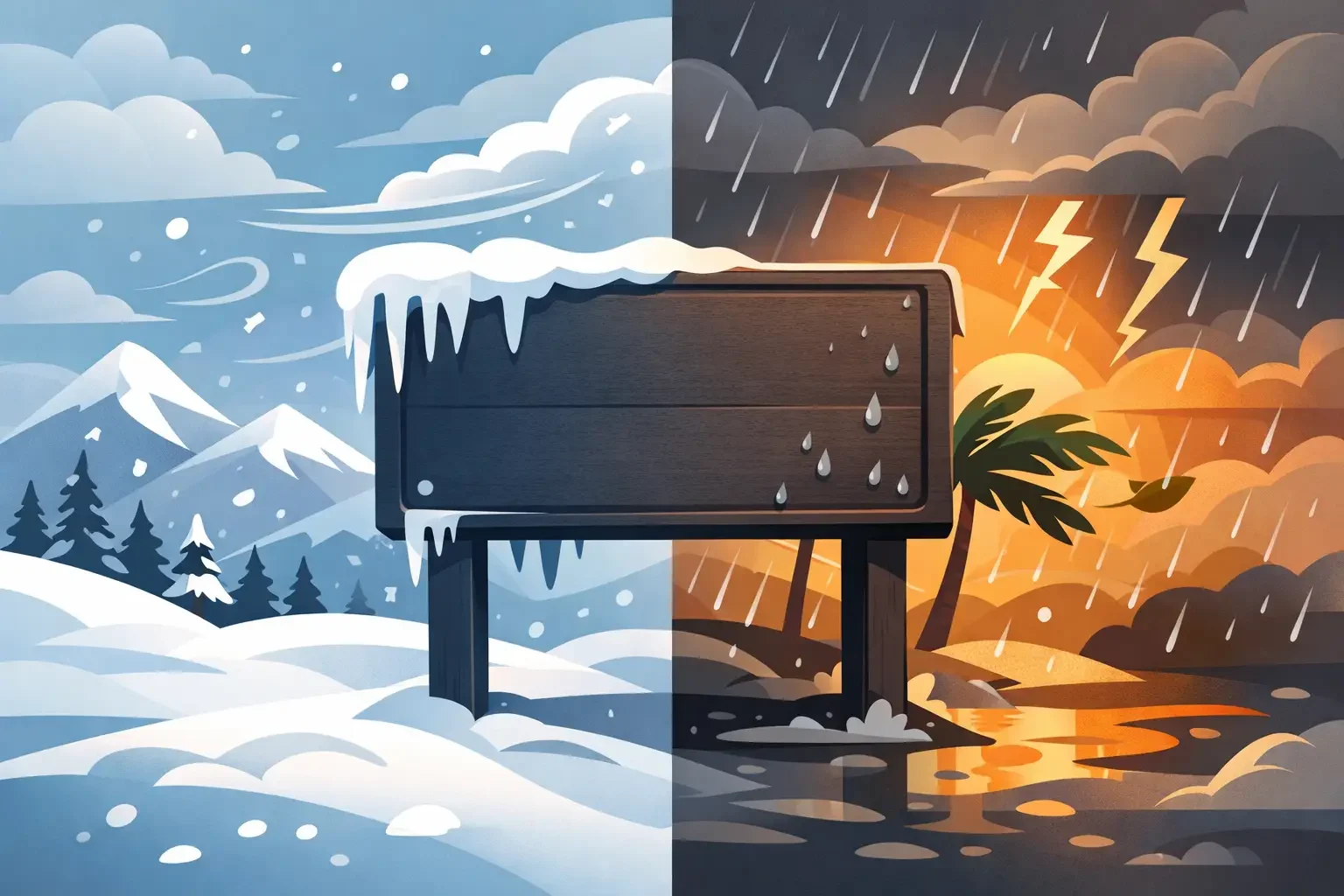
HDU is used for outdoor signs, but extreme exposure needs careful planning. A coastal entrance, a sun-facing wall and a snowy roadside location place different demands on the paint, hardware and supporting structure. Tell us about the setting when you request a quote.
High-density urethane is widely used for dimensional exterior signage because it does not absorb water like wood, will not rot, and is not susceptible to insect damage. Those advantages are real. They do not mean every HDU sign is automatically suited for every climate or exposure condition. The difference between a sign that holds its appearance for years and one that develops finish failures, movement, or mounting issues usually comes down to production control.
What HDU Handles Well Outdoors
HDU’s closed-cell structure gives it low water absorption and resistance to rot. Rain, snow and repeated freezing can still affect the finish, joints, hardware and supporting structure, so the whole sign needs to be suited to the location.
This is especially useful for sandblasted signs, carved panels, routed letters, and dimensional monument faces where a wood look is desired without the maintenance exposure of real wood. HDU can be CNC routed to consistent depths, shaped for dimensional copy, and finished with textures that hold coatings well when the preparation is correct.
HDU also performs well in temperature swings because it does not expand and contract at the same rate as many metals. That does not eliminate movement from the total sign assembly. A large HDU panel attached to an aluminum frame, steel support structure, or masonry wall still requires mounting methods that account for the materials around it.
The material's weather resistance is also different from impact resistance. HDU is durable for its intended use, but it is not structural steel, aluminum plate, or solid hardwood. A panel may tolerate years of rain and UV exposure yet still be vulnerable to direct vehicle strikes, repeated abuse, or unsupported spans in high-wind locations.
Can HDU Signs Handle Extreme Weather in Every Climate?
They can perform reliably in severe climates, but the specification must match the exposure. Extreme weather is not one condition. It can mean sustained UV and high heat in Arizona, wind-driven rain on the Gulf Coast, salt exposure near the ocean, deep freeze-thaw cycles in the Midwest, or heavy snow loads in mountain markets.
High Heat and UV Exposure
Direct sunlight is usually harder on finishes than on the HDU substrate. Extended ultraviolet exposure can fade pigments, chalk lower-grade coatings, and weaken an improperly prepared paint film. Dark colors add another variable because they absorb more heat, increasing surface temperatures on exposed faces.
For high-UV projects, use an exterior-grade coating system designed for architectural signage, not an interior or light-duty craft finish. Proper priming is essential, particularly on routed edges, deep carved areas, and textured surfaces where coating coverage can be inconsistent. A quality topcoat and clear coat, when appropriate to the finish system, protect color retention and make maintenance more manageable.
Very large panels in full sun deserve extra engineering attention. Heat can affect adhesive joints, trim details, and dissimilar-material assemblies even when the HDU itself remains stable. Mechanical fastening and adequately designed framing are preferable to relying on adhesives alone for major exterior components.
Rain, Humidity, and Freeze-Thaw Cycles
Unlike wood, HDU does not wick water into grain lines or end cuts. That makes it a strong candidate for wet climates and signs exposed to recurring precipitation. Still, water can find its way behind faces, into mounting pockets, around fasteners, and between layered components.
The practical concern is not usually the panel swelling. It is corrosion at unprotected metal hardware, coating failure at joints, or trapped water behind the sign. Use compatible exterior fasteners, seal penetrations where the system requires it, and avoid details that create standing-water shelves. A clean drainage path is a fabrication and installation requirement, not an afterthought.
Freeze-thaw conditions place additional stress on any water trapped in seams or fastener locations. For this reason, fabricated joints should be tight, finished consistently, and designed so water does not sit against exposed backing materials or structural components.
Coastal Salt and Wind-Driven Moisture
Coastal exposure calls for a system-level specification. HDU offers a major advantage over wood because moisture does not create rot, but salt air can still attack steel, inferior fasteners, exposed hardware, and coating defects.
Use corrosion-resistant hardware and properly protected steel reinforcement. If metal is embedded in or attached to an HDU assembly, its finish and isolation from moisture matter. For severe coastal projects, material callouts should identify the structural metals, fastener grade, coating system, and drainage approach before fabrication begins.
Wind is a separate design load. An HDU sign face can be appropriate in high-wind regions, but the substrate should not be expected to carry loads that belong to the frame, posts, monument structure, or wall attachment system. Large freestanding signs require engineered support design based on panel area, elevation, local code, and site exposure.
Snow, Ice, and Physical Exposure
In snowy locations, plan for accumulated loads and impact from plows or maintenance equipment. Thin raised lettering, narrow projections and deep unsupported relief need particular attention where ice or frequent contact is expected.
This is where a production-minded design review pays off. Increasing letter stroke width, reducing unsupported projections, using metal reinforcement where appropriate, or shifting vulnerable features out of traffic zones can preserve the intended look without creating a field-repair problem.
The Fabrication Details That Determine Service Life
Weather performance is driven by the full build, not simply by ordering HDU. A sign shop or commercial buyer should evaluate the following points during quoting and submittal review:
- HDU density and thickness: Higher-density material generally provides a firmer surface for detailed routing, sandblasting, dimensional letters, and exposed exterior faces. Thickness must match the panel size, relief depth, mounting method, and reinforcement plan.
- Finish specification: Primer, paint, texture coat, metallic finish, and clear coat must be compatible. The finish schedule should cover faces, edges, routed cavities, and reverse-side details that may see moisture.
- Structural design: HDU is a sign substrate, not a substitute for engineered steel or aluminum. Large signs, cantilevered components, and high-wind installations need an appropriate internal frame or external support system.
- Fastening and hardware: Fasteners should suit the exposure and the receiving structure. Blind attachment methods may improve appearance, but they still need sufficient pullout capacity and service access where required.
- Freight protection: A well-fabricated sign can arrive compromised if dimensional elements are not blocked, crated, and protected for transit. Packaging is part of production quality for large routed panels and install-ready assemblies.
Precision repeatability matters most on multi-location programs. If a franchise package includes dozens of HDU monument faces, dimensional logos, or routed letter sets, every component must follow the same depth, finish, mounting pattern, and packing standard. Variation creates installation delays and margin-eroding field fixes.
When HDU Is Not the Best Material Choice
HDU is not the right answer for every exterior sign. If the project requires a thin panel with significant structural span, exposed metal performance, extreme impact resistance, or a very high-traffic environment where contact is likely, aluminum, steel, acrylic, polycarbonate, or a hybrid assembly may be more appropriate.
Likewise, a low-density HDU blank may not be the best choice for fine detail, deep carving, or demanding public-facing applications. Density selection should be based on the finish and fabrication process, not only on initial cost. Saving money on material can create more labor in finishing, a weaker edge condition, or a sign that does not meet the expected commercial standard.
For major monument programs, the strongest approach is often a hybrid: HDU provides the carved or dimensional face, while fabricated metal handles the structural load path. This allows the project to retain the visual depth and texture of HDU without assigning structural responsibilities to the decorative substrate.
Specify the Exposure Before the Sign Is Built
A reliable HDU sign begins with accurate job information. Identify whether the sign will face full southern sun, sit near a coastal roadway, mount to an existing steel frame, or stand in a snowplow zone. Provide panel dimensions, desired relief depth, paint requirements, attachment conditions, and any local wind-load requirements during the quoting stage.
We review the sign’s routing, finish and packing requirements for the agreed order. Your local installer or engineer must confirm the supporting structure and attachment for the site. We manufacture and ship custom HDU signs nationwide. Installation is not included or provided.
Send photographs of the location and describe the sun, moisture, wind and physical contact the sign may face. These details help us discuss a suitable sign face and finish before manufacturing.