
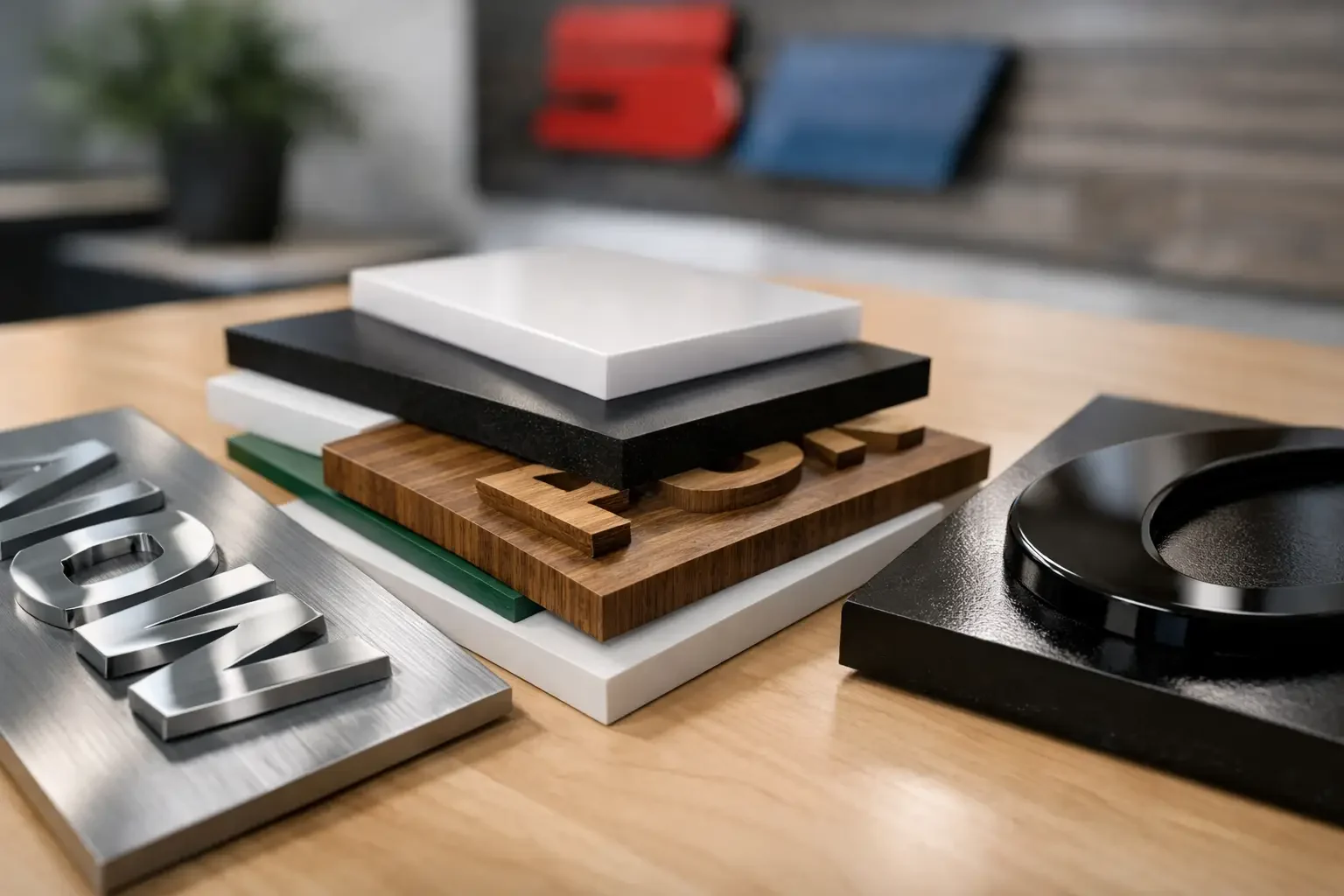
Choosing a material starts with the sign you want to make: its depth, lettering, finish and location. A sheltered reception logo and a large outdoor entrance panel have different needs. Here are the practical differences to discuss before ordering.
HDU is useful for routed exterior signs because it has a uniform structure, resists water absorption and does not rot like wood. Acrylic, metal and wood also have suitable applications. The right choice depends on the design, exposure, support and finish.
What Determines the Best Substrate for Dimensional Signs?
The substrate is the structural body of a dimensional letter, logo, plaque, or panel. Buyers often focus first on thickness and color, but the production questions are more consequential: Does the material hold a crisp routed edge? Can it accept the specified finish? Will it stay stable outdoors? Can it be pinned, stud-mounted, or mechanically fastened without failure? Is the weight practical for the wall system and installation crew?
Exterior exposure is usually the first filter. Materials that absorb water can swell, split, delaminate, or create coating failures over time. UV exposure can embrittle certain plastics. Metal substrates introduce a different set of concerns, including thermal movement, denting, corrosion at cut edges, and the need for proper finishing before delivery.
Fabrication method matters just as much. A sign shop outsourcing CNC-routed letters needs predictable cutting behavior and repeatable thickness. A built-up metal logo requires material that can be bent, welded, or formed. A flat-cut interior donor-wall letter may need only a polished face and clean edge, making acrylic or metal more economical than a heavier exterior-grade substrate.
Where HDU works well outdoors
High-density urethane is a closed-cell foam formulated for dimensional sign work. Unlike wood, it does not wick moisture. Unlike some plastics, it can be routed, sandblasted, textured, primed, and painted without fighting excessive expansion or surface instability. It is also substantially lighter than solid metal or thick wood, which reduces handling demands and can simplify installation planning.
For exterior letters, monument panels, address markers, development identification signs, and sandblasted architectural signage, HDU provides a useful balance of durability and machinability. It supports deep routing, V-carving, prismatic edges, raised copy, and custom logo geometry that would be slow or impractical to produce by hand. CNC routing also produces precision repeatability when a franchise package, multi-site rollout, or contractor program requires matching components across locations.
Density selection is not an afterthought. Lower-density HDU can work for larger lightweight elements where fine detail and impact resistance are less demanding. Higher-density grades are better suited to sharp copy, smaller strokes, detailed logos, and fabricated components that need a more durable edge. The correct density should be specified with the letter size, thickness, finish system, and mounting method in mind.
HDU does need proper finishing. A routed blank is not an install-ready exterior sign until the surface is sealed, primed, and coated with a compatible system. Exposed routed edges, recesses, and sandblasted texture need full coating coverage. When that production sequence is controlled, HDU delivers long-term exterior performance without the rot, checking, or grain movement associated with wood substrates.
When Acrylic Is the Better Material
Acrylic is a strong option for clean, contemporary dimensional letters, especially indoors or in protected exterior locations. It is available in solid colors, translucent colors, clear stock, and specialty finishes. Polished edges and laser-cut profiles can create a precise appearance that is difficult to duplicate with a painted substrate.
Its limitations become more apparent on large exterior elements. Acrylic can expand and contract with temperature changes, and large pieces require mounting provisions that account for that movement. It is also more vulnerable to cracking from impact or overtightened hardware than HDU. Thin acrylic letters can be cost-effective and visually sharp, but they are not the default choice for deeply routed, textured, or heavily exposed architectural signs.
Acrylic is particularly effective where illumination, face color consistency, or a glossy retail finish drives the specification. For a lobby logo, wayfinding package, or individually mounted non-illuminated letters under a canopy, it may be the most efficient material. For a freestanding monument panel exposed to weather and lawn equipment, HDU usually provides a more forgiving foundation.
Where Aluminum and Steel Fit
Aluminum is the practical metal choice for many exterior sign systems. It is lightweight relative to steel, corrosion-resistant when properly finished, and well suited to fabricated cabinets, flat-cut letters, panel skins, returns, and structural cladding. It can also provide the crisp, architectural appearance some commercial brands require.
Metal earns its place when the design calls for thin profiles, folded returns, metallic finishes, high-impact resistance, or non-combustible construction requirements. Aluminum letters and fabricated elements are often the better route when a project needs a premium metal aesthetic or must integrate with an illuminated sign system.
Steel is heavier and requires more corrosion control, but it can be necessary for structural supports, concealed frames, mounting brackets, and certain industrial applications. It is rarely the best standalone face substrate for a typical routed dimensional sign. In many durable sign assemblies, the smartest approach is a combined system: HDU for the routed decorative body and metal for the structural reinforcement or mounting hardware.
Wood Still Has a Place, With Clear Limits
Cedar, redwood, and other wood products remain relevant when authentic grain, carved character, and traditional architectural styling are central to the project. A properly made wood sign can be visually distinct, particularly in hospitality, parks, golf, and historic environments.
The trade-off is maintenance and variability. Wood moves with moisture, varies from board to board, and can develop checking or finish failure even under good coating practices. It also requires careful stock selection and more labor to achieve consistent results. For a one-off carved sign with a deliberately natural appearance, wood may be the right material. For repeat commercial fabrication where stable dimensions and predictable finishing matter, HDU is generally the more controlled production choice.
Why Low-Density Foam Is Not a Long-Term Substitute
Expanded polystyrene and other low-density foam products are useful for temporary displays, theatrical props, short-term events, and lightweight interior shapes. They are inexpensive and easy to cut, but they do not offer the edge durability, impact resistance, or coating stability required for most commercial exterior dimensional signs.
The problem is not simply appearance. Soft foam can crush during handling, deform under mounting pressure, and suffer damage in freight before it reaches the installer. A low initial material cost can disappear quickly when replacement parts, field repairs, and schedule delays are factored into the job. For permanent exterior work, specify a substrate built for exterior service rather than trying to upgrade a temporary material with more paint.
Match the Substrate to the Installation System
A good substrate choice can still fail if the mounting method is treated as an afterthought. Stud-mounted letters need enough material thickness and density to retain the hardware. Large HDU letters may require internal reinforcement, a backer, or a concealed frame to control flex. Thin acrylic needs careful drilling and fastener spacing to avoid stress cracking. Metal letters may need welded studs, returns, or rail systems designed for the actual wall condition.
Wall type also changes the calculation. Masonry, EIFS, corrugated metal, tilt-up concrete, storefront systems, and wood-framed façades each create different fastening and load-transfer requirements. Provide the fabricator with final letter sizes, thicknesses, mounting elevations, wall construction, and whether the sign will ship as individual parts or an assembled panel. That information prevents avoidable redesign after fabrication has started.
Freight deserves the same attention. Oversized routed letters, fragile acrylic faces, and finished panels require packaging that supports corners, edges, and mounting hardware. A material that performs well on the router table but arrives damaged is not a production success. Factory packaging, crating strategy, and part labeling are part of an install-ready dimensional sign system.
Specify for Service Life, Not Just Purchase Price
The lowest-cost substrate is rarely the lowest-cost installed sign. Evaluate material choice against expected service life, finish requirements, field conditions, installation labor, replacement risk, and the cost of a crew returning to repair failed components. That is where HDU often protects margin: it provides a stable, routable exterior substrate without the weight and fabrication burden of solid metal.
Send your artwork, approximate dimensions, quantity and preferred finish. Include the mounting information you have, and tell us if your installer needs patterns or hardware. We can review the details with you before quoting.