
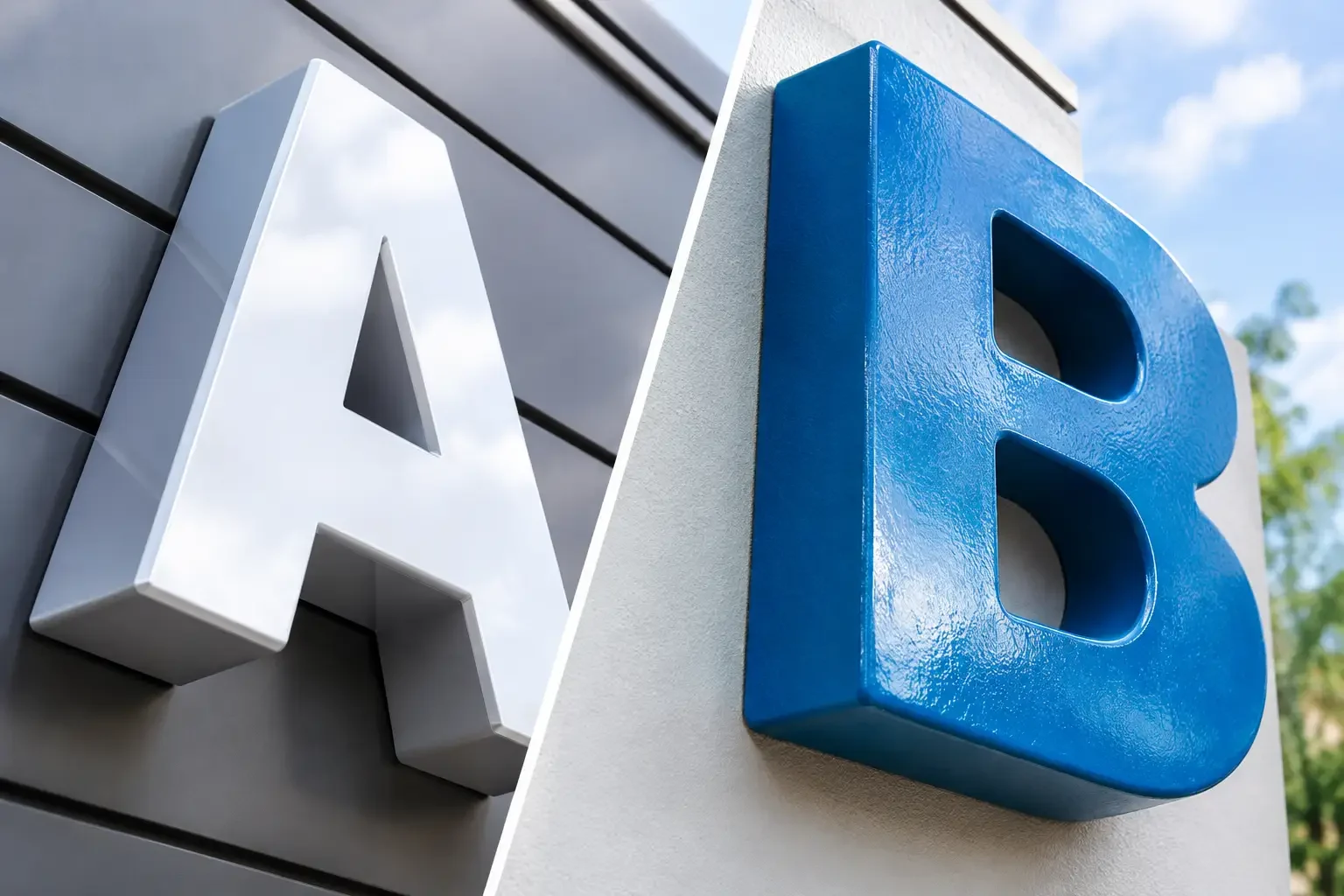
HDU and fiberglass suit different kinds of exterior signs. HDU is useful for routed letters and detailed sign faces, while fiberglass is often used for molded shapes. Start with the shape you need, the quantity and how the finished sign will be supported.
High-density urethane, commonly called HDU, is usually the more efficient choice for routed dimensional copy, sandblasted panels, architectural plaques, and custom sign faces. Fiberglass earns its place where molded shape, shell strength, or large lightweight forms are central to the design. The fabrication method matters as much as the material itself.
Urethane Versus Fiberglass: The Core Difference
HDU is a rigid, closed-cell polyurethane foam manufactured in densities suited to carving, routing, and exterior finishing. It contains no wood grain, will not absorb water like wood, and does not rot. For dimensional signage, it provides a stable substrate that machines cleanly on a CNC router and accepts detailed relief work, prismatic edges, raised letters, and custom profiles.
Fiberglass is a reinforced composite. Glass fibers are embedded in resin, typically with a gelcoat or painted exterior surface. Its performance depends heavily on the resin system, laminate schedule, mold quality, reinforcement layout, and curing process. “Fiberglass” is not a single predictable material specification in the way a defined HDU density can be.
That distinction affects estimating. An HDU sign component can be routed directly from a digital file with repeatable thickness and relief depth. A fiberglass component may require a mold, layup process, trimming, curing, and finish work before it reaches the same stage. For a one-off or short-run custom sign, that setup difference can change the economics quickly.
Where HDU Has a Production Advantage
HDU can be CNC routed for clean lettering, recessed backgrounds, V-carved details and consistent panel shapes. Approved artwork can be used to repeat the design, with suitable dust extraction and handling precautions for machining.
HDU also gives finishers a practical surface for commercial sign systems. Routed faces can be sealed, primed, painted, and finished to match brand colors or architectural palettes. Sandblasted textures and faux wood grain are achievable without relying on a molded texture. That is valuable when a project calls for a custom look but does not justify the cost or lead time of mold development.
For wholesale buyers, repeatability is the operational benefit. A routed HDU panel can be produced in matched sections, fitted with dimensional copy, and prepared for a defined mounting method. This reduces the uncertainty that often reaches the installation crew as trimming, alignment correction, or field touch-up.
Where Fiberglass Is the Better Fit
Fiberglass is often the stronger option when the sign design is essentially a shell. Deep-radius cabinet faces, sculptural forms, faux boulders, large curved pylons, and repeated molded elements can favor fiberglass because it can carry shape without the bulk of a solid substrate.
It is also well suited to projects with enough unit volume to amortize mold costs. Once a quality mold is in place, identical parts can be produced efficiently. That can make sense for a franchise rollout with a standardized three-dimensional identifier, provided the laminate, finish, and quality-control process are documented.
The trade-off is that fiberglass production is less forgiving of poor process control. Inconsistent resin ratios, trapped air, insufficient reinforcement, thin edges, or inadequate cure time can create problems that may not be obvious at shipment. Surface print-through, cracks, and localized flex are not simply “fiberglass issues.” They are often laminate and manufacturing issues.
Durability Depends on Design, Not Material Labels
Both HDU and fiberglass can perform outdoors for years when they are fabricated and finished correctly. Neither material should be selected on a simplistic claim of being maintenance-free.
HDU resists moisture intrusion because of its closed-cell structure, making it a dependable option for exterior panels and dimensional letters. Its primary limitation is structural capacity. It is not a load-bearing replacement for steel, aluminum, or properly engineered internal reinforcement. Large HDU assemblies require a sound mounting plan, reinforced areas where required, and attachment details that distribute load rather than concentrate it at isolated fasteners.
Fiberglass offers better inherent shell strength and can tolerate shapes that would be impractical in thick routed foam. But its exterior protection is only as good as the gelcoat or coating system. UV exposure, thermal cycling, impact, and neglected damage can eventually lead to crazing, fading, or moisture migration through compromised finishes.
For either material, the most common exterior failures begin at edges, penetrations, seams, unsupported spans, and mounting hardware. A well-written fabrication specification should address those details before production starts. Material selection cannot correct a weak attachment design.
Machining, Finishing, and Installation Considerations
HDU is generally easier to machine, modify, and repair in a sign-shop workflow. CNC tools produce accurate profiles, and small finish repairs can often be handled without rebuilding an entire component. Because HDU does not have a directional grain, it is particularly useful for precision-carved graphics, routed logo elements, and panel systems requiring consistent visual depth.
Fiberglass can be cut and drilled, but it requires more controlled dust management and careful edge treatment. Exposed cut edges must be properly sealed and finished. Field modification can be more labor-intensive, especially when it affects a molded profile or finished gelcoat surface.
Installation planning should be settled before either material is fabricated. HDU letters may need threaded studs, aluminum backers, steel armatures, or concealed mounting plates based on size and projection. Fiberglass shells may require internal framing, bonded inserts, or engineered attachment points. In both cases, specifying “mounting included” without defining the wall condition, wind exposure, access, and hardware requirements invites avoidable rework.
Total Cost Is More Than Material Price
Raw material cost is only one line in the estimate. The real comparison includes design complexity, programming, mold requirements, machining time, finishing, reinforcement, crating, freight risk, and installation labor.
For a custom monument panel or dimensional-letter package, HDU often delivers the lower total production cost because it avoids mold tooling and supports direct CNC manufacturing. It also reduces the number of process steps between approved artwork and finished component.
Fiberglass may carry a higher initial cost on custom work, then become economical when a repeatable molded form is produced in meaningful volume. It can also be the only practical choice for certain deep or highly sculpted designs. The correct estimate evaluates the complete production cycle rather than comparing a per-sheet foam price to a per-pound composite price.
Specify the Material Around the Sign System
A productive quote request starts with the actual job conditions: overall dimensions, thickness, relief depth, finish requirements, intended mounting method, quantity, and site environment. If the sign includes structural steel, illumination, cabinet components, or oversized freight sections, those should be part of the fabrication conversation from the beginning.
Choose HDU when the project needs routed precision, sandblasted texture, dimensional lettering, economical customization, or a stable exterior sign face without the cost of mold tooling. Choose fiberglass when the design depends on a molded shell, deep compound curves, structural form, or repeated three-dimensional components that justify a controlled mold process.
Send us your drawing, dimensions and intended location if you are considering an HDU sign. We can discuss the carving and finish while your installer checks the support and mounting requirements.