
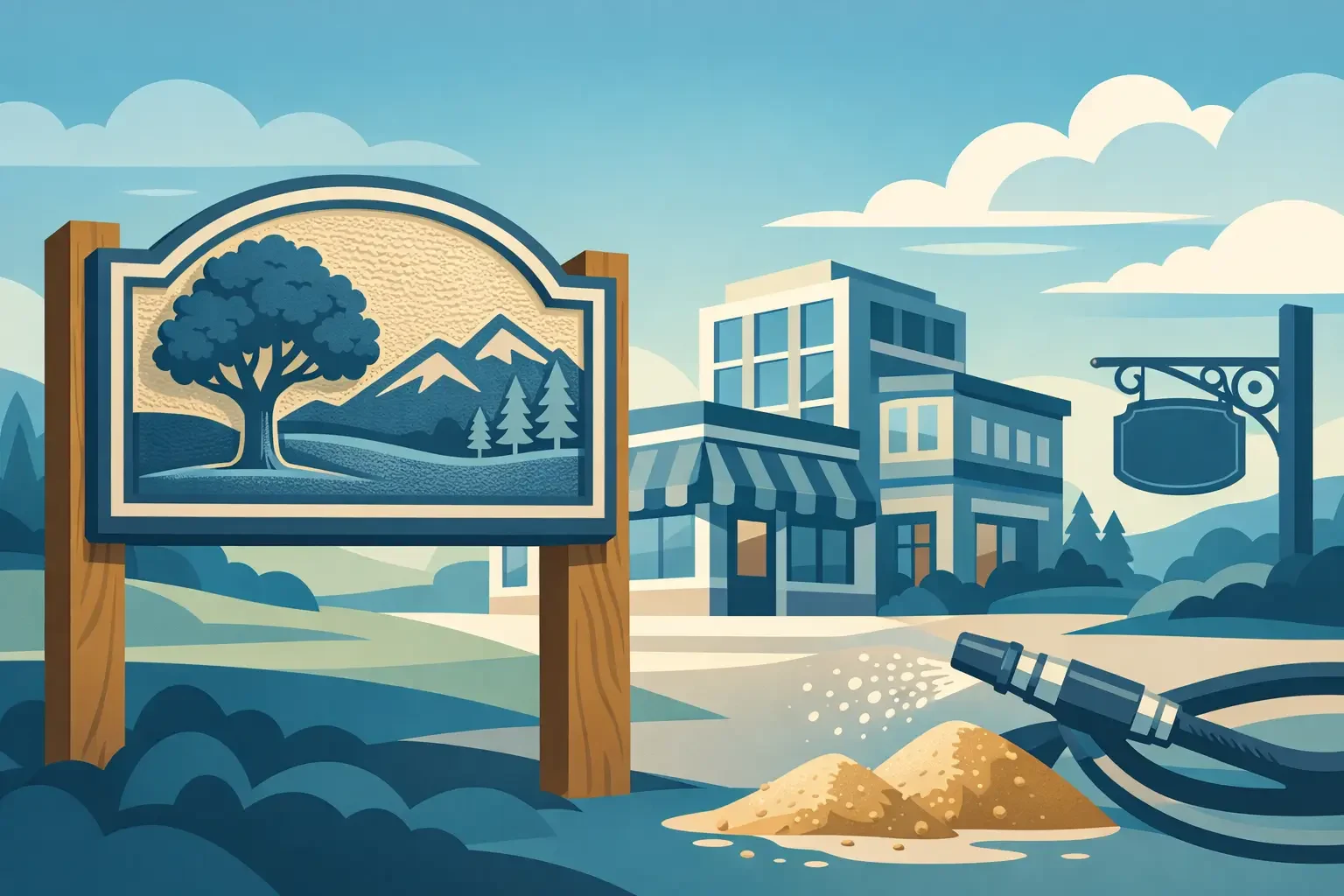
A sandblasted background adds texture around raised letters and logos. It can give an HDU sign a traditional carved appearance, making it a useful choice for entrance signs, churches, businesses and community names.
The layout still needs to read clearly. Letter size, background depth and color contrast matter more than adding texture everywhere. Plan those details around the viewing distance and the space available.
Why sandblasted HDU signs stay in demand
The appeal is straightforward. Sandblasted HDU signs replicate the textured, dimensional look traditionally associated with redwood or cedar, but without the same vulnerability to rot, warping, splitting, and grain inconsistency. HDU, or high-density urethane, is a closed-cell substrate built for exterior sign fabrication. It does not absorb moisture like wood, and it gives fabricators a more predictable base for routing, blasting, priming, and finishing.
For trade buyers, predictability is the real selling point. When you are quoting commercial work, your margin is tied to repeatability. If one panel moves, checks, or takes finish differently than the next, you are paying for that problem in labor, schedule disruption, or replacement. HDU reduces that variability.
The sandblasted finish adds another layer of value. It softens the machined look of a routed panel and creates a more natural carved texture across the background field. On the right project, that texture is what separates a commodity-looking sign from an architectural sign package.
Where sandblasted HDU signs fit best
Not every exterior sign should be blasted. If a project calls for razor-sharp contemporary faces, fine serif detail at small scale, or ultra-clean corporate minimalism, a smooth routed finish may be the better path. But where texture, depth, and a traditional carved appearance are part of the design intent, blasted HDU performs well.
This is especially true for entrance monuments, wayfinding systems, municipal signage, retail centers, churches, resorts, golf communities, medical plazas, and franchise programs trying to add warmth to an otherwise standardized exterior package. It also works well when a client wants the look of carved wood but does not want to budget for the maintenance cycle that comes with actual wood signage.
HDU is a manufactured board, not timber. It can give a sign a carved appearance, but it will not reproduce every feature of natural wood grain or aging. Choose it when the painted dimensional finish suits the design.
Material performance is the reason buyers switch
HDU offers a consistent surface for cutting and texturing, and resists the moisture damage associated with wood. The complete sign still depends on proper finishing and support.
First, moisture resistance. Because the board is closed-cell, it does not pull in water the way wood does. That reduces swelling, cracking, and finish failure tied to moisture intrusion. Second, weight. HDU is substantially lighter than many comparable carved sign materials, which helps with handling, freight, and installation planning. Third, machinability. It can be CNC routed accurately, shaped cleanly, and prepped for blasting without forcing a shop through the mess and inconsistency of wood carving.
There are still specification decisions to make. Density matters. Thickness matters. Structural support matters. Large-format signs, double-sided monument faces, and signs integrating metal frames or posts need engineering attention. HDU is an excellent sign face material, but it is not a substitute for internal structure when the application requires load-bearing support. Experienced buyers already know that, but it is where many lower-end fabrications go wrong.
How the sandblasted finish is actually produced
The production sequence can vary with the design and the shop. Routing and blasting are used to form the lettering, borders and textured background while keeping the intended raised details clear.
Good artwork and enough space around the lettering are important whichever sequence is used. Fine details and narrow gaps need to be reviewed with the texturing process in mind before the sign is made.
This is one reason trade buyers often outsource this category of work. A shop may have the design and sales strength to win the project, but not the bandwidth, blasting setup, finishing system, or quality controls to produce it profitably in-house. Outsourcing becomes less about capability in theory and more about maintaining throughput without tying up labor on a specialized fabrication stage.
Design decisions that affect the final result
The best sandblasted signs are designed for the process, not forced into it. Deep background texture paired with shallow copy can flatten readability. Overly fine detail can get visually lost. Extremely tight interior corners may not carry the same character after texturing as they do on a clean routed panel.
Letter style, stroke width, relief depth, border treatment, and finish system all need to work together. Raised copy with a blasted background is a common solution because it preserves legibility while adding texture where it has the most visual impact. Prismatic letters, inset panels, and layered appliques can also work, depending on viewing distance and brand standards.
Color selection matters more than some buyers expect. Heavily textured backgrounds catch light differently than smooth painted surfaces, so contrast needs to be evaluated in field conditions, not just on a rendering. A color pair that looks strong on screen can lose clarity outdoors if the texture and sheen are not considered.
Production concerns that affect cost and margin
For sign companies and commercial buyers, the question is rarely whether a sign can be made. The question is whether it can be made accurately, shipped safely, and installed without expensive surprises.
That is where fabrication discipline matters. Panel thickness has to match the application. Mounting provisions need to be planned before finishing. Multi-panel jobs need consistency across faces. Freight packaging has to account for edge protection, finish protection, and handling risk. If any of those points are treated casually, the savings from outsourcing disappear fast.
Sandblasted HDU signs can be highly cost-effective, but only when the production process is controlled. Rework on textured dimensional signage is not cheap. Neither is replacing a damaged panel on a deadline-driven commercial job. Buyers who source this work regularly tend to prioritize suppliers that understand specification-based fabrication, not just decorative signmaking.
We make fully finished sandblasted HDU signs and ship them to your delivery address, with shipping included in the quote. Share the size, wording, colors and mounting requirements with us. Your local installer is responsible for installation and any supporting structure.
When sandblasted HDU is the wrong choice
There are cases where another material or finish should be specified. If the project needs a modern, ultra-smooth painted face with no visible texture, a non-blasted HDU panel or another substrate may be more appropriate. If the sign will face heavy impact risk in a vulnerable ground-level location, metal-faced construction may provide better abuse resistance. If the client wants actual wood character, including grain and natural aging, HDU will not replace that authentically.
This is not a limitation so much as a specification issue. The right material depends on the application, the design intent, the expected service environment, and the maintenance expectations. Good fabrication starts with matching the material to the job instead of forcing every job into the same material family.
What experienced buyers should ask before ordering
Before approving production, buyers should confirm density, overall thickness, relief depth, finishing method, mounting strategy, and whether the panel is shipping as a standalone face or as part of a larger install-ready system. They should also review how the supplier handles scale consistency across repeat locations, especially for franchises and multi-site commercial programs.
It is also worth asking how the shop manages blasting consistency. Texture that looks attractive on one panel but inconsistent across ten locations becomes a brand control issue. The same goes for paint coverage, edge treatment, and packaging standards.
Ask to see examples of the background texture and lettering style you want. Send those preferences with the artwork and dimensions so we can discuss how they will work together on your sign.