
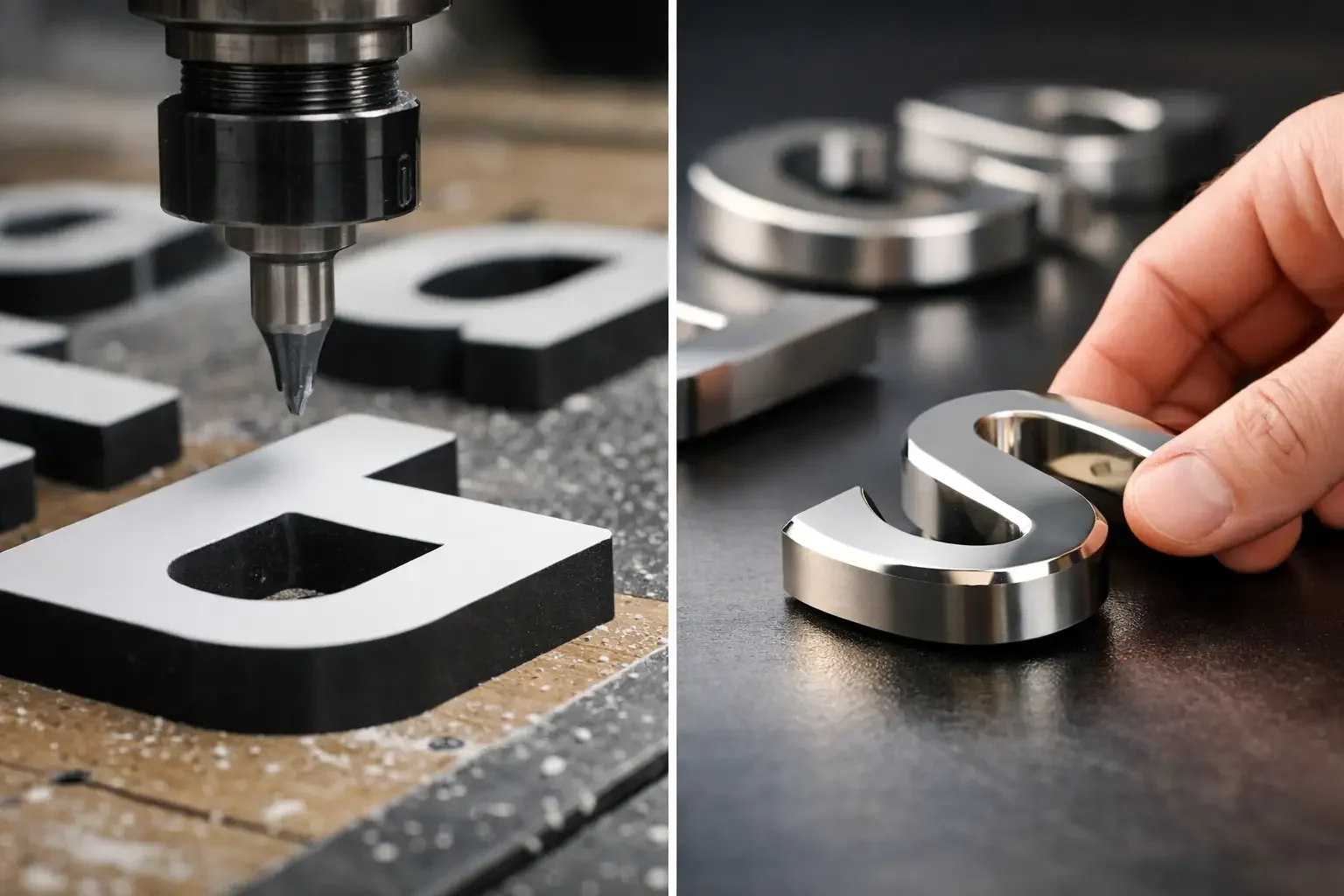
Routed and cast letters can create a similar outline, but their materials, weight and finish are different. Before choosing, consider the lettering style, depth, wall surface and appearance you want.
For most commercial exterior applications, the right choice depends on the required letter style, expected viewing distance, wall condition, finish specification, and whether the project needs a custom-built component or a standard architectural product. Sign professionals should evaluate the fabrication method as early as the estimating stage, not after a customer has approved an attractive but impractical concept.
Routed Letters vs Cast Letters: The Core Difference
Routed letters are cut from sheet or block material using CNC equipment. Common substrates include HDU, aluminum, acrylic, PVC, and composite sheet. In the HDU category, letters are machined from high-density urethane board to a specified profile and thickness, then finished for exterior exposure. CNC routing allows the fabricator to produce custom typography, logos, varying stroke widths, and nonstandard shapes without the fixed tooling associated with casting.
Cast letters are formed by pouring molten metal into a mold. Cast aluminum and cast bronze are common architectural options, particularly for established letter styles, plaques, institutional buildings, and projects that call for the visual weight of metal. The casting process produces a solid metal letter with a traditional, often slightly textured surface. Many cast-letter programs rely on standard fonts, standard depths, and established mounting patterns.
Neither process is universally better. Cast metal remains a strong choice when the design calls for a classic metal appearance and the selected style falls within available casting options. Routed fabrication is typically the more flexible production path when the job requires custom geometry, larger copy, branded typefaces, painted HDU construction, or exact replication of a logo.
Design Freedom and Brand Accuracy
The first practical difference is how closely the finished letters can follow the artwork. With routed letters, the production file drives the CNC toolpath. If the vector art is clean and the stroke widths are appropriate for the selected material and thickness, the fabricator can reproduce custom fonts and logo shapes with high precision repeatability. This matters for franchise programs, multi-location accounts, and commercial developments where visual consistency must carry across multiple signs.
Cast letters are more constrained by mold availability. Standard cast-letter families offer dependable results, but the available type styles may not match a client's proprietary brand font. A custom casting can be produced, but custom patterns and tooling add cost and time. That investment can make sense for a large repeat program, but it is rarely efficient for a one-off storefront sign or a small architectural package.
Routed HDU letters are especially useful where a designer wants deep, substantial copy without the weight associated with solid cast metal. They can be built to the required thickness, shaped with bevels or prismatic edges, and finished in standard or custom colors. Fine interior details still require review. A tight counter, narrow serif, or extremely thin stroke may need adjustment to preserve strength and clean paint coverage.
Depth Is More Than an Aesthetic Choice
Letter depth affects shadow lines, visual impact, mounting hardware, and freight exposure. Cast letters are commonly offered in predetermined depths based on the manufacturer and letter series. This works well when standard proportions fit the design.
Routed letters give the production team more control. A project may call for 1-inch HDU letters on a low-profile wall sign, 1.5-inch copy for stronger shadow definition, or thicker fabricated components for a monument face. The selected depth should match the viewing conditions and mounting surface. Deep letters can create a premium architectural look, but unnecessary thickness adds material, finishing time, and shipping volume.
Material Performance in Exterior Conditions
Cast aluminum has a long track record in exterior architectural signage. It does not rust, performs well in changing weather, and can be supplied with painted, anodized-look, brushed, polished, or specialty finishes. Bronze offers a distinct premium appearance and develops character over time, although it carries a higher material cost and requires realistic expectations about patina and maintenance.
HDU is a closed-cell board that resists water absorption and does not rot like wood. It is lighter than cast metal, which can make larger letters easier to handle. The design still needs suitable support and a compatible exterior finish.
The finish system is critical in either category. A poorly prepared painted letter will fail before the substrate reaches its service limit. Routed HDU letters need complete edge sealing and a compatible exterior coating system. Cast aluminum letters require proper surface preparation and coating adhesion. When quoting, specify the expected exposure, color requirements, texture, and whether the sign will face intense sun, coastal air, freeze-thaw cycles, or irrigation overspray.
Cost, Lead Time, and Production Control
For standard copy in a common cast style, cast aluminum letters can be an efficient, recognizable option. The manufacturer has already absorbed the tooling cost across a catalog of fonts and sizes. If the design fits that system, pricing and lead times may be straightforward.
Once custom fonts, unusual sizes, logo elements, or nonstandard depths enter the scope, routed production often becomes more economical. CNC routing eliminates the need to create a new mold for each custom shape. It also allows a fabricator to nest multiple components efficiently, maintain accurate spacing from the approved artwork, and repeat the same files on future orders.
Allow for artwork preparation, approval, material scheduling, finishing, packing and transit. After you agree to our order and pay, we prepare the artwork/proof for your approval before manufacturing. We confirm the schedule for the actual design and finish.
For sign shops outsourcing production, repeatability protects margin. A factory partner should be able to work from approved vector files, confirm thickness and mounting requirements, maintain consistent profiles, and package the job so it arrives ready for field installation. Rework caused by incorrect spacing, weak mounting hardware, or damaged edges is rarely recoverable on a fixed-price project.
Installation and Mounting Considerations
Both routed and cast letters can be installed with stud mounting, pads, rails, or direct mechanical fastening, depending on the substrate and project requirements. The wall construction matters as much as the letter material. Brick, masonry, EIFS, corrugated metal, ACM panels, wood, and interior drywall all require different fastening strategies.
Cast letters are heavier, especially at larger sizes or deeper returns. Confirm that the wall can support the load and that the installer has a reliable pattern and anchoring plan. Heavy letters on an uneven masonry wall may require more field adjustment than the initial quote suggests.
Routed HDU letters reduce handling weight and are well suited to larger painted copy, monument signs, and decorative architectural applications. They should still be mounted with hardware sized for the letter dimensions, wind exposure, and substrate. A lightweight material is not a substitute for sound installation engineering.
For either option, request a clear mounting layout before fabrication is released. Verify baseline, letter spacing, stud locations, hardware projection, and whether a paper or rigid installation pattern is required. These details prevent a clean fabrication job from becoming a difficult field install.
Selecting the Right Letter for the Job
Choose cast letters when the project benefits from a traditional metal product, a standard architectural font, and the natural durability and appearance of aluminum or bronze. They are a proven fit for professional offices, civic buildings, donor recognition, and applications where a classic metal finish is part of the design intent.
Choose routed letters when custom branding, scalable size, controlled depth, lighter weight, or painted HDU construction drives the specification. They are often the practical choice for custom storefront identities, monument signage, development entrances, tenant panels, and repeat commercial programs that cannot be forced into a standard cast font catalog.
We make routed HDU letters to your approved design and ship them nationwide. Tell us whether you want loose letters, supplied mounting provisions or letters assembled on a panel. Installation is not included or provided.
Send your artwork, desired depth and finish, and a photograph of the mounting location. We can review whether routed HDU will suit the job.