
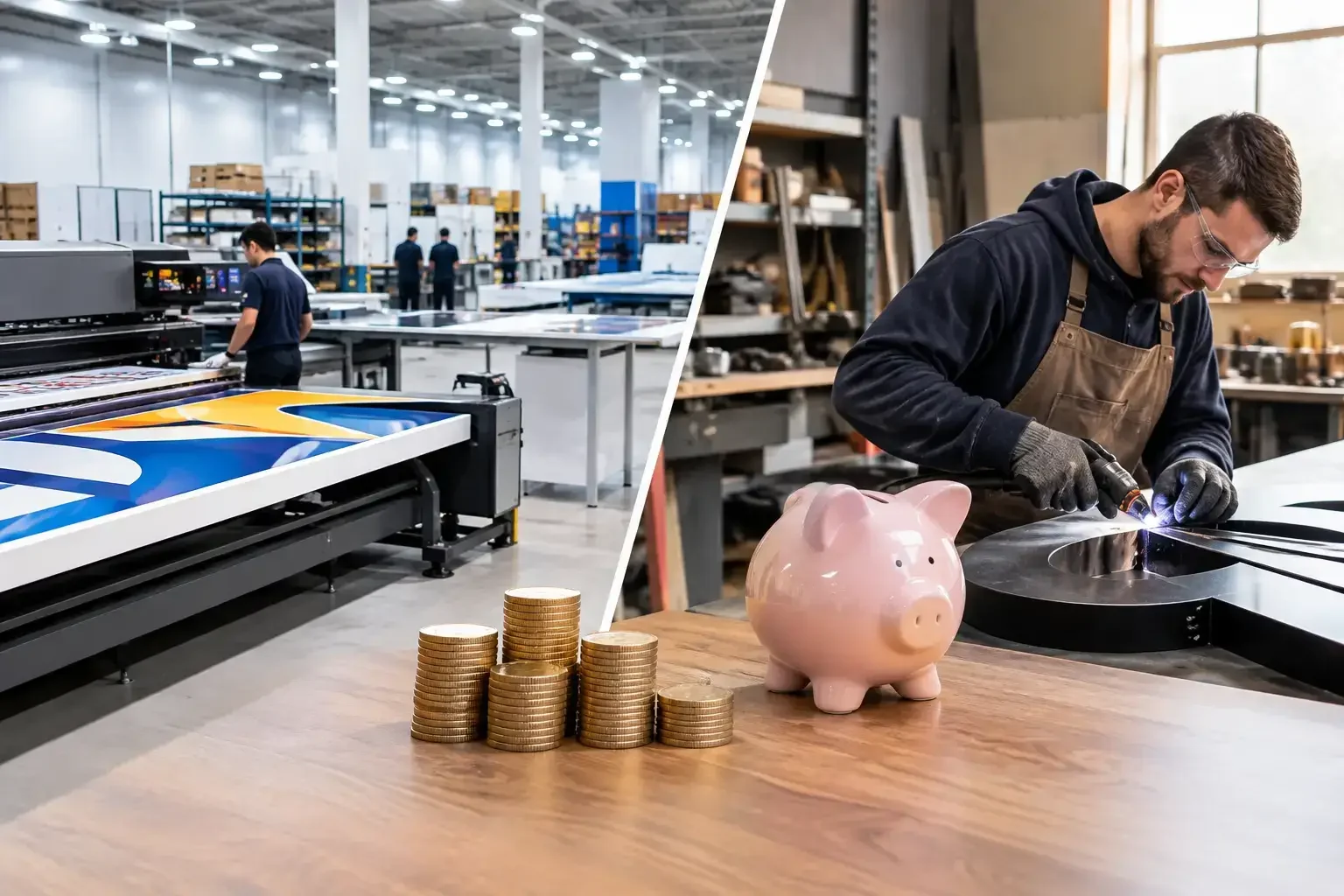
A dimensional sign can look simple on an estimate and become expensive on the shop floor. A missed router tolerance, undersized mounting hardware, inconsistent finish, or damaged shipment can turn a profitable job into a rework problem. The factory direct signs vs local fabrication decision is not simply about who has the lower unit price. It is a production decision involving scope control, capacity, logistics, installation requirements, and the real cost of managing risk.
For sign shops, brokers, franchise programs, contractors, and commercial buyers, the right source depends on what must be controlled locally and what can be fabricated more efficiently at scale. Local fabrication has a clear role. Factory-direct production has a clear advantage when repeatability, material expertise, and wholesale throughput matter more than proximity.
Factory Direct Signs vs Local Fabrication: What You Are Buying
A local fabricator is typically selling access, responsiveness, and geographic convenience. You may be able to inspect samples in person, make a late change, coordinate installation details face-to-face, or resolve a small issue without involving freight. For projects with uncertain field conditions, unusual site constraints, or a compressed install window, that proximity can be valuable.
A factory-direct manufacturer is built around a different production model. The value is not just that the fabricator is farther away. It is that the work moves through established equipment, documented processes, dedicated finishing operations, and shipping procedures designed for repeatable output. On a run of routed HDU letters, sandblasted panels, tenant signs, or architectural components, that process control matters.
The comparison should therefore start with the actual deliverable. Are you buying a design concept that still needs field interpretation? Or are you buying a specification-defined, install-ready signage component with approved artwork, dimensions, finish requirements, mounting details, and a known delivery destination? The more defined the production package, the stronger the factory-direct case becomes.
Unit Price Is Not the Same as Project Cost
Local fabrication may appear less expensive when freight is visible as a separate line item. That comparison often misses the production cost behind the quote. A local shop with limited CNC capacity may interrupt other work, outsource finishing, hand-process details that should be machined, or build a one-off fixture for a short run. None of that is inherently wrong, but it affects pricing and lead time.
Factory-direct pricing benefits from specialization. When a manufacturer routinely routes HDU, builds dimensional letter sets, fabricates metal reinforcement, applies commercial finishes, and packages oversized components for shipment, the process is already in place. Material purchasing, machine setup, finishing workflow, and quality checks are spread across consistent production volume rather than loaded onto one unusual job.
That does not mean factory-direct is automatically the lowest landed cost. Freight can erase a unit-price advantage on a small, heavy, low-value item. A single replacement panel needed tomorrow may be better sourced locally. But on multi-location packages, repeated sign families, larger HDU components, and work that would otherwise consume valuable internal labor, the calculation changes quickly.
A useful estimate compares more than the supplier quote. Include your internal artwork preparation, routing time, paint labor, rework allowance, crating or packaging effort, production scheduling disruption, delivery coordination, and expected installation labor. Margin is protected when those costs are visible before the job is sold.
Precision Repeatability Favors Purpose-Built Production
HDU signage is forgiving in some ways and unforgiving in others. The material does not rot like wood and performs well outdoors when properly specified and finished, but dimensional accuracy, edge treatment, grain simulation, coating coverage, and mounting preparation still determine the final result. A panel that is technically fabricated but poorly sealed, inconsistently blasted, or inadequately reinforced creates a field problem later.
Local shops can produce excellent HDU work, particularly when they have experienced operators and the right equipment. The issue is consistency under volume. A project involving dozens of panels, a franchise rollout, or a set of coordinated monument and wayfinding elements requires more than craftsmanship. It requires process discipline.
Factory production is strongest when the job calls for controlled repetition. CNC routing follows approved vector files at production scale. Reusable fixture methods improve alignment. Standardized finishing sequences support color consistency across a sign family. Quality checkpoints can verify dimensions and component completeness before packaging. Those controls reduce the variation that creates installation delays and costly remakes.
For trade buyers, this is especially relevant when fabrication is being sold under your own brand. Your customer does not care whether the dimensional letters were routed in your building or by a production partner. They care that the letter spacing is correct, the finish holds up, the stud pattern matches the template, and the shipment arrives ready to install.
Lead Time Depends on Capacity, Not Distance Alone
The nearest fabricator is not always the fastest fabricator. A local operation may have a short drive time but a full production board, limited finishing space, or a bottleneck at routing, painting, or assembly. Conversely, a factory-direct supplier may have to ship across several states but can start the work promptly because the necessary equipment and labor are dedicated to that category of production.
The right question is not, “How close is the shop?” It is, “What is the committed production schedule from approved proof to shipment or delivery?” That schedule should account for artwork approval, material availability, routing, fabrication, finishing, cure time, inspection, packing, carrier transit, and any jobsite delivery restrictions.
Factory-direct production works best when approvals are locked before release. Late revisions are expensive in any model, but they can be especially disruptive once a multi-step fabrication job enters routing or finishing. Local fabrication can be more accommodating when the project is still fluid and the installer needs to verify details at the site. Once the specification is stable, factory throughput often provides the more dependable path.
Freight Is a Production Requirement, Not an Afterthought
Freight is the most common objection to outsourcing architectural signage, and it is a legitimate concern. HDU panels, routed letters, metal frames, and finished sign faces can be damaged by poor packaging or mishandling in transit. The answer is not to ignore freight. The answer is to treat it as part of the fabrication scope.
A production partner shipping nationwide should understand how sign components fail in transit. Painted edges need protection. Raised details need clearance. Large panels need support that prevents flexing. Multi-piece kits need part identification and organized packing. Freight-safe crating or palletization is not decorative packaging. It is a control point that protects the finished product and keeps the installer from sorting through damaged components on site.
Local pickup can still be the right choice for fragile, oversized, or unusually urgent assemblies. It also gives the buyer direct control over transport. But if a fabricator routinely ships commercial signage, distance does not automatically equal risk. Inexperienced packing creates risk. Incomplete specifications create risk. Selecting the wrong carrier service creates risk.
When Local Fabrication Is the Better Call
There are projects where local fabrication should win. A site survey may reveal uncertain wall conditions, hidden structural conflicts, or a need for rapid field modifications. A small job may not carry enough value to absorb freight. A sign package may require integrated installation, municipal coordination, or last-minute client review that benefits from an on-site relationship.
Local partners are also useful for immediate service work, replacement components, and projects where the fabricator has unique knowledge of a property or jurisdiction. If the job requires frequent physical collaboration, local access has operational value that should not be discounted.
The mistake is treating that value as universal. A nearby shop is not automatically the best source for complex routed HDU work, large-volume production, or repeat architectural components. Proximity cannot compensate for an overloaded schedule, inconsistent finishing, or limited capacity.
When Factory-Direct Production Creates Better Margin
Factory-direct fabrication is often the better fit when you have approved production files, a defined bill of materials, known installation requirements, and enough scope to benefit from production scale. It is particularly effective for sign shops that want to sell dimensional HDU signage without tying up routers, paint booths, labor, and floor space.
It also supports brokers and franchise coordinators who need consistent output across regions. A centralized production source can maintain a controlled sign family rather than asking different local shops to interpret the same drawings, colors, textures, and mounting requirements. That consistency protects both brand standards and estimating discipline.
Wholesale HDU Signs operates in this production lane: specification-based HDU fabrication, routed dimensional components, finishing, structural support where required, and freight preparation for nationwide delivery. The point is not to replace every local sign partner. It is to give trade buyers a dependable backend source when their own capacity, equipment, or labor should be focused elsewhere.
Before releasing any fabrication package, define the items that drive field success: finished dimensions, thickness, texture, color system, reinforcement, mounting method, templates, hardware, packaging requirements, ship-to conditions, and the installation sequence. A clear production package lets a factory produce accurately. It also lets a local fabricator quote honestly.
Choose the source that gives the project the best control over quality, schedule, and margin. For a tightly specified commercial sign package, the best fabrication partner is often not the closest one. It is the one built to make the same result correctly, every time.