
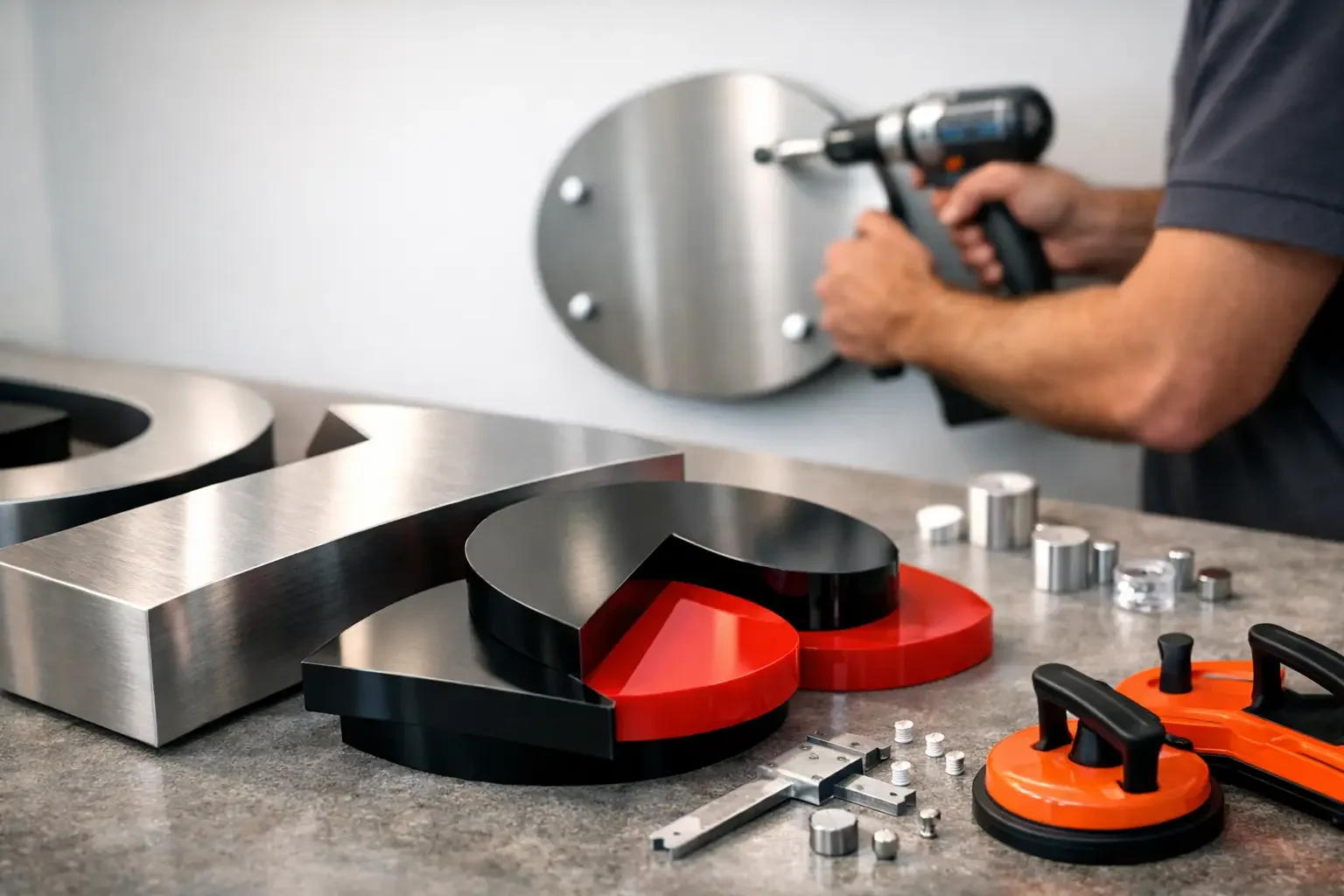
A letter set needs to match the approved spacing, thickness and finish, and a replacement panel needs to fit its opening. Accurate cutting begins with those measurements and continues through finishing and packing.
For repeat orders, keep the approved file and construction notes together. That gives the shop a dependable reference for the next batch or a replacement part.
What Precision Means in Sign Fabrication
Precision in sign production begins before the CNC table starts. It comes from converting approved artwork into fabrication-ready geometry, accounting for material thickness, tool diameter, internal radii, mounting hardware, paint buildup, and the tolerances of the final installation surface.
A letter profile may look correct in a proof while still creating production issues. Tight inside corners can exceed the capability of a router bit. Small bridges in a logo can become fragile during shipping. A shallow routed detail can disappear after primer and finish coats. These are not design failures, but they require fabrication judgment before material is cut.
Precision repeatability means the approved file, material specification, and production method produce the same expected result from part to part. On a commercial project, that consistency matters more than a single attractive sample. It keeps replacement parts compatible, supports phased installations, and prevents installers from modifying components in the field to make them fit.
The Components That Demand Tight Process Control
Not every sign element requires the same cutting method or tolerance. Material selection and intended use should drive the fabrication plan.
Routed HDU letters and logos
High-density urethane is a practical material for dimensional exterior graphics because it does not rot, swell, or split like wood. Properly fabricated HDU letters can carry sharp profiles, raised details, and custom thicknesses without adding unnecessary weight to the installation.
The quality difference is often visible at the edges. Controlled CNC routing produces consistent letter shapes and repeatable depths. It also allows a production team to plan for stud mounting, raceway attachment, backer-panel placement, or other installation methods before shipment. When a component is cut without a clear mounting plan, the installer inherits the problem.
HDU does have trade-offs. It is not the right material for every thin stroke, high-impact location, or unsupported span. Larger letters may require internal support, metal reinforcement, or a different construction method depending on the size, thickness, and exposure conditions. A qualified fabricator should identify those limits during quoting instead of treating every vector file as a direct-cut job.
Sandblasted and routed HDU panels
Architectural panels often combine several processes: panel sizing, edge shaping, recessed copy, raised copy, sandblasting, background texture, and painted finishing. The dimensional effect depends on keeping those processes aligned.
A sandblasted HDU panel can create a traditional carved appearance, while CNC routing is better suited to defined depths, detailed logos, and repeatable production. On many projects, the best result uses both. The choice depends on the desired character, copy size, depth requirements, and quantity.
For sign professionals, the production concern is not just visual depth. It is whether copy remains legible after finishing, whether panel edges are prepared for exposure, and whether the finished part can be crated and installed without damage. Those details affect the job long after the router cycle is complete.
Metal frames, returns, and structural elements
Dimensional signage frequently needs metal to do the work HDU should not be asked to do alone. Aluminum or steel framing can provide stiffness for large panels, support stand-off mounting, create welded sign structures, and hold components square during transport and installation.
Combining routed HDU with fabricated metal is effective when the material roles are clear. HDU handles the carved or dimensional face. Metal manages span, attachment, structural load, and mounting interfaces. Designing those elements as a single assembly reduces the chance that the face, frame, and hardware arrive as separate parts that do not line up.
Why File Preparation Controls the Finished Part
Production-ready artwork is one of the strongest predictors of a clean fabrication outcome. A print file, low-resolution logo, or unconverted font may be enough for a customer approval, but it is not necessarily enough to manufacture precision-cut parts.
Fabrication files need clear vectors, defined cut paths, correct scale, and identified layers for routing, engraving, drilling, or paint masks. Copy should be reviewed for minimum stroke width and spacing. Logos should be checked for overlapping paths, open vectors, and details too small to survive the selected process.
We review the drawing for details that may be difficult to cut or too fragile to handle. If a change is needed, you approve the revised artwork before manufacturing.
A strong quote request includes overall dimensions, material and thickness preferences, quantity, finish expectations, mounting method, destination, and required delivery date. If the customer needs a panel to mount to an existing structure, hole locations, hardware requirements, and site conditions should be part of the conversation. A precise component cannot correct inaccurate field measurements.
Agree on the dimensions that matter
Tell us which measurements must fit an existing frame or line up with supplied hardware. We can review the practical tolerances before cutting.
Material thickness can vary slightly. Painted surfaces build film thickness. Large panels can require allowances for thermal movement. Existing walls, brick, stone, and steel structures may be out of square. The right approach is to establish which dimensions are critical to fit and which dimensions allow practical installation adjustment.
For example, a set of individual letters may need tight center-to-center spacing and a reliable drilling pattern, while the overall layout pattern may allow minor adjustment at the wall. A routed panel that nests into a metal frame may need controlled outside dimensions, but the frame design should account for coating thickness and drainage. Precision means understanding where accuracy is mandatory and where a field tolerance prevents a costly bind.
Protecting Margin Through Outsourced Production
In-house routing can make sense for shops with stable volume, trained operators, available floor space, and a reliable finishing process. It becomes less attractive when large, custom, or irregular jobs interrupt core production, require specialized tooling, or expose the shop to rework risk.
Outsourcing precision cut sign components lets a trade buyer sell a broader range of dimensional work without carrying every machine, material inventory, and fabrication specialty internally. The advantage is not merely labor savings. It is predictable capacity, repeatable output, and the ability to quote work based on known production costs.
The lowest initial component price is not always the lowest job cost. A part that requires edge cleanup, repainting, redrilling, field trimming, or replacement freight can erase the apparent savings quickly. Factory-direct fabrication should reduce touches after delivery, not create more of them.
We manufacture routed HDU panels, dimensional letters and related sign components to the agreed order. Your quote lists the material, finish and any supplied mounting provisions. We manufacture and ship custom HDU signs nationwide. Installation is not included or provided.
Freight Is Part of the Fabrication Plan
A finished sign component is only useful if it arrives in usable condition. Oversized panels, dimensional letters, framed assemblies, and painted faces all need shipping protection matched to their risk profile.
Crating, internal blocking, edge protection, face separation, and clear part identification are production requirements, not shipping afterthoughts. Components should be packed so that they cannot rub, flex excessively, or transfer load through delicate raised details. Multi-part projects also need logical labeling so installers can identify what belongs together without sorting through an unmarked crate at the jobsite.
The shipping method depends on size, finish, destination, and urgency. LTL freight is often practical for large fabricated components, but it requires packaging built for forklift handling and terminal movement. Buyers should inspect freight at delivery, document visible damage, and note exceptions before signing when conditions warrant. That discipline protects both the project schedule and the claim process.
Specify for the Installation, Not Just the Appearance
The strongest sign packages are designed backward from the install. If a component will mount to masonry, plan for the drilling pattern and hardware. If it will span between posts, account for structural support. If it must align with an existing cabinet or canopy, verify field dimensions before releasing production.
Appearance still matters. Edge profiles, recessed copy, background texture, color separation, and finish quality all influence the final impression. But commercial signage is judged just as quickly by whether the parts fit, mount cleanly, survive transit, and remain serviceable after the crew leaves.
Send your artwork, measurements and any critical fit requirements with the quote request. After you agree to the order and pay, we prepare the artwork/proof for approval before manufacturing.