
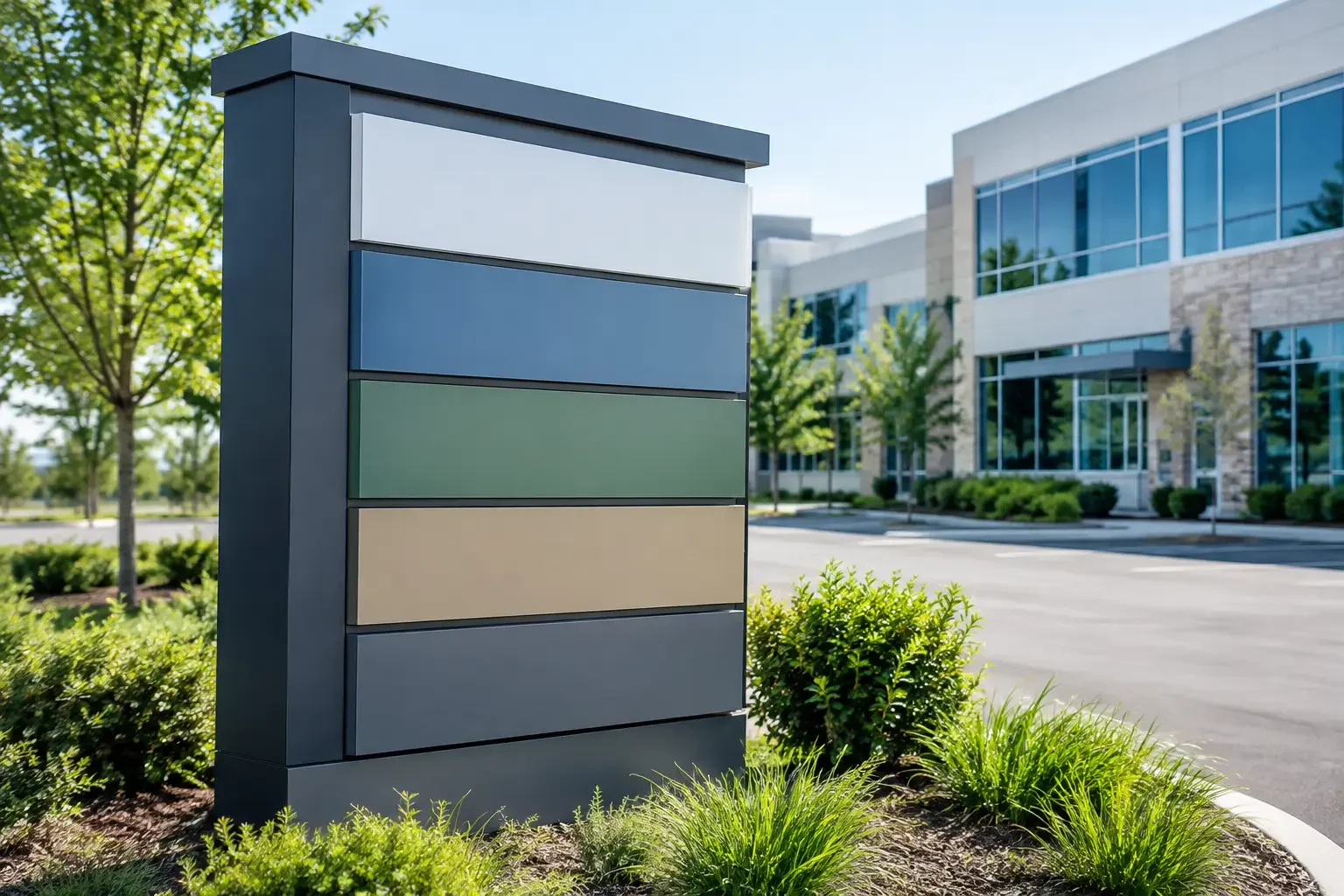
A multi-tenant sign needs to make the property easy to identify and give each business readable space. It also needs a practical way to replace tenant panels when occupants change.
This article presents an illustrative commercial-plaza scenario, not a documented completed customer project. It explores the decisions that commonly arise when planning a directory sign: limited space, changing tenants, consistent branding and future panel replacement.
The Project Requirement: One Sign, Multiple Time Horizons
In this illustrative scenario, a commercial center has six lease spaces and needs a freestanding entrance sign. The layout places the center name above a tenant directory and must fit the permitted size and the entrance landscape plan.
The immediate request was for a finished monument sign. The more important requirement was maintaining it after occupancy changed. Tenant turnover was expected over the life of the property, so the directory could not be treated as permanently routed copy. The sign had to support replacement panels without forcing a contractor to repaint, patch, or rebuild the entire structure.
That distinction affects the fabrication plan from the first drawing. A fixed-letter monument can work for an owner-occupied building. A multi-tenant pylon or monument requires serviceability. If the copy changes every few years, panel retention, mounting access, color consistency, and replacement-part repeatability matter as much as the initial appearance.
Using HDU for the Sign Faces
In this example, HDU is used for the decorative sign faces. It resists moisture absorption, does not rot and can be routed for borders, lettering and relief. A separate support structure is still required and must be designed for the site. Related: HDU and cedar comparison
For this project, the monument was specified with routed HDU faces mounted over an engineered internal support structure. The HDU provided the visual body of the sign, while structural metal handled the load path and anchoring requirements. This division of labor is important. HDU is an excellent sign material, but it is not a substitute for properly engineered steel where post loads, wind loads, and foundation connections govern the installation.
The sign face incorporated a routed perimeter border and a raised header area for the plaza name. The directory zone was designed as a defined field with individual removable tenant panels. The result was an architectural sign face with controlled geometry rather than a collection of unrelated panels mounted to a generic cabinet.
Designing for Tenant Panel Replacement
The tenant panels were the most operationally sensitive part of the sign. Each panel needed to sit flush, maintain even spacing, resist vibration, and be replaceable without damaging adjacent finishes. Small tolerances become visible quickly when six stacked panels are installed in a common frame.
The fabrication approach used CNC-routed panel openings and standardized panel dimensions. That allowed every tenant location to be produced from the same controlled file rather than measured and cut independently. The retention method was selected to provide secure attachment while keeping fasteners accessible during a future changeout.
This is where a low initial price can become expensive later. A directory fabricated without a replacement strategy may require painted-over copy, drilled-through faces, mismatched inserts, or field-cut panels when a tenant leaves. Those fixes reduce the quality of the property presentation and create unnecessary labor for the sign company servicing the account.
Production Controls That Prevent Field Problems
The approved design package included overall dimensions, panel layout, copy locations, mounting details, finish schedule, and shipping orientation. Before routing began, production verified that the routed HDU face dimensions aligned with the internal frame, the tenant panel openings, and the planned attachment points.
Precision repeatability was the central production objective. The property header, tenant panel openings, and decorative routed details all had to register correctly across the assembled sign. CNC routing delivered consistent geometry, particularly in the panel field where even a minor variation would create inconsistent gaps.
The finish process was equally controlled. Exterior HDU signs depend on proper surface preparation, compatible coatings, and coverage at routed edges and recessed areas. The project called for a dark field color with contrasting raised copy and tenant panel faces. Each color break was planned around the sign geometry, reducing the risk of uneven edges and excessive touch-up during assembly.
Dimensional copy was fabricated separately where appropriate, then positioned using layout references established in production. This reduces dependence on installer placement in the field. A sign crew should be setting a prepared system, not trying to establish letter alignment on a jobsite after the monument is already in place.
The Trade-Off: Fixed Panels vs. Flexible Directory Systems
Not every multi-tenant sign needs the same panel system. The right approach depends on tenant turnover, design standards, visibility distance, maintenance access, and the owner’s budget.
A fixed routed panel with permanently applied dimensional copy can provide the cleanest architectural result for stable tenants. It is a sound choice for medical campuses, professional buildings, or owner-controlled properties where names rarely change. The trade-off is that a copy revision generally requires replacing the full panel.
A removable insert system costs more to design correctly, but it can reduce future service labor. It is usually the better choice for retail centers, leasing-driven office parks, and properties with variable occupancy. A well-designed system lets the sign company manufacture a replacement panel from the original specifications, ship it directly, and complete the update without repainting the monument face.
There is also a visibility trade-off. A six-tenant directory may meet the available square footage, yet still fail at the roadway if every panel carries too much copy. In this case, panel dimensions and tenant identity were reviewed against the approach distance. Short names, logos with strong contrast, and simplified copy typically outperform dense layouts. The sign can be technically compliant and still be difficult to read.
Installation and Freight Planning Were Part of the Fabrication Scope
Large monument components are vulnerable before they reach the site. Routed edges, raised letters, finished corners, and removable panels can all be damaged by inadequate packaging or shifting freight. For this project, components were organized for freight-safe handling, with protective separation between finished faces and clear identification for assembly sequence.
The installer received components in a format that supported efficient staging. The structural elements, face assemblies, tenant panels, and hardware were coordinated to reduce guesswork. That matters because field time is expensive. If hardware is missing, panel positions are unclear, or a face requires trimming to fit the structure, labor costs rise quickly and the risk of finish damage follows.
A clean installation also depends on early coordination with the foundation and electrical scope. If illumination is specified, conduit routes, access points, and service clearances should be resolved before fabrication. If the sign is non-illuminated, the anchor pattern and support configuration still need to match the approved foundation plan. Fabrication accuracy cannot correct a foundation that was poured from an outdated drawing.
What the Case Study Shows About Long-Term Sign Value
The most successful multi-tenant monuments are not simply the ones that look good at opening. They are the ones that continue to look intentional after the third tenant change, the first storm season, and years of routine property maintenance.
For sign shops and commercial buyers, that means evaluating more than the finished rendering. Ask how panel openings are controlled, how replacement parts are reproduced, where structural responsibility begins, what finish system is specified, and how the finished components will be protected in transit. Those questions expose whether the manufacturer is planning a production system or merely building a one-off sign.
We manufacture HDU faces and dimensional elements for directory signs. Share the panel dimensions, artwork and replacement requirements with us. Your installer or engineer is responsible for the supporting structure and installation.
Plan how each tenant panel will be replaced before ordering the first set. Consistent panel sizes, recorded colors and accessible fixings can make later updates easier.