
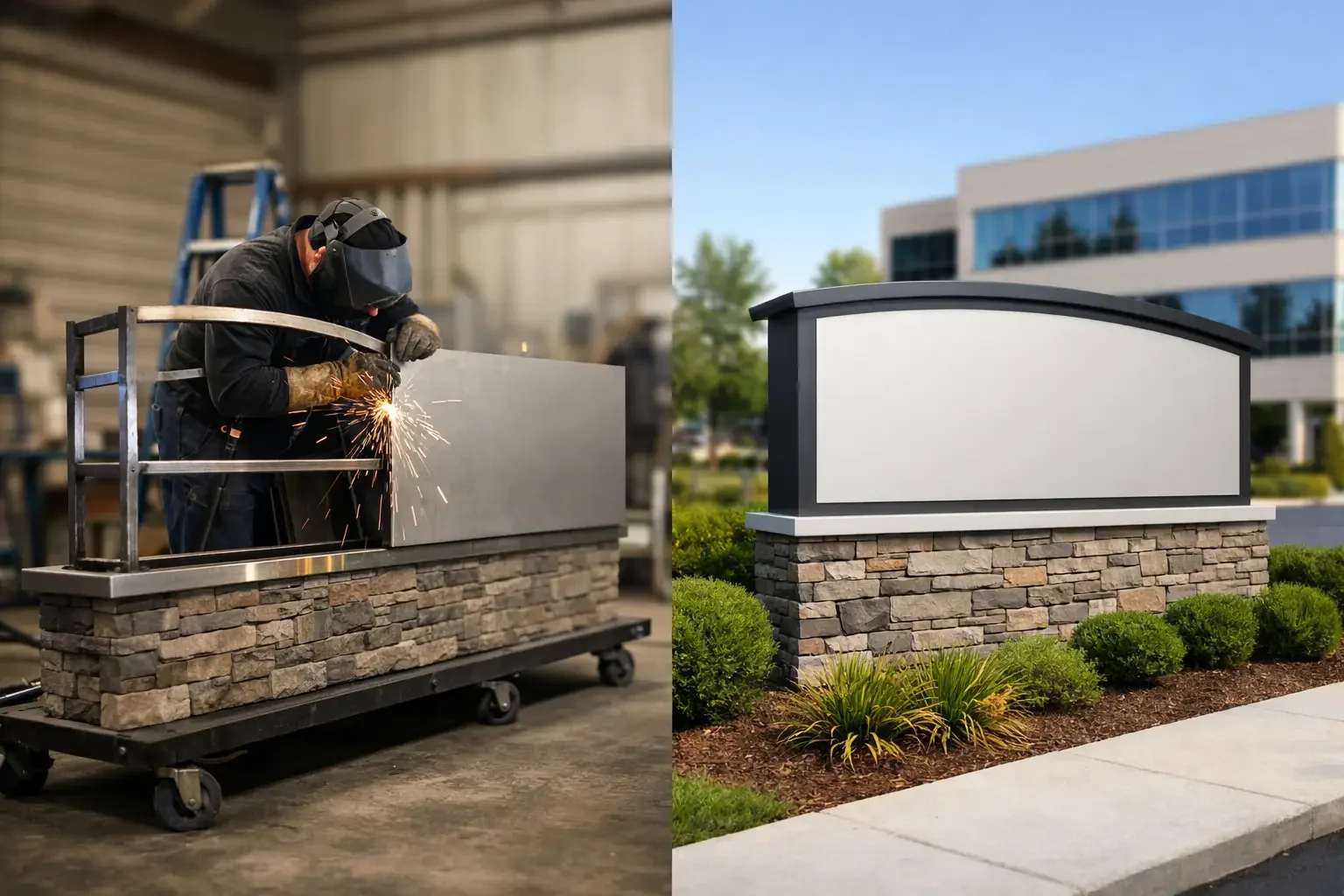
A monument sign combines a visible face with a supporting structure and base. Those parts need to fit together. Plan the face dimensions and attachment details with the local contractor before the sign is manufactured.
We manufacture the sign face and agreed supplied components. Your local contractor handles the structure, foundation and installation. This guide explains how to coordinate that work.
What Monument Sign Fabrication Actually Includes
A monument sign is an architectural assembly, not a single material. Depending on the project, it may combine an internal steel frame, HDU faces or panels, aluminum returns, routed letters, acrylic copy, lighting components, brick or stone cladding, base trim, and concealed mounting hardware. Each component has to be specified around the others.
Confirm the finished face size, lettering, colors and attachment requirements. Send those details with the quote request so the supplied panel can be planned around the contractor's structure.
HDU is useful for dimensional lettering and textured sign faces, but it is not a substitute for a designed structural support. The local contractor or engineer should specify the structure and its attachment to the site. Related: About HDU material
Start With the Structure, Not the Face
Resolve the support and face attachment early. Provide the agreed dimensions and fixing positions so they can be coordinated with the routed panel before finishing.
A freestanding monument typically relies on embedded posts, base plates, internal tube steel, or a combination of these elements. The correct approach depends on sign height, width, face area, soil conditions, local wind criteria, footing design, and whether the sign includes illuminated components. A low, non-illuminated entrance sign has different demands than a multi-tenant pylon-style monument with tenant panels and electrical service.
Fabricators should receive usable installation information, not just a visual concept. At minimum, production needs overall dimensions, frame geometry, post spacing, finished grade relationship, face attachment method, and any required electrical access. If engineering is required by the jurisdiction or project, that process needs to occur before fabrication is released, not after a finished sign is waiting in a crate.
Steel Must Support Repeatable Installation
Internal steel fabrication should be accurate enough that field crews are not drilling, shimming, or cutting through finished materials to make the sign fit. Welded assemblies need consistent dimensions, clean preparation for coatings, and attachment points that line up with the fabricated face system.
For larger signs, dividing the system into manageable sections can reduce freight risk and simplify installation. That trade-off adds field assembly steps, so flange connections, splice covers, fasteners, and alignment points need to be planned into the production drawings. A one-piece assembly may look cleaner on paper, but it is not always the right choice for shipping lanes, jobsite access, or crane availability.
Material Selection Drives Service Life
HDU is widely used in monument sign fabrication because it offers stable, workable material for dimensional exterior signage. It can be CNC routed for raised copy, prismatic details, carved textures, or recessed panels. It can also be sandblasted to create woodgrain, stone-like texture, and custom backgrounds without introducing the moisture problems associated with wood.
Density and thickness matter. Lower-density HDU may be appropriate for some nonstructural decorative elements, while larger faces, deep carving, and more demanding dimensional work often call for denser material or added reinforcement. The answer is not always to use the thickest available board. Material selection should match the routing depth, unsupported span, attachment layout, finished weight, and intended appearance.
Aluminum is often the better choice for returns, fabricated cabinets, trim, and components exposed to repeated handling. Acrylic can provide clean, illuminated copy where lighting is required. For dimensional letters, routed HDU, acrylic, aluminum, or formed plastic may each be appropriate depending on depth, finish, lighting, and budget. The right material is the one that performs in the finished assembly, not the one that appears cheapest as a raw sheet.
Routing and Finishing Are Where Quality Becomes Visible
CNC routing establishes more than the shape of a letter. It controls depth consistency, edge quality, fit between components, and the repeatability needed for multi-location programs. When a monument package includes multiple panels or tenant sections, consistent toolpaths and controlled production files prevent copy from drifting in size or placement from one assembly to the next.
Deep-carved HDU faces require particular attention to wall thickness, detail scale, and cleanup. Fine lines may look acceptable at small scale but break down when routed into a large exterior panel. Designers and estimators should review letter stroke widths, small copy, border offsets, and recessed areas against the selected fabrication method before approving art.
Finishing is equally consequential. Exterior coatings must be compatible with the substrate and applied over properly prepared surfaces. Primer coverage, edge sealing, texture treatment, and paint system selection affect both appearance and maintenance demands. A high-contrast, multi-color monument sign can require masking and staged finishing that adds production time. That is not wasted time. It is the difference between clean architectural color breaks and overspray, bleed-through, or inconsistent gloss.
If you want a particular woodgrain texture or special color effect, send a reference when requesting the quote. Agree on the approval method and any sample requirements as part of the order. We prepare the artwork/proof after payment and manufacture after your approval.
Build for Freight Before the Sign Is Finished
Large sign faces need careful packing around their edges, lettering and projections. The packing method should suit the panel's size and shape and the agreed delivery arrangements.
A freight-ready package may require skids, blocking, edge protection, foam separation, shrink wrapping, banding, and crating based on the part geometry and carrier requirements. Panels should not shift against each other. Dimensional letters and loose hardware should be protected and labeled. Heavy steel components need restraint that prevents movement without crushing finished faces.
Confirm which mounting parts, templates or diagrams will be supplied with the sign face. Your installer should review those requirements before manufacturing.
Production Controls Protect Margin
The cost of a monument sign is not limited to material and labor. Rework, missed freight appointments, field modifications, replacement parts, and installer downtime can quickly exceed the original fabrication savings. Trade buyers should evaluate a fabricator's process controls as closely as its unit price.
A reliable workflow includes approved production drawings, documented dimensions, material verification, CNC file control, in-process inspection, finish checks, and final packing review. For repeat programs, retained production files and controlled specifications make future locations more predictable. That precision repeatability is especially valuable for franchise networks, healthcare systems, retail centers, and multi-property management groups where signs need to match across markets.
The price we quote includes your fully finished sign and shipping to your delivery address. We manufacture and ship custom HDU signs nationwide. Installation is not included or provided. Foundations, masonry, local permits and site work remain with your local contractor.
When to Outsource Monument Sign Work
Outsourcing the HDU face can help when a panel exceeds your routing capacity or would interrupt other shop work. Confirm the supplied scope separately from any structural metalwork or site work you arrange locally.
The right wholesale partner should be able to work from controlled specifications, identify fabrication conflicts before production, and produce components in the condition the installer expects. Lowest price alone is not a production strategy. A lower quote that omits structural coordination, finish protection, or freight-safe packaging can create more cost after the purchase order is issued.
Send the face design and the contractor's mounting requirements together. That lets us discuss the sign we can supply and resolve fit questions before manufacturing.