
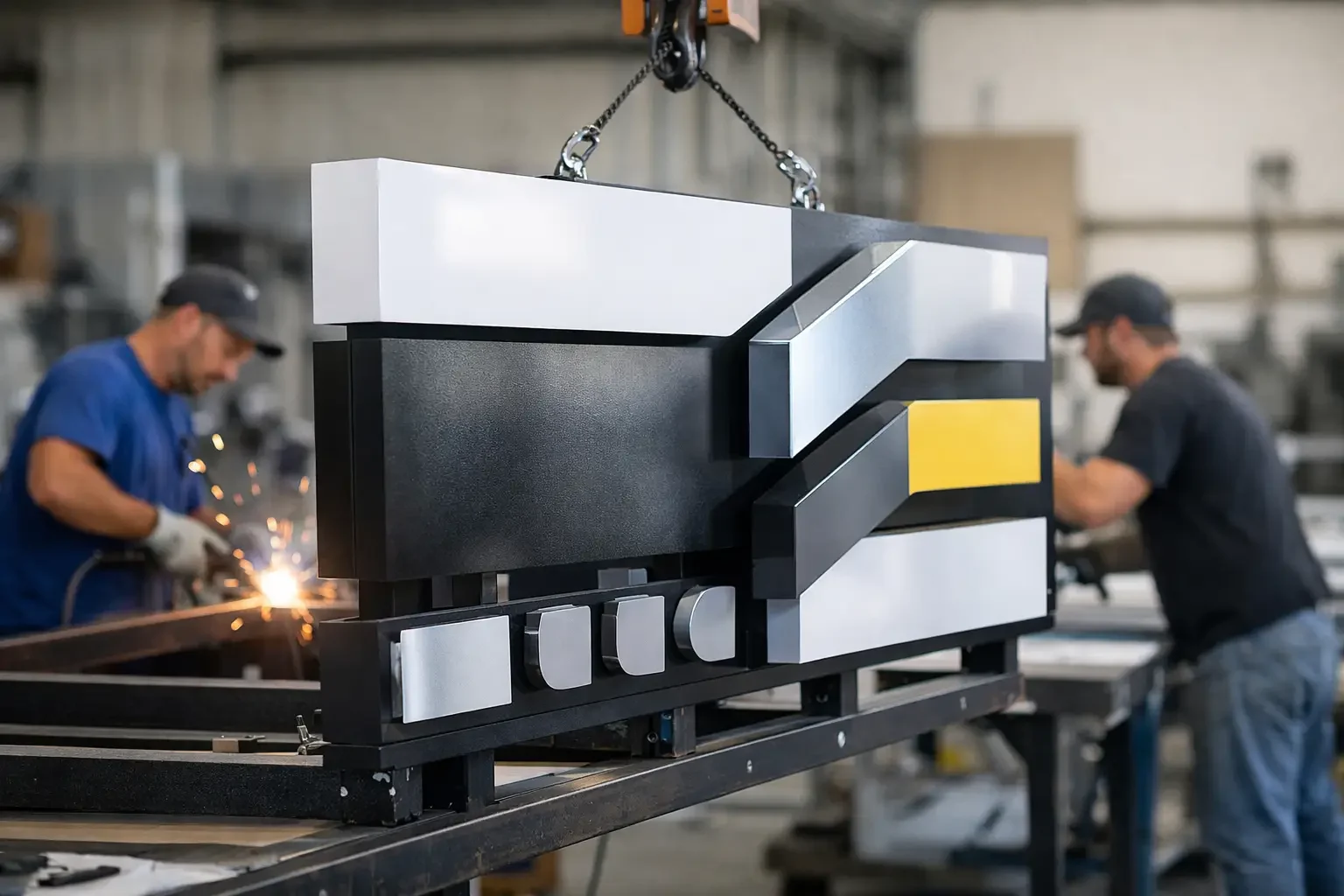
A finished sign face needs a suitable structure behind it. This guide explains the information to coordinate with your structural fabricator, installer and engineer when a project includes frames, posts or foundations. Our work is the manufacture and shipment of custom HDU signs and components.
Agree on the dimensions, attachment points and responsibilities before ordering the face. We manufacture and ship custom HDU signs nationwide. Installation is not included or provided.
What Structural Fabrication Covers
Structural fabrication is the production work that gives an exterior sign its load-bearing backbone. Depending on the project, that can include welded aluminum or steel frames, internal tube structures, formed returns, raceways, base plates, mounting brackets, cabinet bodies, posts, anchor provisions, and reinforcement for dimensional sign faces.
The correct scope depends on how the sign transfers load. A routed HDU panel mounted directly to a masonry wall has different structural requirements than a freestanding entrance monument, a multi-tenant pylon face, or a large architectural letter set mounted on a stand-off rail system. Treating all of these as simple sign panels creates problems later, usually at installation.
A fabricator should build to the approved specifications rather than make assumptions about structural intent. That means confirming finished dimensions, mounting method, material thickness, internal reinforcement, drainage requirements, access points, and the relationship between decorative faces and the supporting frame. When a project includes HDU, aluminum, steel, acrylic, or composite materials in the same assembly, those details matter even more.
Coordinate the face and the support structure
Exterior signage is a manufacturing project, not a collection of separate parts. A welded frame can be dimensionally correct but still create trouble if routed panels were not produced from the same reference points. Likewise, a finished face may look clean in the shop but be unusable if fasteners, raceways, or bracket locations do not align at the jobsite.
Process control starts before material reaches the machine. Production teams need a clear fabrication package that identifies overall dimensions, component thicknesses, finish callouts, mounting hardware, electrical provisions where applicable, and freight considerations. Any ambiguity at this stage becomes a production decision, and unapproved production decisions often become field corrections.
Use the same verified dimensions and attachment points for the routed face and its support structure. Your structural fabricator and installer should confirm the frame, loads and site connections before we make the HDU components.
For repeat programs, this control becomes even more valuable. Franchise rollouts, medical campuses, municipal wayfinding systems, and multi-location commercial projects need more than a one-time prototype that looks good. They need precision repeatability across sizes, locations, and reorder cycles.
Material Selection Is a Performance Decision
Aluminum is frequently specified for exterior sign structures because it resists corrosion, reduces weight, and works well with many architectural sign systems. Steel may be appropriate where higher strength, heavier loads, or particular base and post configurations are required. The trade-off is that steel needs proper preparation and coating to manage corrosion exposure.
HDU is an effective material for dimensional faces, sandblasted panels, carved graphics, and architectural sign details because it does not rot, split, or absorb moisture like wood. It is not, however, a substitute for a properly engineered frame where the assembly spans long distances, carries significant wind load, or uses post-mounted construction. HDU should be supported according to panel size, thickness, attachment method, and expected exposure.
Mixed-material assemblies also require attention to movement and drainage. Metal and polymer-based materials respond differently to heat, cold, and direct sun. A system that is clamped too tightly or sealed without a drainage path can show stress, finish failure, or water retention over time. Good fabrication accounts for those conditions before finishing begins.
Details That Separate Install-Ready Work From Shop-Ready Parts
A finished face may still need a frame, site hardware or other work by your installer. List what each supplier will provide so no one assumes an unquoted component is included.
Confirm hole locations, backing and access for fasteners with the installer before the sign is made. Any brackets, patterns or other parts supplied with the face should be listed in the written order. Related: Mounting guidance
Finish quality is equally operational. Welds should be cleaned and prepared for the specified coating system. Routed HDU edges and pockets need to be sealed and finished consistently. Components that meet at visible joints need controlled gaps and alignment. A premium paint system cannot compensate for poor substrate preparation, just as a clean weld cannot compensate for an incorrect frame layout.
Freight planning also belongs in the fabrication conversation. Oversized panels, welded frames, and finished dimensional assemblies can be damaged when packaging is treated as a final shipping task rather than a production requirement. Crating, corner protection, internal blocking, and labeled components reduce the risk of cosmetic damage and lost hardware. For a national project, freight-safe packing is part of delivery quality.
Specifications to Resolve Before Fabrication Starts
Experienced buyers know that a quote can only be as accurate as the production information behind it. The following items should be resolved before structural work is released:
- Overall sign dimensions, thicknesses, and finished face layout
- Structural materials, tube sizes, sheet gauges, and reinforcement needs
- Mounting method, hardware requirements, base plate details, and anchor locations
- Finish system, color standard, texture, sheen, and exposure conditions
- Electrical access, raceway clearance, service doors, and wiring paths when illuminated elements are involved
- Site constraints such as wind exposure, wall construction, footing design, access equipment, and delivery limitations
Not every job needs a fully engineered submittal package from the sign fabricator. It depends on the size, jurisdiction, installation method, and responsibility assigned in the contract. But every job needs enough information to produce parts that fit the intended site condition. If footing design, wind-load engineering, or final anchorage is outside the fabrication scope, that boundary should be explicit.
Choosing a Fabrication Partner for Complex Sign Work
The lowest unit price is rarely the lowest project cost when structural accuracy is involved. A supplier that sends an incomplete or poorly coordinated assembly can shift labor, correction, and liability back to the sign shop or contractor. The result is usually rushed work in the field, delayed inspections, and an installation crew waiting on replacement parts.
Evaluate a fabrication partner on production capability, not only on sample photos. Ask whether the team can coordinate CNC-routed HDU components with welded metal structures, whether it works from specifications and approved drawings, and whether it has a defined finishing and packaging process. Confirm how revisions are controlled and whether the supplier can support repeat orders without rebuilding the job from scratch.
We supply routed HDU panels, dimensional letters and finished sign faces for businesses and trade buyers. Tell us which components you want made and provide the support details from your installer. Do not assume structural metalwork, foundations or installation are included in a sign-face quote.
Keep the approved sign drawing and structural drawings together. Check that their dimensions and attachment points agree before either supplier begins fabrication.
Send us the face dimensions, artwork and mounting provisions required for your project. Your local project team should confirm the structure and installation plan.