
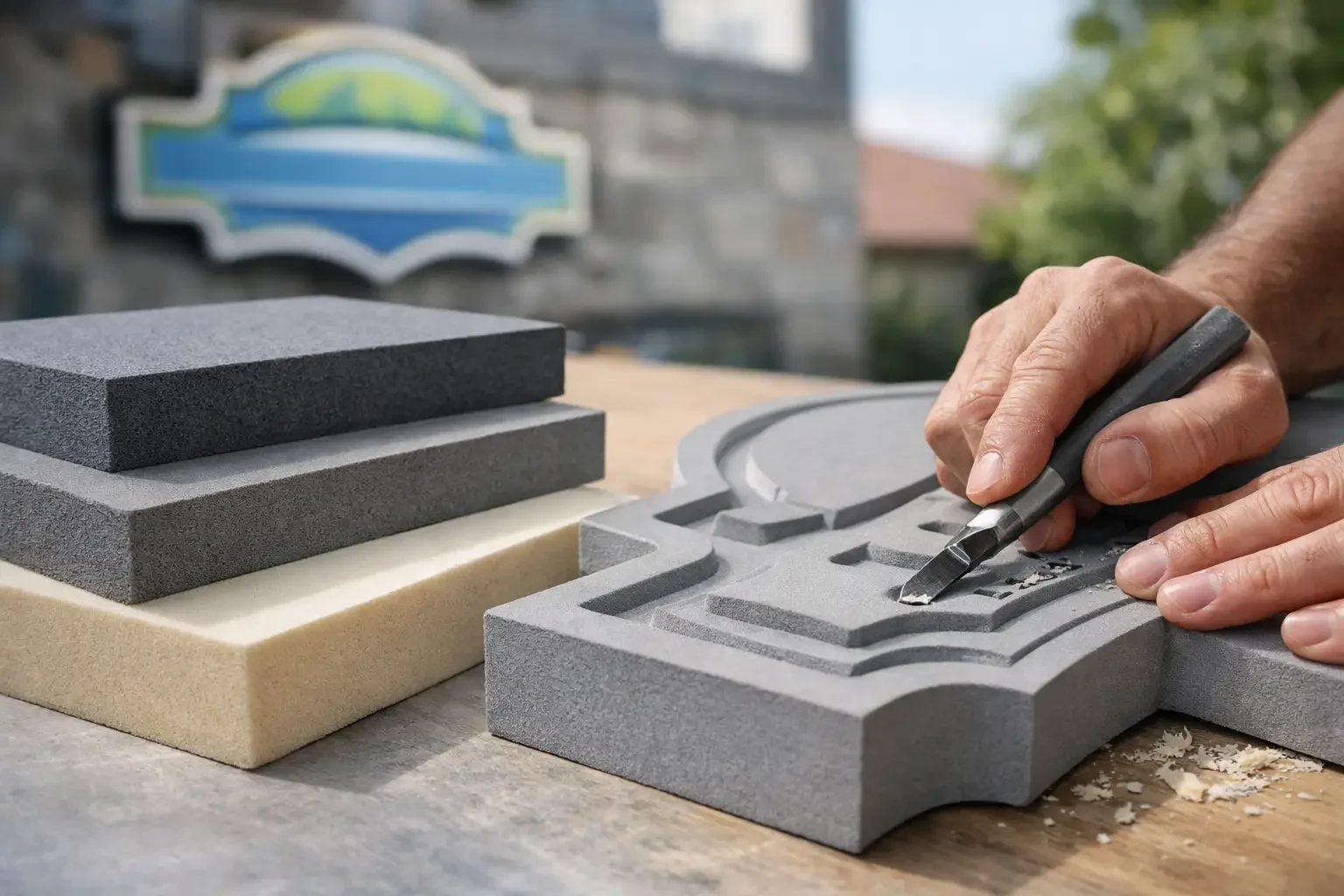
HDU density is one part of the sign specification. The lettering, carving depth, panel size and support also matter. Discuss them together before choosing the board.
Density describes how much material is in a given volume. It affects weight and surface toughness, but a higher number does not remove the need for suitable backing, mounting and finish.
What HDU Density Actually Means
HDU, or high-density urethane, is a rigid closed-cell foam commonly used for dimensional letters, sandblasted signs, routed panels, monument faces, and architectural elements. Density is typically expressed in pounds per cubic foot, often written as PCF. A 15 lb HDU board weighs approximately 15 pounds per cubic foot, while a 30 lb board weighs approximately 30 pounds per cubic foot.
Higher density does not make HDU structural in the same way as aluminum, steel, or exterior plywood. It does, however, produce a harder surface with greater resistance to dents, sharper machined details, and improved performance where the finished part will see handling, contact, or demanding routing geometry. Lower-density material remains useful because it is lighter, easier to carve, and usually more economical.
Confirm density and thickness together in the order. If you do not know which to request, send the design and size so we can discuss them with you.
How to Specify HDU Density by Sign Application
The right density depends on what the part must do after it leaves the fabrication floor. Start with the application, then evaluate the visual detail, panel size, mounting method, and exposure conditions.
Standard routed letters and dimensional copy
Our standard material is 15 lb HDU. We review the lettering size, thickness, detail and support for each order; other densities should be discussed as a project-specific choice.
This range works best when letters are not excessively thin, small details are limited, and the mounting system does not depend on screws threaded directly into the HDU. Stud-mounted letters, adhesive-mounted copy, and letters mounted to a separate backer are common applications. When specifying these components, provide letter thickness, stroke widths, return requirements if any, mounting pattern, and finish system alongside the density.
Sandblasted panels and carved sign faces
For carved or textured panels, choose the density with the relief depth, lettering and panel construction in mind. Do not assume that every sandblasted or carved sign needs the same higher-density board. Related: Textured sign options
For a sandblasted panel, density is only one part of the build. The specification should state the overall panel thickness, border treatment, background texture, raised-copy height, paint colors, and whether the panel will receive a high-build coating system. A 1.5-inch or 2-inch panel may be appropriate for substantial carved relief, but thickness alone does not replace the need for adequate density.
Large exterior panels and monument sign faces
A large exterior face needs its thickness, support and attachment planned together. Size alone is not a reason to prescribe 20 lb HDU as a universal starting point.
However, large panels should not be specified by density alone. HDU is not intended to span long distances without support. A broad sign face may require an aluminum frame, steel substructure, composite backer, or reinforced mounting system to control flexing. If a sign is mounted across posts, installed on a monument cabinet, or fabricated as a freestanding panel, identify the support layout and attachment points during quoting.
A properly engineered 15 lb panel with adequate reinforcement can outperform a 30 lb panel that is under-supported. Density improves the material surface. Structural design manages loads, wind, deflection, and attachment reliability.
High-detail routed work and exposed edges
Fine lettering and exposed edges may justify a different density or a change to the design. Send the artwork at its intended size so the detail can be reviewed before the material is agreed.
This is particularly relevant for close-view signs, branded architectural elements, and panels with layered paint colors that reveal routed detail. If the design depends on tight tolerances, send vector artwork and identify any dimensions that cannot be adjusted for tool diameter. CNC routing can achieve precision repeatability, but the final result still depends on realistic stroke widths, corner radii, and material selection.
Components that need mechanical attachment
Do not assume HDU density alone will provide dependable fastener holding. Higher-density boards offer better screw retention than softer grades, but HDU should not be treated like wood when mounting heavy letters, hardware, lighting components, or structural brackets.
For mechanically attached assemblies, specify the intended fastening method. That may include through-bolts with washers, embedded threaded inserts, aluminum reinforcement, steel armatures, or attachment to a separate structural backer. If the sign will be installed in a high-wind location or exposed to public contact, the attachment design deserves as much attention as the face material.
Build the Density Into a Complete Fabrication Spec
A usable HDU specification tells the fabricator what to produce, how the component will perform, and where responsibility for structural support begins. A density number without these details invites assumptions and quote revisions.
Record the agreed material grade and thickness alongside the finished dimensions and quantity. Identify whether you are ordering a panel, separate letters or several assembled layers.
Next, document the machining scope. State whether the design requires through-cuts, V-grooves, engraved copy, raised copy, shallow relief, deep relief, or blasted texture. For sandblasted work, call out the desired depth and border width. For routed letters, identify the face profile, edge treatment, and any areas requiring exceptionally sharp detail.
Finish requirements matter because coatings affect both appearance and production sequence. Identify whether the HDU will ship raw, primer-coated, painted, textured, or fully finished. If color matching is required, provide the color standard. A premium exterior coating system improves durability, but it cannot correct weak design geometry or an unsuitable mounting plan.
Finally, specify installation conditions. Note whether the sign will mount to masonry, a raceway, a steel frame, monument posts, or an existing sign cabinet. Provide mounting-hole locations, stud patterns, reinforcement locations, and any hardware that must be installed before shipment. This turns a material request into an install-ready system.
Avoid the Most Common Density Specification Errors
The first error is specifying the lowest density to reduce the initial price without considering finishing, handling, and installation risk. A lower material cost can disappear quickly when thin edges chip, a panel flexes, or field crews need to improvise reinforcement.
The second is over-specifying density where it provides no measurable return. A high-density panel may add cost and weight to a simple, well-supported sign face that would perform well at 15 lb or 18 lb. The goal is not to select the hardest board available. The goal is to select material that meets the application with production efficiency.
The third is treating HDU as the structural backbone of a sign. HDU is an excellent sign substrate, but large monument systems, post-mounted signs, illuminated assemblies, and high-load installations require appropriate metal fabrication and engineered support. Keep decorative HDU components and load-bearing structure clearly separated in the specification.
The fourth is omitting freight and handling considerations. Large finished HDU panels can be damaged by flexing, edge impacts, or poor crate design even when the material itself is correctly specified. For nationwide delivery, finished dimensions, panel rigidity, loose components, and packing requirements should be reviewed before production is released.
A Practical Default for Commercial Quotes
Start a discussion with the design, size and location rather than guessing a density. We use 15 lb HDU as our standard and review any alternative along with the carving detail, thickness and support requirements.
We review density together with the design, thickness, finish and supplied mounting provisions. The agreed specification is recorded before manufacturing.
A useful specification tells us what the sign needs to look like and how it will be supported. If you have a sketch or logo but no material specification, that is enough to begin the conversation.