
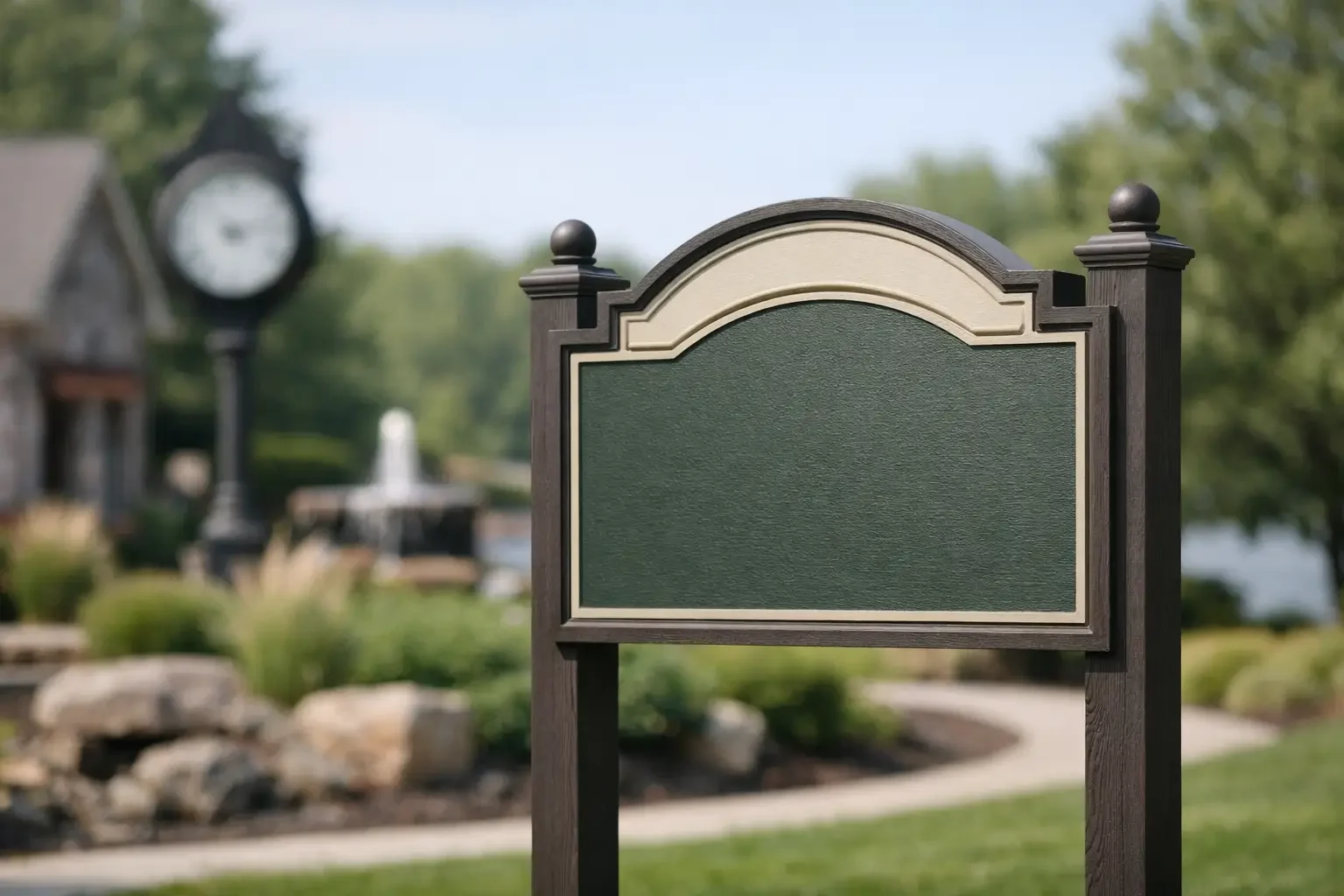
There is no single lifespan that applies to every HDU sign. The panel, paint, support and exposure all matter. Tell us where the sign will be used so we can discuss a suitable construction and finish.
HDU's resistance to moisture-related decay makes it useful for carved panels and dimensional letters. It can still be damaged, and the paint and mounting need care. The finished sign should be considered as a complete assembly. Related: About HDU material
How Long Do HDU Signs Last in Exterior Service?
The paint may need attention before the panel needs replacement. Inspect the finish and mounting periodically, and ask for advice if you notice damage or loosening. Our 5-Year Workmanship Warranty describes the coverage for our work; it is not a promise of a fixed maintenance-free lifespan.
That distinction matters in estimating. HDU does not typically fail because it decays from the inside out. More often, the sign reaches a maintenance point because paint has weathered, an edge has been damaged, a mounting assembly has corroded, or the original graphics need replacement. A panel can remain structurally usable while the visible finish system needs attention.
Look beyond the face material. Panel thickness, backing, hardware, finish, drainage and handling all affect how the sign performs at its location.
What Determines HDU Sign Service Life?
Density and panel thickness
Not all HDU performs the same way. Lower-density material can be appropriate for certain interior or low-impact applications, but exterior architectural signs often benefit from denser stock. Higher-density HDU provides better edge definition, greater resistance to incidental impact, and more stable performance on larger routed or sandblasted components.
Thickness also matters. A thin panel may look adequate on a shop table but flex after installation, particularly on wide spans or signs exposed to wind loading. Flexing can stress coatings, fasteners, and applied elements. Larger panels need adequate thickness, proper frame support, or a reinforced fabrication approach rather than relying on HDU alone to carry the load.
Finish system quality
Prepare and coat HDU according to the board and coating manufacturers' instructions. Routed pockets, edges and backs need consideration as part of the complete finish system.
Sun exposure, color, climate and surface preparation affect the appearance of painted signs over time. Discuss the actual location and desired finish rather than assuming every coating will age in the same way.
Water management and mounting details
HDU resists moisture, but standing water is still a problem for a finished sign system. Water can work into seams, sit behind applied letters, stain textured areas, and accelerate corrosion in steel brackets or fasteners. A panel should be detailed to shed water, with mounting methods that avoid creating pockets where moisture and debris accumulate.
This is particularly relevant for monument signs. The HDU faces may perform well while an underspecified internal frame, steel base, or fastener package deteriorates. Galvanized or properly finished steel, aluminum components where appropriate, stainless hardware, sealed penetrations, and drainage planning protect the complete assembly. The service life of the sign is limited by its weakest component.
Exposure and physical abuse
Sun exposure drives cosmetic aging. Physical contact drives localized damage. Signs near cart traffic, landscaping equipment, delivery routes, parking lots, or public sidewalks need more than an attractive face finish. They need a specification that accounts for impact risk.
HDU is durable, but it is not structural steel. Deep gouges, sharp impacts, and vandalism can damage the surface. The advantage is repairability: damaged areas can often be filled, shaped, primed, and repainted without replacing the entire sign. That is a practical lifecycle benefit for facilities teams and sign companies managing multi-site programs.
Common Reasons HDU Signs Fail Early
Early failure is usually traceable to fabrication or installation shortcuts, not to the basic suitability of HDU. Unsealed edges and routed details are common trouble spots, especially when a shop applies a fast finish schedule that does not adequately cover textured areas. Surface preparation and cure time matter just as much as the paint selected.
Poor support is another frequent issue. Large HDU panels can require internal reinforcement, perimeter framing, or engineered attachment points. Fastening directly through an unsupported face without considering thermal movement, wind load, and panel span can lead to cracking around hardware or visible distortion.
The third issue is mixing materials without accounting for their different movement and corrosion behavior. Metal letters, acrylic elements, steel frames, and HDU faces each respond differently to temperature and moisture. A production-ready design leaves room for expansion, isolates dissimilar materials where needed, and uses attachment methods suited to the assembly.
Protect routed edges, raised details and painted faces during packing and delivery. Inspect the package and sign on arrival and photograph any visible damage before contacting us.
Maintenance That Extends HDU Sign Life
Routine maintenance is straightforward and should be built into the property owner's expectations. Wash the sign periodically with mild soap and water to remove dust, exhaust residue, pollen, and salt deposits. Avoid aggressive pressure washing at close range, especially around seams, painted edges, and applied copy.
During routine site inspections, look for chips, hairline cracks in the coating, failed caulk joints, loose fasteners, fading paint, and corrosion at the frame or base. Small finish repairs made early are faster and less expensive than waiting for weathering to spread across a face panel.
Repainting is a normal lifecycle event for exterior signage, not proof that the HDU has failed. Depending on exposure and color, a painted sign may need refinishing years before the substrate needs replacement. When the panel remains flat, sound, and securely mounted, refinishing can restore appearance and extend useful service life without the cost of a new fabricated assembly.
Specify HDU for the Job, Not the Quote Line
A long-lasting HDU sign begins at the quote stage. Provide the finished dimensions, intended exposure, mounting method, graphic depth, paint requirements, and whether the sign will include metal fabrication, lighting, or applied components. That information allows the fabricator to determine panel density, thickness, structural reinforcement, and packaging requirements before production begins.
For a repeat order, reference the previously approved design and tell us what has changed at the new location. We can review the size, finish and supplied mounting provisions before quoting.
Choose the finish and support with the same care as the lettering. A well-planned sign can be maintained and repaired when needed, without assuming a particular number of years from the material alone.