
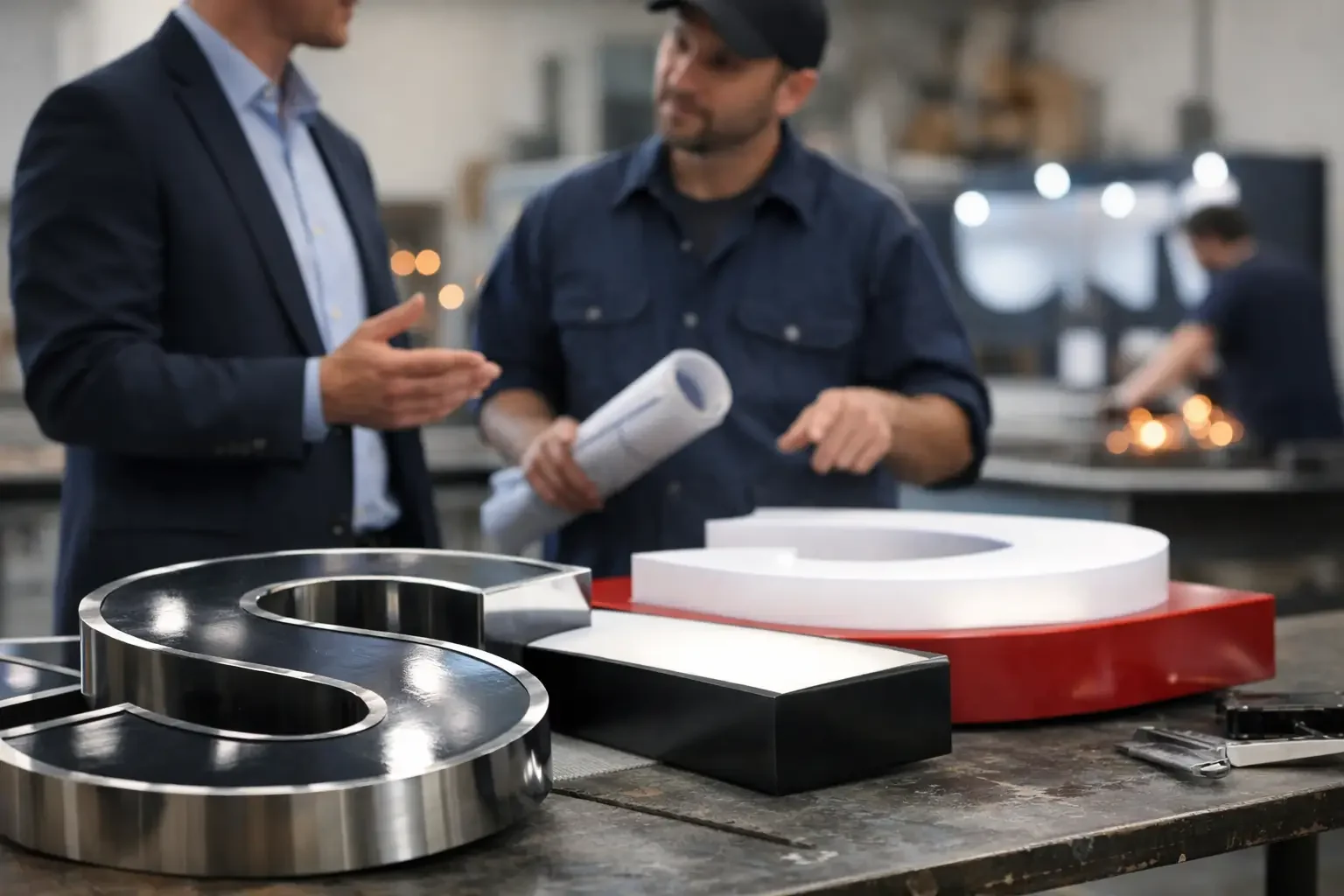
When you outsource a sign, your customer still looks to you if something goes wrong. Choose a fabricator who explains the construction, checks the drawings with you and confirms what will arrive at your shop or jobsite.
Begin with a clearly defined job. Agree on the size, finish, supplied components and delivery requirements so both shops understand where the fabrication work ends and your local work begins.
What a Trade Sign Fabrication Partner Must Deliver
Trade fabrication works when responsibilities are clear. The buyer owns the customer relationship, site conditions, and approved artwork. The fabricator owns the manufacturing process: material selection, CNC accuracy, finishing discipline, structural preparation, packaging, and shipment. That division only holds up when the fabricator understands how sign work is quoted, built, installed, and judged in the field.
For exterior dimensional work, precision is more than a clean routed edge. It includes consistent letter depth, accurate stud locations, dependable panel sizing, proper allowance for paint buildup, and tolerances that support real installation conditions. A nominally correct part can still create field problems if a mounting template does not match, a cabinet opening is undersized, or a panel has not been reinforced for its span.
HDU is a strong example of why material knowledge matters. High-density urethane does not rot, swell, or absorb moisture like wood, making it well suited to many exterior sign applications. But density, panel thickness, routed detail, finishing system, mounting method, and unsupported dimensions all affect long-term performance. A fabricator that treats HDU like generic foam can produce parts that look acceptable at shipment but create failures later.
Evaluate Manufacturing Capability, Not Just a Quote
Compare quotes for the same finished work. A lower figure is hard to judge if it leaves out painting, supplied hardware, packing or delivery.
Start by asking how the shop converts approved files into production. A capable trade fabricator reviews artwork for tool access, minimum stroke widths, inside radii, material thickness, and assembly requirements before CNC routing begins. This matters on intricate logos, serif lettering, layered sign faces, and multi-panel systems where small errors compound across the build.
The following capabilities are worth confirming before assigning complex or repeat work:
- CNC routing sized for commercial panels, dimensional letters, and repeatable profiles
- Knowledge of HDU density, thickness, reinforcement, and exterior finishing requirements
- Integrated metal fabrication for frames, raceways, returns, brackets, and structural components
- Production-grade finishing and packaging methods built for nationwide freight movement
Not every project needs every capability. A set of raw routed letters may only require accurate CNC work and clean labeling. A monument sign face, tenant identification system, or architectural wayfinding package may require routed HDU, metal structure, layered elements, painted finishes, hardware planning, and crate-level freight protection. The key is matching the fabricator's process to the actual job instead of forcing a partial supplier to handle work outside its core capacity.
Ask How Errors Are Prevented
Experienced buyers know that rework is rarely caused by one dramatic mistake. More often, it comes from a missing note, an assumed paint color, a reversed layout, an unconfirmed thickness, or a pattern that was never checked against the installation plan.
A reliable partner should be comfortable working from specification-based documentation. That includes finished dimensions, material callouts, thicknesses, color references, mounting details, quantities, artwork versions, and shipping requirements. If information is incomplete, the fabricator should identify the gap before material is cut rather than making an unverified production assumption.
This is especially important for repeat programs. Franchise and multi-location accounts depend on visual consistency, but consistency is not achieved by referring to a prior job from memory. It requires controlled files, retained specifications, and a production process that can reproduce approved components across locations and release dates.
Lead Time Is a Production Commitment
Sign buyers are often given lead-time promises that sound useful but have no operational definition. A stated lead time should account for artwork approval, material availability, routing, finishing, curing, assembly, quality checks, crating, and carrier pickup. If a supplier quotes only machine time, the schedule can fail during the less visible parts of the process.
Ask what is needed to start the order and when each approval is due. With us, you request a quote, agree to the order and pay, then approve the artwork/proof before manufacturing. Confirm timing before arranging your installation crew.
Speed still matters. A production-focused wholesale fabricator should have the equipment and workflow to support volume without treating every order as a one-off experiment. But rush capacity should be used strategically. Jobs with tight deadlines may require material or finish trade-offs, expedited freight, simplified construction, or an earlier release of approved artwork. The best decision is the one that preserves quality while meeting the actual field date.
Freight Is Part of Fabrication
Large dimensional signage is vulnerable long after it leaves the shop. Routed edges can chip, layered faces can separate under poor restraint, and finished panels can be scratched by inadequate blocking. A fabrication partner that considers shipping an afterthought transfers avoidable risk to the buyer.
Ask how the sign will be packed and received. Tell us about limited access, unloading equipment and receiving hours before the quote is prepared. The price we quote includes your fully finished sign and shipping to your delivery address.
Labeled parts and agreed templates can make the installer's work easier. Confirm which items are included in the order rather than assuming every sign arrives with the same mounting package.
Protect Margin Through the Right Division of Labor
Bringing fabrication in-house can make sense when volume is steady, the work is standardized, and the equipment, labor, ventilation, finishing space, and material handling are already justified. For many shops, however, large-format routing, HDU finishing, and structural sign fabrication create bottlenecks that pull skilled people away from sales, design, installation, and customer management.
Outsourcing is most effective when it removes the difficult portion of the build without giving up control of the customer experience. You can retain estimating, design direction, permitting, installation, and account ownership while placing precision routing and specialty fabrication with a trade-focused production source.
Include your own checking, assembly and handling time when comparing fabrication options. A clear order and reliable communication can save more work than a small difference in unit price.
Build the Relationship Before the Critical Job
Do not wait until a deadline-sensitive monument package or a multi-site rollout to test a new fabrication source. Start with a project that reveals how the partner communicates, reviews files, manages approvals, finishes parts, and packages freight. The goal is not to find a shop that says yes to every request. It is to find one that identifies production risks early and offers practical options.
A dependable trade partner should be direct about what will work, what needs clarification, and where a different construction method would improve durability or cost. That level of candor is useful because it prevents the quote from becoming a problem passed downstream.
Choose a partner whose work and communication you have checked on a manageable first order. Keep a written record of the approved design and supplied parts so repeat orders start from the same information.