
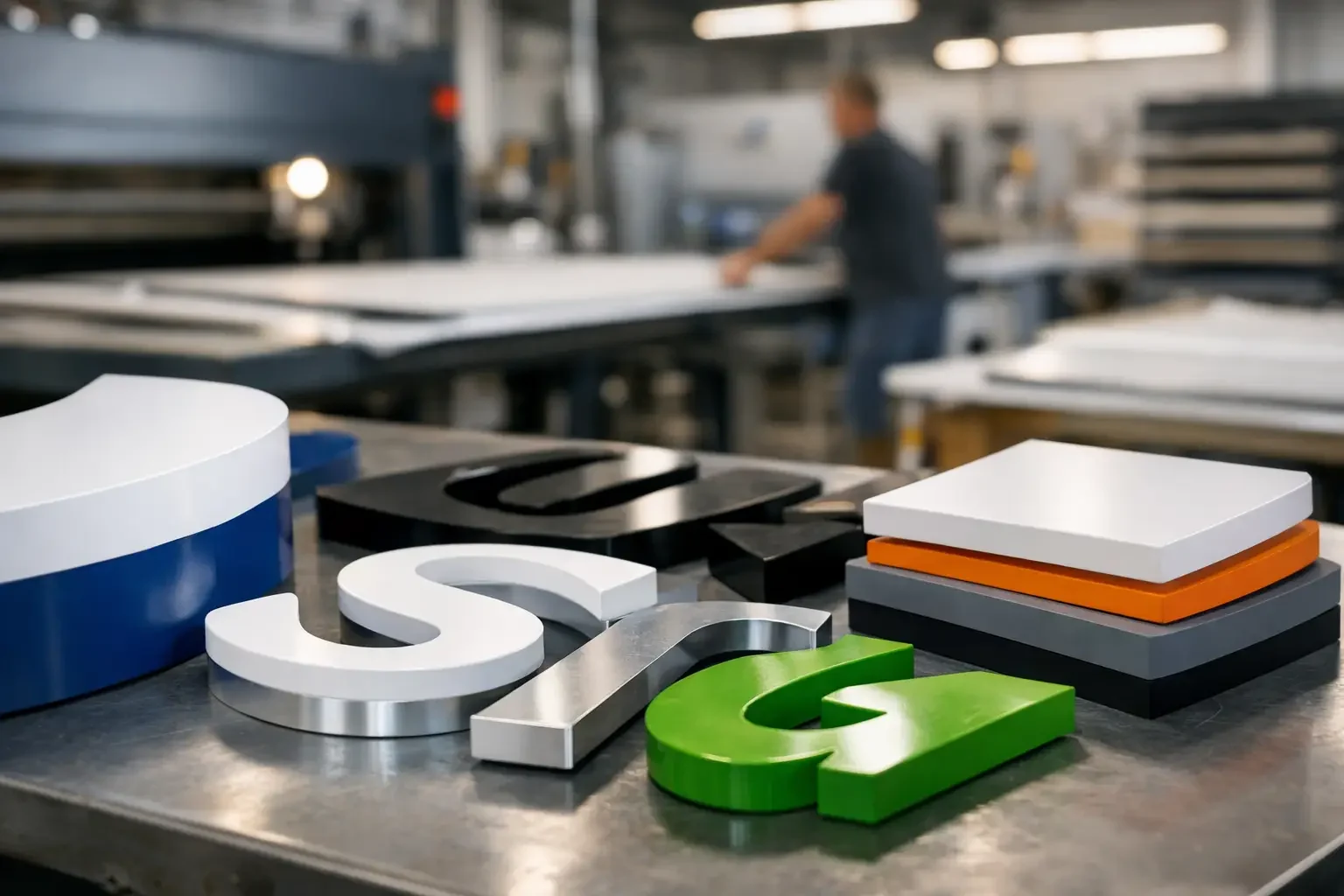
A dimensional sign brings together several pieces of work: routing, edge preparation, painting, assembly and packing. We can handle the stages your shop needs, with the size, depth, finish and supplied parts agreed before manufacturing.
For trade buyers, the value is not simply access to a router or a lower piece price. It is production repeatability. A qualified wholesale fabricator should turn a defined sign package into consistent, install-ready components without forcing your team to absorb the labor, cleanup, material waste, or rework risk of making it internally.
What Wholesale Dimensional Signage Manufacturing Should Deliver
Dimensional signage covers a broad range of fabricated work: raised letters, logo elements, routed panels, monument sign faces, architectural plaques, sandblasted HDU panels, and layered sign assemblies. These products may share a visual category, but they do not share the same fabrication requirements.
A shallow routed HDU letter set for a retail facade has different needs than a multi-layer entry sign with welded steel structure and a painted HDU face. Material thickness, fastening, paint system, wind exposure, lighting clearance, and installation surface all change the production plan. The manufacturer’s job is to identify those constraints before cutting begins, not after a finished piece fails to fit a wall or mounting pattern.
Trade-focused manufacturing should provide three things: accurate fabrication from approved artwork, materials selected for the application, and packaging that protects the sign through delivery. If any one of those areas is weak, the apparent savings of outsourcing disappears quickly.
Why HDU Remains a Practical Exterior Material
High-density urethane is a standard material for exterior dimensional signage because it machines cleanly, resists moisture, and does not rot, split, or swell like wood. It is especially effective for routed letters, sandblasted textures, carved sign faces, and shaped architectural components that need depth without excessive weight.
HDU is not the right answer for every sign. Aluminum, acrylic, steel, and ACM each have roles where their performance or appearance makes more sense. For example, thin, internally illuminated letters generally require metal fabrication, while a polished interior lobby logo may call for acrylic or metal laminate. The correct material depends on the environment, desired finish, structural demands, and budget.
Where HDU performs particularly well is on exterior projects requiring a substantial, carved, or dimensional appearance. A properly specified HDU panel can carry a detailed sandblasted background, raised copy, routed borders, and premium exterior coating while staying manageable for shipping and installation. It also gives sign shops a predictable substrate for repeat production across multi-location programs.
Density and Thickness Are Production Decisions
Not all HDU performs the same way. Density affects how well the material holds fine detail, resists incidental impact, and supports a finished edge. Thickness affects visual depth, rigidity, mounting options, and freight weight. Selecting the cheapest blank without considering the design often creates problems later, especially with narrow strokes, deep pockets, unsupported spans, or long panel dimensions.
A manufacturer should review the letter style and panel geometry before committing to a density and thickness. Fine serif letters, small counters, and detailed logo contours require different machining allowances than large block copy. For oversized panels, the fabrication plan may require laminated material, structural reinforcement, or a sectional design to protect the finished product and make field handling realistic.
Precision Starts Before CNC Routing
CNC routing is central to dimensional sign production, but routing accuracy alone does not guarantee an install-ready result. Good manufacturing begins with artwork review and a clear understanding of what the drawing represents.
Vector files should identify final copy, scale, layer order, material thickness, and required mounting details. When letters need studs, a shop drawing should confirm stud locations, hole diameters, and whether the installer will receive a pattern. When a panel mounts to a frame or masonry wall, the attachment strategy needs to be defined before fabrication. A sign component can be perfectly routed and still be wrong for the install if the mounting assumptions were never addressed.
This is where production communication protects margin. A quote based only on overall dimensions may be appropriate for a simple flat panel. It is not enough for a routed sign system with layered elements, welded brackets, painted returns, or freight-sensitive parts. The more fabrication steps involved, the more the quote should reflect a complete production scope.
Build a Specification Package That Can Be Repeated
For recurring work, franchise programs, and commercial rollouts, a usable specification package prevents the same questions from being solved on every order. It also reduces the chance that a replacement sign will differ from the original installation months later.
The package should establish the final face dimensions and thicknesses, material type and density, finish colors and texture requirements, mounting method, and any structural metal components. It should also identify whether the shipment includes templates, loose hardware, predrilled holes, raceways, or other installation aids.
Color deserves special attention. A paint name alone may not be sufficient when brand standards matter. Specify the color system, sheen level, and whether a field-applied topcoat is expected. Dimensional signs can include multiple materials that reflect light differently, so a color match on one substrate may not read the same on another. For high-visibility programs, an approved sample or production control standard is worth the extra step.
Plan for Assembly, Not Just Individual Parts
Layered dimensional signage often involves more than cutting letters and panel shapes. Components may need alignment, adhesive bonding, mechanical fastening, stud installation, metal reinforcement, or painted assembly. Every added operation creates a tolerance stack.
That does not mean complex assemblies should be avoided. It means they should be engineered for production. Hidden spacers, indexed mounting locations, consistent reveal dimensions, and logical layer sequencing reduce the opportunity for misalignment. When the sign arrives, the installer should receive a system that is ready to place, not a collection of parts that need to be interpreted in the field.
Finishing Is a Performance Requirement
Exterior finishing is not decoration applied at the end of a job. It is part of the sign's weather-resistance system and one of the largest contributors to perceived quality. Routed edges need proper preparation. Sandblasted or textured surfaces need complete coverage without losing the intended relief. Recessed areas, letter returns, and panel edges need the same attention as the visible face.
The right finish process depends on the sign design. A smooth architectural panel may require extensive surface preparation for a clean painted appearance. A sandblasted HDU sign may need a finish approach that preserves contrast between the background and raised elements. Metallic coatings, faux wood finishes, and multi-color graphics require additional process control because touch-up in the field is rarely as clean or profitable as doing the work correctly at the factory.
Ask how the supplier handles masking, edge finishing, color verification, and final inspection. Those details are not minor. They determine whether a job looks commercial-grade at ten feet and still holds up after exposure to sun, rain, and routine maintenance.
Freight-Safe Shipping Is Part of Manufacturing
Dimensional signage has vulnerable edges, raised copy, finished surfaces, and sometimes irregular shapes. Standard parcel packaging is not enough for many fabricated sign components. A sound shipping plan accounts for the size, weight, fragility, and handling points of the completed assembly.
Crating and internal blocking are often necessary for large panels, stacked letters, layered signs, and fabricated metal components. The goal is to prevent movement inside the crate and protect finished faces from abrasion or impact. For freight shipments, clear labeling and logical unloading orientation reduce the chance that a crew damages a sign before it reaches the wall.
There is a trade-off. Better packaging adds cost and sometimes adds lead time. On a small, durable set of letters, over-crating may not be justified. On a custom monument face or a high-value multi-layer sign, under-packaging is an expensive gamble. The right decision depends on replacement cost, delivery distance, site schedule, and the consequences of a damaged shipment.
When Outsourcing Beats In-House Production
A sign shop with routing capacity may still benefit from wholesale fabrication. The decision is not whether the shop can produce the work. It is whether using internal equipment is the most profitable use of available labor, machine time, finishing space, and management attention.
Complex HDU projects can consume production hours through material handling, routing setup, sanding, paint preparation, assembly, and packing. They also create dust, require staging space, and can interrupt simpler jobs with faster turnaround. Outsourcing makes particular sense when the project needs deep routing, sandblasting, high-volume repeatability, structural fabrication, or factory finishing that would stretch internal capacity.
We manufacture routed HDU components, textured panels, dimensional letters and raw blanks in Georgia and ship nationwide. Your shop can retain design, customer communication and installation while we complete the fabrication listed in the order.
Send the artwork, dimensions, finish and quantity, along with your installer’s requirements. The price we quote includes your fully finished sign and shipping to your delivery address. For raw or primed components, the written quote identifies that completion level and includes shipping.