
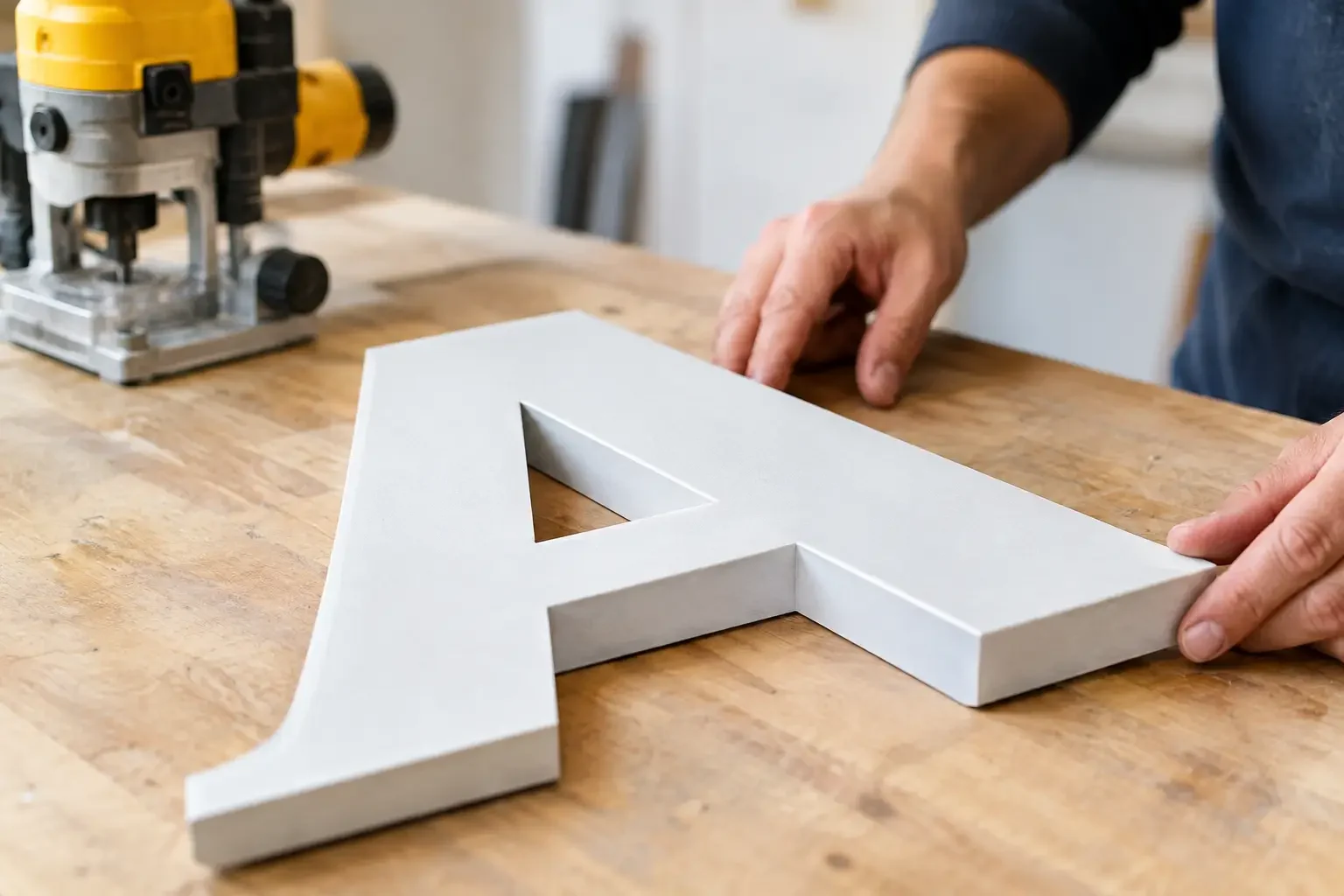
Keeping routed letters flat starts with their design. Thickness, long narrow strokes, coating, mounting positions and packaging can all affect the finished shape, so review them together before routing.
Bowed or twisted letters are harder to align and may need to be remade. Checking the geometry and support early helps avoid that disruption.
Why Routed HDU Letters Warp
HDU resists moisture absorption and does not rot like wood. It can still be damaged or distorted by impact, poor support, temperature changes or mounting pressure. Long, thin letters need particular care during manufacture, shipping and installation.
The most common issue is not the HDU blank itself. It is insufficient structural support for the letter's shape. A 24-inch-wide block letter with broad strokes behaves very differently from a 24-inch script letter with narrow returns, extended terminals, and open interior areas. The script may have less material tying its sections together, making it more vulnerable to flexing during finishing, packing, freight, and installation.
Heat also matters. Dark finishes absorb significantly more solar energy than light colors, especially on southern and western exposures. A thin, dark letter installed against a hot masonry wall can experience more thermal stress than the same letter mounted on a shaded interior feature wall. HDU remains an excellent exterior substrate, but material selection and fabrication details must match the application.
Start With the Right HDU Thickness
Thickness is the first structural decision. It should be driven by letter height, stroke width, overall span, mounting method, and exposure conditions rather than by the lowest material cost.
For smaller copy with compact geometry, thinner HDU may be appropriate when the letters will be flush mounted to a stable, flat substrate. As letters become taller, wider, or more intricate, additional thickness provides greater rigidity and a better foundation for stud mounting. Large letters with narrow sections often benefit from thicker material even when the desired visual profile is relatively shallow.
This is particularly relevant for letters with long unsupported spans. Wide uppercase characters such as E, F, L, T, and Y can flex if their strokes are thin relative to their overall height. Script fonts, serif faces, and logos with sweeping curves deserve the same scrutiny. A production review should identify the weakest points in the geometry before routing begins.
When a project requires a slim profile but the design needs more strength, a fabricated solution may be more appropriate than simply reducing HDU thickness. A concealed backer, integrated aluminum reinforcement, or a modified mounting approach can preserve the intended appearance without accepting unnecessary movement risk.
Review Font Geometry Before Production
Artwork approval is not the same as fabrication approval. A font that looks balanced on a proof can contain fragile bridges, narrow crossbars, or isolated sections that create handling problems at full scale.
Production teams should evaluate minimum stroke widths, interior cutouts, transitions between thick and thin areas, and the relationship between letter size and mounting points. If a letter cannot accept adequate stud placement without drilling too close to an edge, the design needs a different mounting strategy. Trying to force studs into undersized sections can split material, telegraph stress through the face, or leave the letter unsupported where it needs support most.
Machine for Flatness, Not Just Cut Accuracy
CNC accuracy is essential, but cut accuracy alone does not ensure a stable routed letter. HDU blanks should be stored flat, supported across their full area, and allowed to acclimate to the production environment before machining. A blank that is already stressed, unevenly supported, or exposed to excessive heat can create avoidable problems before the router starts.
During routing, the hold-down method must secure the sheet without crushing it or introducing distortion. Tool paths should be selected to avoid unnecessary stress on delicate features, especially on smaller strokes and intricate copy. Clean tooling matters because excessive cutting force can damage edges and require aggressive sanding or filler work later.
After routing, letters should remain supported on flat surfaces. Stacking finished copy carelessly, leaning long letters against a wall, or carrying a large script letter from one weak point can introduce a bend that becomes more apparent after paint and installation. Large or delicate letters should be handled with temporary support panels, trays, or purpose-built packing fixtures.
Use a Balanced Finish Schedule
Coatings protect HDU, improve appearance, and support long-term exterior performance. They can also create problems when they are applied unevenly or rushed through curing.
A proper finish schedule starts with compatible primer and coatings suitable for HDU. Edges, routed returns, and faces require consistent coverage. Heavy buildup on one side of a thin letter, followed by incomplete coating on the opposite side, can contribute to imbalance. The answer is not to undercoat the letters. It is to apply controlled, even coats and allow appropriate drying and cure time between stages.
Avoid placing freshly coated letters in direct heat or stacking them face-to-face before the finish has stabilized. Dark-painted letters deserve extra care because they will see higher surface temperatures after installation. Where the design allows, lighter colors, metallic finishes, or a more substantial letter profile can reduce exposure-related stress.
Paint should never be used to hide structural shortcomings. Thick coating may disguise minor surface imperfections, but it will not stiffen an underbuilt letter system or correct poor stud placement.
Prevent Routed Letter Warping With Better Mounting
Many apparent warping issues are actually installation issues. A letter mounted to an uneven wall, a warped raceway, or an irregular sign panel will conform to the surface unless the mounting system is designed to control that condition.
Flush-mounted HDU letters need a flat, stable substrate. If the wall has pronounced variation, installers should address the mounting plane rather than forcing the letters into place. Tightening fasteners against an uneven surface can bend the letter or place constant stress on the mounting points.
Stud mounting should be engineered for the letter's geometry. Studs need to be distributed across the letter to prevent rotation and to support long projections. Large letters often require multiple mounting points, while narrow strokes may require concealed reinforcement or an alternate attachment method. Adhesive can supplement mechanical mounting where appropriate, but it should not be used as the only answer for large, exterior dimensional letters unless the installation conditions and adhesive system have been specifically evaluated.
Expansion clearance also matters. Holes drilled too tightly around studs or fasteners can restrict normal material movement and concentrate stress. A controlled mounting pattern allows the letter to remain secure without being forced into a locked, distorted condition.
Treat Freight as Part of the Fabrication Process
A flat letter can be damaged between the shop and the jobsite if it is packed as an afterthought. Freight-safe shipping requires the same level of planning as CNC routing.
Letters should be secured so they cannot flex inside the crate or carton. Large copy should be supported across its full length, with separators that prevent face-to-face abrasion and bracing that prevents lateral movement. Fragile script letters, thin elements, and long horizontal components may need custom cradles or sacrificial support material.
Do not rely on bubble wrap alone for structural protection. It cushions impact, but it does not keep a wide letter from bending when a package is stacked, tilted, or handled by a freight carrier. The package needs a rigid exterior and an interior support strategy matched to the geometry of the fabricated parts.
Receiving procedures matter as well. Customers should inspect packaging before signing for freight, note visible damage, and keep components supported until installation. A large HDU letter should not sit leaning against a loading dock wall for several days before the crew is ready.
Specify for the Actual Installation Environment
The correct fabrication approach depends on where the letters will live. A set of lobby letters mounted to a smooth interior wall does not require the same design margin as dark exterior letters installed on a sun-exposed monument or a textured masonry facade.
Before production, confirm letter height, thickness, font, finish color, substrate, mounting method, wall condition, exposure, and shipping destination. These details let the fabricator identify risk before material is cut, when changes are still inexpensive and practical.
When you order routed letters from us, share the letter size, thickness, finish and your installer’s mounting requirements. We will confirm the sign components included in the quote; installation is arranged by you.
Check long strokes, narrow joins and mounting positions while the design is still on screen. Your installer should confirm the support the letters need before you approve them for manufacture.