
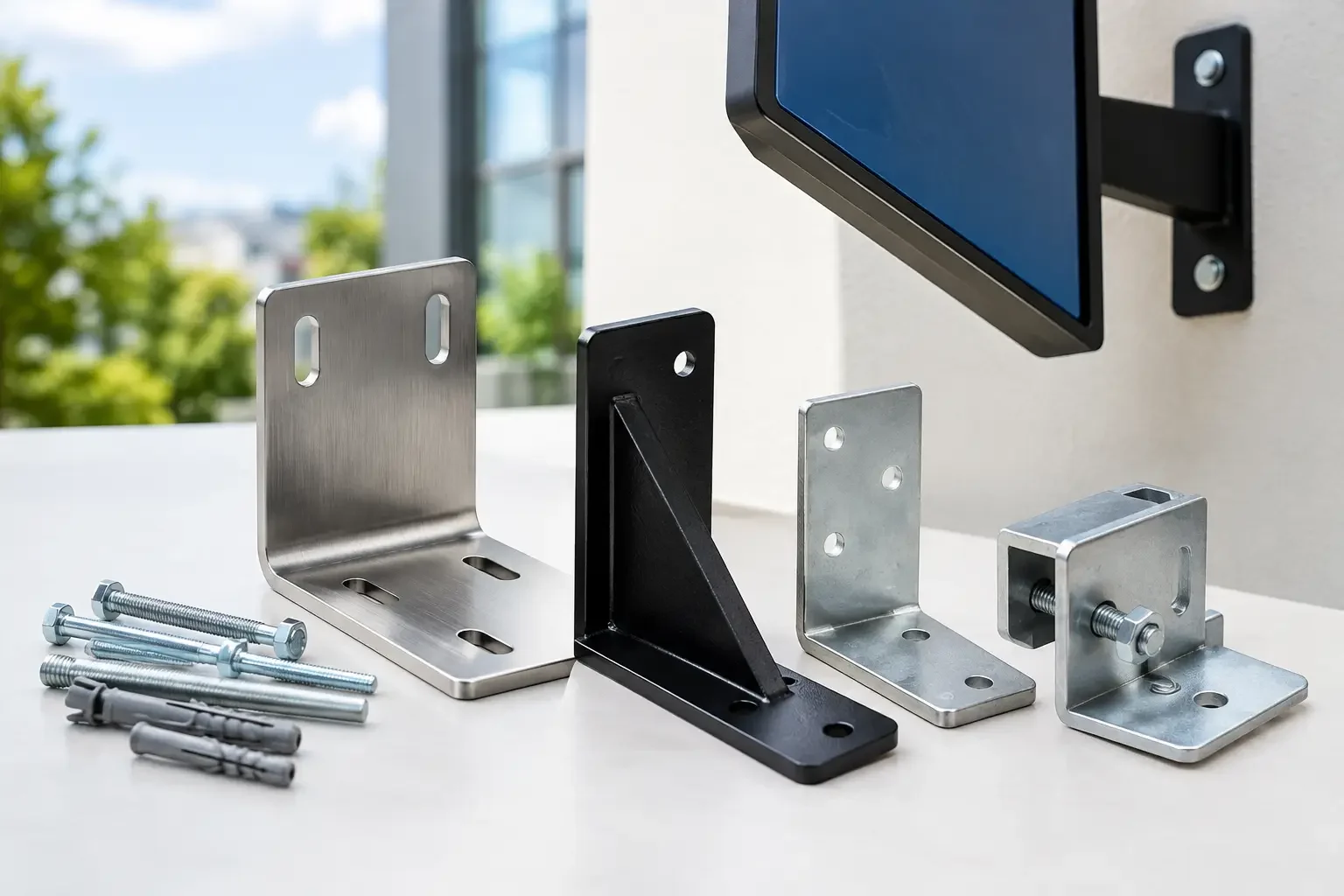
A sign bracket needs to suit the sign’s weight, projection and wind exposure as well as the wall or post it attaches to. This guide explains the details to discuss with your installer or engineer before you order the sign.
For HDU panels and letters, the bracket connects a relatively lightweight sign face to a supporting structure. Its shape, metal, coating and fasteners all need to work together.
Start With the Load Path, Not the Bracket Shape
The first question is not whether an L-bracket, angle, tube arm, or plate bracket will fit behind the sign. The first question is where the load travels. A sign face may be lightweight, but its projected area can create substantial force at the wall connection during wind events. The bracket must transfer that force from the sign body into a properly rated substrate without bending, tearing fasteners loose, or concentrating stress at one point.
Break the assembly into its actual loads: dead load, wind load, eccentric load, and any installation or service load. Dead load is the static weight of the sign, frame, lighting, and attached hardware. Wind load often governs exterior applications, especially for projecting signs, elevated panels, and signs installed in open commercial corridors. Eccentric load matters whenever the sign sits away from the wall or support column. That offset creates leverage, increasing demand on both the bracket and its anchors.
A shallow HDU panel mounted flat to a masonry wall may require simple concealed aluminum or steel mounting plates. A double-sided projecting sign needs a deeper structural arm or welded tube assembly because the weight and wind force act away from the wall. Treating both applications as a standard bracket job is how underbuilt systems reach the field.
Match Metal Selection to the Environment
Metal selection affects strength, corrosion resistance, weldability, finishing, and cost. The correct choice depends on service exposure and the bracket's role in the assembly.
Carbon steel is a practical option for many fabricated sign brackets because it is strong, readily welded, and cost-effective. It works well for internal frames, concealed structural arms, base plates, and fabricated components that will receive a durable protective coating. Its limitation is corrosion. Bare or poorly coated steel is not appropriate for exposed exterior use, particularly where water can sit in seams, tubes, or fastener pockets.
Aluminum is lighter and naturally corrosion resistant, making it useful for wall-mounted letter rails, nonstructural trim supports, and applications where handling weight matters. It does not offer the same stiffness as steel at the same thickness, so a lightweight aluminum bracket may need a larger section or added reinforcement to control deflection. Aluminum also requires attention when connected to dissimilar metals. Isolate it from steel where moisture could create galvanic corrosion.
Stainless steel is often justified for coastal environments, high-moisture locations, and exposed architectural details where the metal itself remains visible. It carries a higher material and fabrication cost, but it can reduce maintenance risk when specified correctly. Not all stainless performs the same outdoors. Grade selection should reflect the environment, especially near saltwater or deicing chemicals.
For most commercial exterior sign work, the decision comes down to properly finished carbon steel versus aluminum. Steel is usually the better value where structural capacity and welded fabrication are priorities. Aluminum is often the better fit where low weight and corrosion resistance outweigh its lower stiffness.
Thickness Is Only One Part of Capacity
Specifying a thicker plate without reviewing the full bracket geometry can create a false sense of security. Capacity depends on material grade, section depth, unsupported span, bend radius, gusseting, weld location, and anchor spacing. A thin but properly formed channel can outperform a flat plate that has no return flange or reinforcement.
Deflection deserves as much attention as ultimate strength. A bracket that technically supports the load but flexes under wind can leave a panel visibly out of level, crack rigid finishes, or fatigue fasteners over time. Dimensional signs need stable support systems, not brackets designed only to avoid immediate failure.
Choose the Right Bracket Configuration
A flat mounting plate is appropriate when the sign or letter assembly mounts close to a stable wall and the plate's purpose is load distribution or concealed fastening. It is often used behind HDU panels, dimensional elements, and installation-ready assemblies where face fasteners are not acceptable.
Angle brackets work well for light-to-moderate loads where the connection geometry is straightforward. They are economical and familiar to installers, but they become less effective as stand-off distance increases. Adding gussets can materially improve stiffness when an angle bracket supports an offset panel or canopy-style element.
Tube arms and welded frame brackets are the correct direction for projecting signs, large panels, and assemblies with meaningful leverage. Square or rectangular tube provides section depth and torsional resistance that flat stock cannot match. Closed tube sections should include drainage provisions where water intrusion is possible. Water trapped inside a tube can corrode steel from the interior even when the exterior coating appears intact.
For monument signs and freestanding structures, brackets may be secondary to the main steel frame, post system, or footing design. In those cases, the metal connection still needs to accommodate panel removal, service access, thermal movement, and the installation sequence. A clean fabrication drawing should show which components are structural, which are cosmetic, and which fasteners remain accessible after the sign is installed.
Specify Finish as a Performance Requirement
A finish is not an afterthought added after fabrication. It is part of the bracket specification. Exterior steel brackets need a coating system suited to the exposure, geometry, and expected service life.
Powder coating provides an attractive, durable finish for many exterior brackets when surface preparation and film coverage are controlled. It is especially effective for visible components and color-matched architectural assemblies. However, powder coating can be vulnerable at sharp edges, weld spatter, unsealed seams, and damaged areas created during installation.
Hot-dip galvanizing provides strong corrosion protection for structural steel in demanding outdoor conditions. It is a practical choice for post-mounted systems, concealed frames, and components exposed to persistent moisture. Its appearance is more industrial than powder coat, and dimensional tolerances require planning because the galvanized coating adds thickness. If a painted architectural finish is required, a duplex system of galvanizing plus a compatible topcoat can provide both corrosion protection and appearance.
Do not ignore cut edges, welds, drilled holes, and contact points. These are common points of coating failure. Bracket designs should avoid tight crevices that retain water and should allow coating coverage around welded gussets and tube connections.
Fasteners and Substrate Control the Installation
A well-built bracket cannot compensate for the wrong anchor or an unknown wall condition. The fastening schedule must match the substrate: structural steel, poured concrete, concrete masonry unit, wood framing, engineered blocking, or a rated cladding support system. Fastening into veneer, thin sheet metal, EIFS, or unverified backing is not an acceptable substitute for structural attachment.
Anchor selection should account for pullout, shear, edge distance, embedment depth, and spacing. Concrete anchors installed too close to an edge can compromise the substrate. Masonry block may require a different anchoring approach than solid concrete, and hollow-cell conditions can dramatically reduce available capacity. On framed walls, locate structural members or provide blocking before the sign arrives on site.
Field tolerances also matter. Slotted holes can help installers level an assembly and accommodate minor variation in wall layout, but excessive slotting can weaken the connection or allow movement if hardware is not tightened correctly. Use adjustment where it solves a real installation problem, then define final tightening and locking requirements.
Build Fabrication Details Into the Quote Package
The fastest way to prevent bracket revisions is to provide usable production information before fabrication begins. Include overall sign dimensions and weight, mounting elevation, stand-off distance, wall or support condition, expected wind exposure, finish requirement, and whether brackets must remain concealed. If drawings show only a sign face with the note “mount to wall,” the fabricator is being asked to make structural assumptions that may not survive field conditions.
For multi-location programs, standardize the bracket logic wherever site conditions allow. Precision repeatability reduces fabrication variation, simplifies installer training, and makes replacement components easier to produce. Where sites differ, identify those differences early rather than forcing a standard bracket into incompatible substrates.
We make the HDU sign components. Your installer or engineer should specify the brackets, structural supports and site attachment. Send us the agreed mounting dimensions so any sign-side provisions can be discussed and included in the written quote.
Before manufacture, confirm the bracket arrangement, wall construction, coating, connections and access with your installer. Keep those details with the approved sign drawing so everyone works from the same information.