
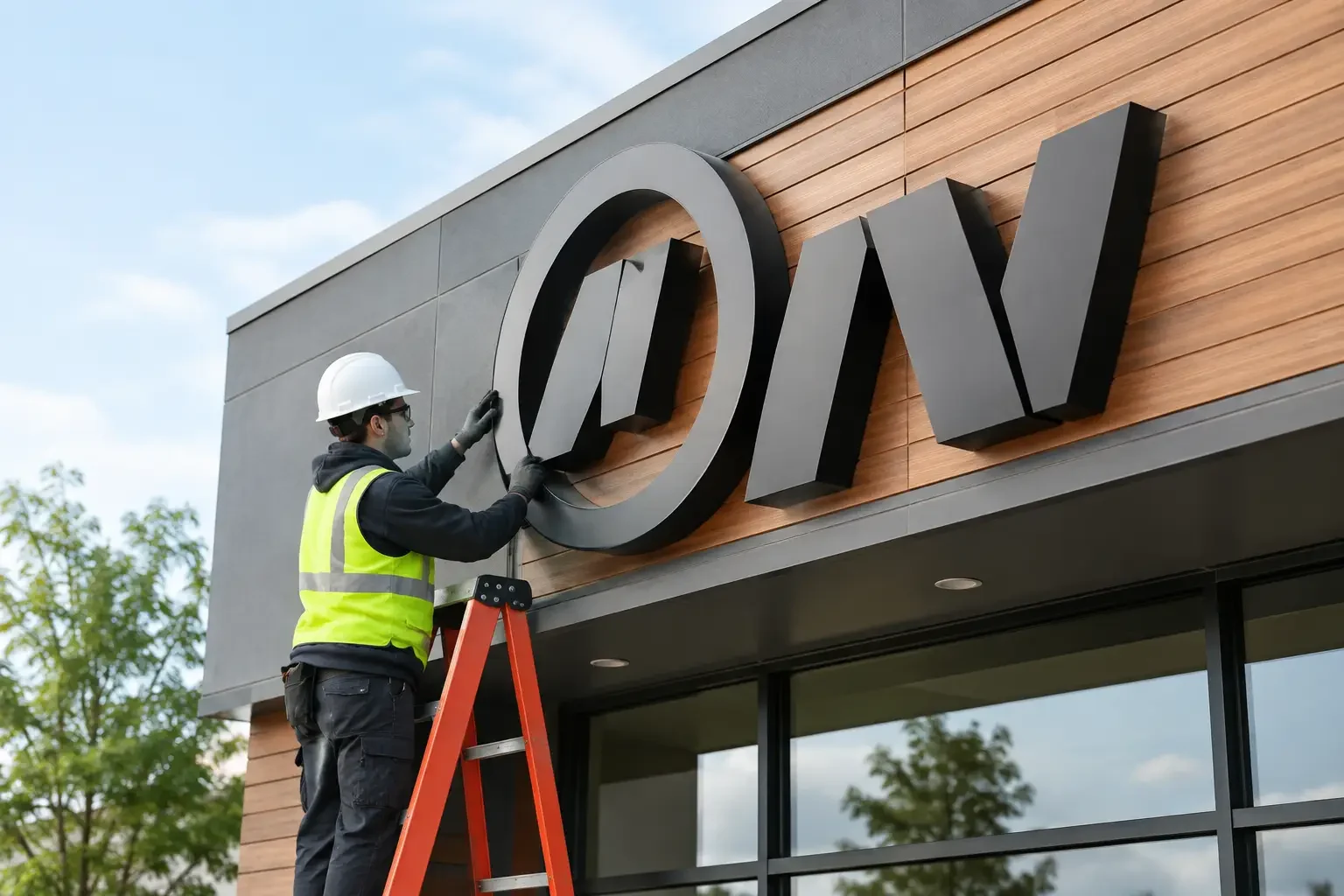
Building letters need to read clearly from the intended approach and fit the wall where they will be mounted. Send a photograph of the elevation, the available space and your wording or logo before choosing the letter size and depth.
Confirm the material, finish and attachment method together. The local installer should identify the wall construction and any backing or fixing requirements before the letters are manufactured.
What Commercial Facade Lettering Must Accomplish
Exterior letters are often expected to do several jobs at once. They identify a tenant or facility, support architectural standards, withstand weather, and provide enough visual presence to read from the intended approach. Those requirements do not always point to the same fabrication method.
A shallow letter may suit a protected entry wall where the viewer stands 20 feet away. The same profile can look underpowered on a large elevation viewed from a drive aisle or public road. Increasing letter height helps, but depth, contrast, lighting, and mounting surface all influence legibility. A fabrication package should address the complete visual and structural condition rather than treating copy height as the only variable.
For trade buyers, repeatability matters just as much as appearance. Franchise programs, medical campuses, retail centers, and multi-building developments need lettering that can be reproduced from approved artwork without visual drift between locations. That requires controlled tooling, documented paint formulas, consistent depth specifications, and reliable pattern output.
Material Selection Starts With the Elevation
There is no universal best material for dimensional letters. The right choice depends on the facade, the exposure, the desired profile, and the budget allocated to the sign package. HDU, acrylic, metal, and fabricated aluminum each solve different production problems.
HDU for Deep, Architectural Letter Forms
HDU can be routed into deep letter forms and painted to suit the design. It resists moisture-related decay, but it still needs suitable support and care. Confirm the weight and mounting requirements for the particular wall.
Its main advantage is profile flexibility. CNC-routed HDU letters can be built in substantial depths and finished with smooth painted faces, faux-metal coatings, or dimensional edge treatments. For monument-adjacent branding, medical offices, municipal facilities, and commercial developments, that depth can create the shadow line needed for a more substantial facade presence.
HDU is not the answer for every application. It should be properly sealed, coated, and engineered for the mounting condition. A thin, exposed letter with inadequate reinforcement can be vulnerable to impact, and aggressive solvent exposure during field work can damage an improperly specified coating system. Material performance depends on both fabrication and installation discipline.
Acrylic and Metal for Specific Visual Requirements
Acrylic letters work well for clean, crisp color programs and applications where a relatively thin profile is acceptable. They can provide strong color consistency and are commonly used in tenant identification, interior-to-exterior transitions, and protected commercial entries. However, acrylic can be less forgiving in high-impact environments and may not deliver the depth expected for a large architectural facade.
Flat-cut aluminum, stainless steel, and brass are selected when the project requires true metal faces, brushed grain, polished surfaces, or high-end durability. Metal brings a distinct visual value, particularly on institutional, hospitality, and corporate projects. It also brings different considerations: material cost, finish protection, potential corrosion compatibility, and handling requirements.
Fabricated aluminum letters are often the better choice for illuminated or very large letter forms because they can provide depth without the weight of solid material. The trade-off is more fabrication complexity. Returns, internal structure, weld quality, drainage, and access for electrical components must be controlled before the letters leave the factory.
Mounting Is Part of the Fabrication Scope
The most common avoidable issue in facade lettering is treating mounting as a field-only decision. Stud locations, bond surfaces, stand-off requirements, and wall conditions should be defined before production begins.
Flush-mounted letters can provide a clean, direct appearance, but the facade must be suitable for drilling and anchoring. Brick, EIFS, stucco, ACM, corrugated panels, precast concrete, and metal siding each require different attachment approaches. A mounting pattern designed for a solid masonry wall may not be appropriate for a thin metal panel or an EIFS system with unknown backing.
Stud-mounted letters remain a reliable option when a mechanical connection is required. Accurate stud placement, correct stud projection, and a full-scale installation pattern reduce layout time and prevent the crew from making corrections at the wall. For larger letters, stud diameter and embedment should be matched to letter weight, wind exposure, and substrate conditions rather than selected by habit.
Pad mounting or stand-off mounting adds depth and creates a visible shadow line. It can also help protect a textured or uneven wall face from direct contact. The detail must be intentional. Excessive stand-off can make letters look detached from the architecture, while too little clearance can trap debris or make cleaning difficult.
For projects using adhesive, surface preparation cannot be assumed. Adhesive performance depends on substrate cleanliness, temperature, coating compatibility, and contact area. It may be appropriate for lightweight letters on suitable smooth surfaces, but it is not a substitute for mechanical fastening where the elevation or exposure calls for a more secure system.
Finish Quality Is More Than Color Matching
Color and sheen can look different in sunlight than in a shop or on a screen. Provide your color reference and discuss the desired finish before approving the order.
Paint system selection should reflect the environment and desired service life. Exterior-grade primers and topcoats, properly applied over prepared material, protect the substrate and stabilize the finished appearance. Edges deserve particular attention because they receive more handling during packaging and installation and can be the first place a poor coating system shows failure.
For metallic-looking HDU letters, confirm the painted appearance you want. Beautiful gold-leaf appearance achieved with a durable metallic gold painted finish. Agree on any sample requirements and approval method before manufacturing.
Production Details That Protect Field Margins
Commercial facade lettering becomes easier to sell and install when the production package removes guesswork. The most useful deliverables are not flashy extras. They are the details that prevent rework: verified artwork, finished dimensions, mounting method, stud map, installation pattern, paint designation, and packaging instructions.
A full-scale pattern is especially valuable on multi-letter layouts, custom logos, and projects with tight alignment requirements. It gives installers a physical reference for placement and helps confirm that letter spacing will translate from the drawing to the wall. When a logo includes multiple components, the pattern can also preserve orientation and prevent field assembly errors.
Freight packaging deserves the same attention as routing and finishing. Dimensional letters are vulnerable at corners, painted faces, and projecting studs. Individual protection, separated components, rigid backing, and properly sized crates or cartons reduce the risk that a finished letter arrives with chipped paint or a distorted mounting element. Cheap packaging can turn a production win into a replacement claim.
We manufacture dimensional letters and the supplied mounting provisions agreed in your quote. The price we quote includes your fully finished sign and shipping to your delivery address. Your local installer handles the wall preparation and installation.
Specify the Letter Set Before Releasing Production
Before approving commercial facade lettering, confirm the final artwork and overall dimensions, then verify the intended viewing distance and elevation conditions. Identify the wall substrate, fastening method, desired letter depth, finish level, and whether a mounting pattern is required. If the project is part of a rollout, document those decisions so the next location does not become a new interpretation of the original sign package.
Check the wording, size, finish and supplied mounting details on the artwork/proof before approving manufacturing. We prepare that proof after you agree to the order and pay, with timing confirmed for your project.